By Anna Selman
Contributing Writer
CINCINNATI—For their Sept. 3 advocacy event, AJC Cincinnati made a bold choice: They put a college student in charge of the conversation.
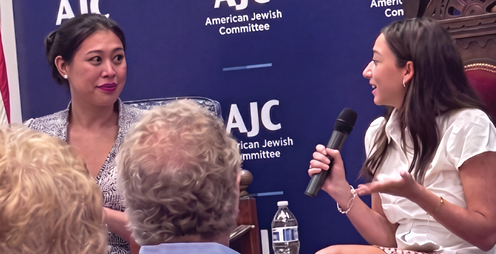
Samantha Abdoo, a University of Cincinnati junior and president of Bearcats for Israel, did more than introduce the experts at “Antisemitism in the Age of Algorithms: Confronting Hate in a Digital World.” She developed every question and moderated the discussion with Holly Huffnagle, AJC’s U.S. director for combating antisemitism, and Jocelyn Flores, its assistant director of research and advocacy.
Before an audience of between 100 and 150 people (including many college students) Abdoo steered the panel through questions about online hate, anti-Zionism, campus advocacy and personal safety. As the evening continued, the two longtime professionals increasingly turned questions about campus life back to Abdoo, placing the student experience at the center of the discussion.
Abdoo began attending UC in fall 2023, shortly before the Oct. 7 Hamas attacks, and has since witnessed some of the university’s most contentious anti-Israel demonstrations. During the panel, AJC speakers repeatedly deferred to her when audience members asked about the current campus climate.
“On campus, we see a lot of conspiratorial antisemitism: the nose, the hair,” Abdoo said. “People think it’s OK because they think it’s a joke, and sometimes other Jews make the jokes themselves.”
Abdoo also described recently losing a friend following a disagreement over antisemitism and anti-Zionism.
“Anti-Zionism is also a big problem because people today are seeing antisemitism and think it’s OK because of anti-Zionism,” said Holly Huffnagle, AJC’s U.S. director for combating antisemitism.
Jocelyn Flores, AJC assistant director for antisemitism policy, said she’s “not surprised” to hear that Jewish students are losing friendships over anti-Zionism. According to AJC’s 2024 Survey of American Jewish Opinion, almost one in six Jews report losing a friendship over disagreements about the Israel-Hamas war.
Abdoo asked Huffnagle when it is appropriate to report online antisemitism, respond to it or disengage. Huffnagle advised students to first take a screenshot, but not to comment on or share the content because engagement can increase its reach. Users should then report it through the platform’s internal system, she said.
If the platform does not respond, Huffnagle said users can contact AJC or CyberWell, an Israeli nonprofit that monitors online antisemitism and works with social-media companies to enforce their hate-speech policies.
“We have to call this out,” Flores said. She also cautioned students to use available privacy and security settings to protect themselves while advocating for Israel online.
Huffnagle raised similar concerns about Wikipedia, citing what she described as coordinated editing by anti-Israel and antisemitic activists. She pointed to recent changes involving the Dreyfus Affair as an example of attempts to manipulate Jewish history. A March 2025 Anti-Defamation League report identified at least 30 Wikipedia editors whose activity, researchers said, suggested a coordinated effort to alter content involving Israel, Jews and Palestinians.
The discussion also turned to Ohio Senate Bill 87, now pending in the Ohio House. The bill would define antisemitism for certain civil and administrative purposes using the International Holocaust Remembrance Alliance working definition and expand Ohio’s ethnic-intimidation law.
The panel fielded a question about testimony delivered against the bill in February by CAIR-Ohio Executive Director Khalid Turaani, who falsely alleged that Israel maintained a skin bank using the bodies of Palestinians.
“We have to say this is a lie, and we have to push back on those kinds of statements,” Huffnagle said.
AJC Cincinnati Regional Director Justin Kirschner said AJC had held a briefing at the Statehouse the previous day with Gov. Mike DeWine’s office and the Ohio Jewish Caucus.
“It really resonated with lawmakers,” Kirschner said. “I was really impressed with the staff members’ questions.”
Responding to Turaani’s testimony, Kirschner added, “It is our responsibility to call it out. The moderate middle is looking toward Jews to call this out.”
For students preparing to have those conversations, Huffnagle recommended practicing 30-second responses in front of a mirror and approaching disagreement with curiosity rather than defensiveness.
Abdoo appeared comfortable doing both. When told after the
program that she had held her own alongside two experienced professionals, she gave a more modest explanation.
“Well,” she said, “I had my flashcards.”
The evening was presented in partnership with Cincinnati Hillel and Hillel at Miami University, two organizations that play a vital role in supporting Jewish students and fostering strong campus communities across the region. Their collaboration helped ensure the conversation reached the very students most affected by the issues discussed.