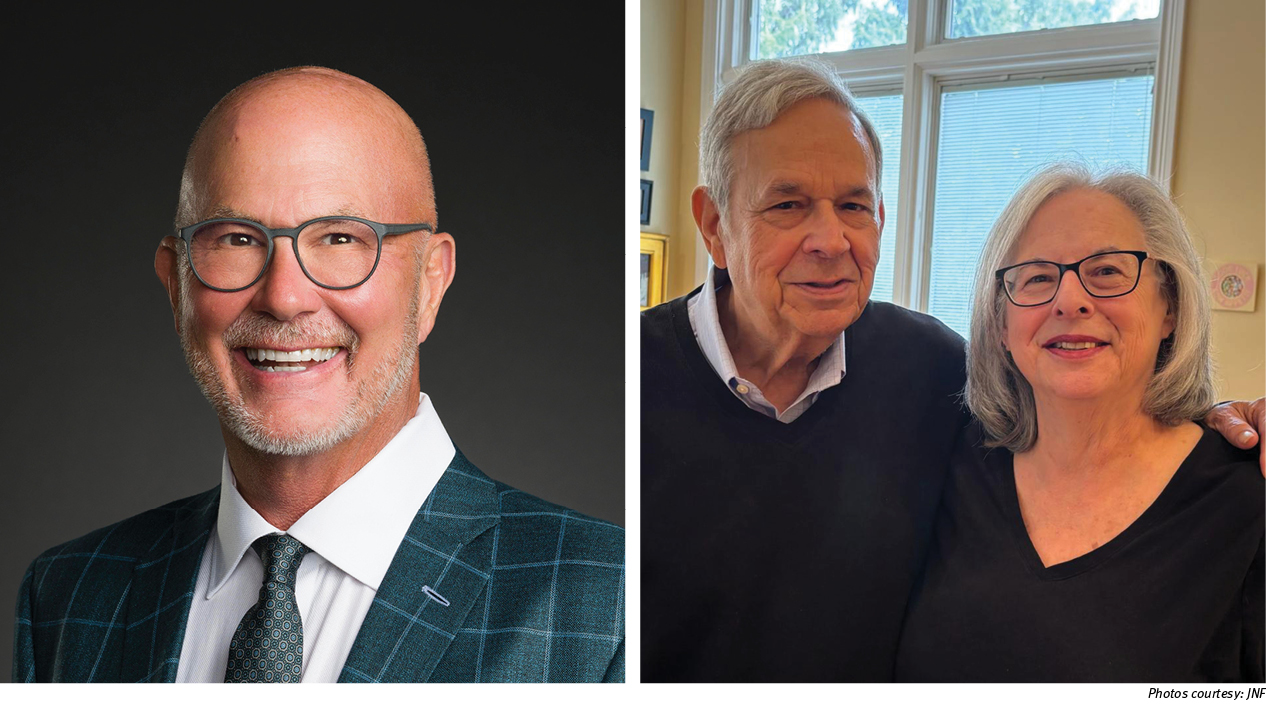
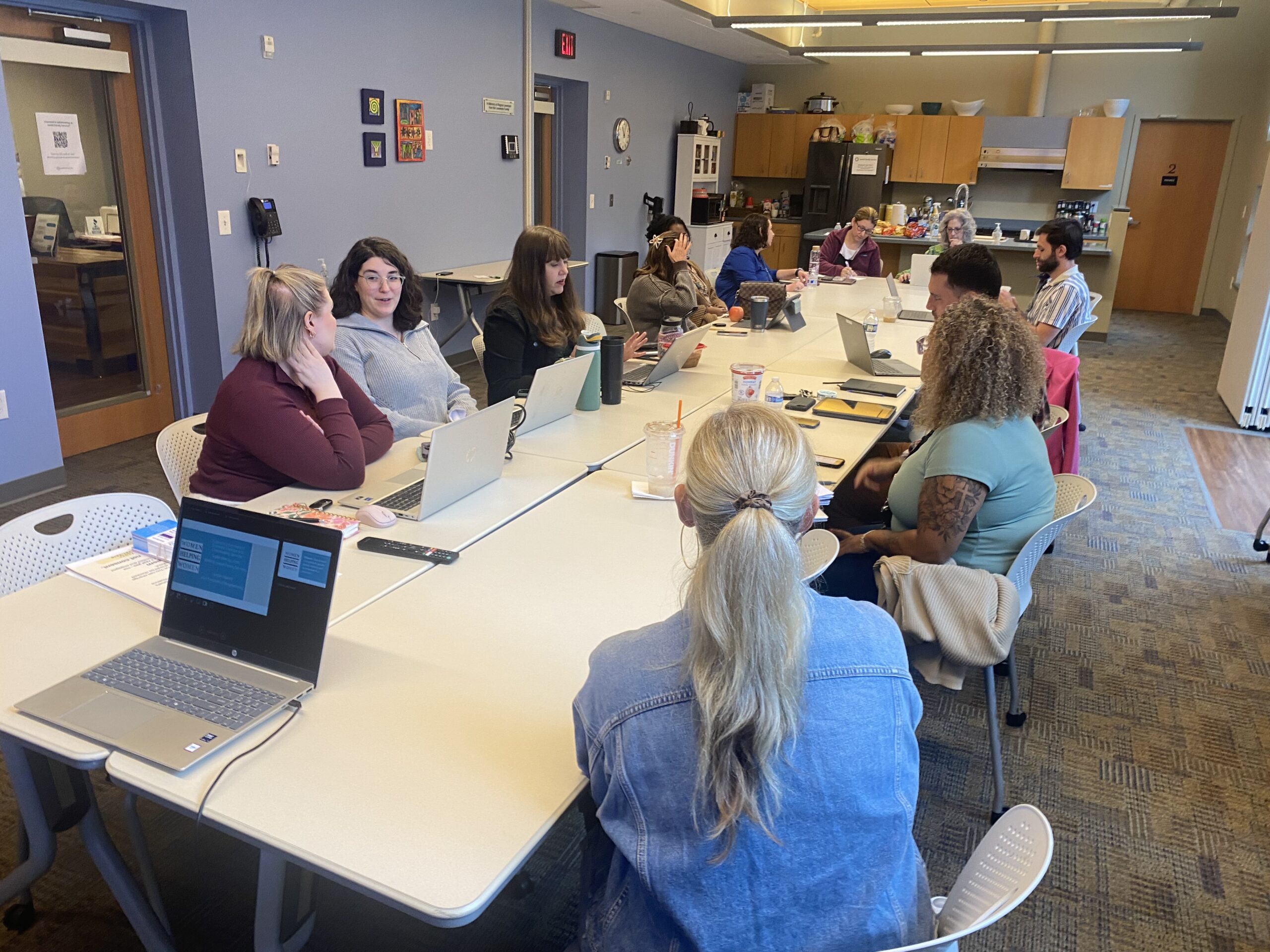
Photo courtesy: JFS. Recent trainings for staff, like this one at Jewish Family Service’s Barbash Family Vital Support Center, have strengthened knowledge and collaboration between Jewish Family Service and Women Helping Women
Submitted by Jewish Family Service
Jewish Family Service (JFS) has just announced a new partnership with Women Helping Women, whose mission is to prevent gender-based violence and empower all survivors. “We formed this partnership to really help our staff, and their staff, serve our clients and community better,” says Ann Sutton Burke, Interim Co-CEO and Chief Services Officer for Jewish Family Service.
Kristin Shrimplin, President and CEO of Women Helping Women, and in her second year as member of the JFS board, agrees. “It is a step up,” she says. “It is important to pause and create space for more of that dialogue and learning and connection.” Efficiency and access are key goals. “Now we’re trying to build up an efficient pathway for referral around domestic violence and sexual assault.”
Gender-based violence has only increased since the pandemic, says Shrimplin. “When I first came to the agency, the statistics were that one out of three women in their lifetime would experience any form of intimate partner violence, sexual assault. It’s now one out of two.”
Two recent trainings have led the way in strengthening the connection between the nonprofits. The first, on September 10, at one of Women Helping Women’s multiple locations, was led by Rabbi Yair Walton, JFS’s K’vod Connect Senior Rabbi. He taught a seminar to a full room of Women Helping Women staff on Jewish cultural competency. “I am here to be a resource for you,” he concluded, confirming his continued availability if staff had additional questions or concerns.
Then, on September 24, Amber Malott, Vice President of Programming for Women Helping Women, led a seminar for a room full of JFS staff at the Barbash Family Vital Support Center on domestic violence and how to best access services for JFS clients. She said that at her agency, “survivors are believed.” She emphasized that survivors come from every demographic, and that “spiritual coercion can be a method of maintaining control or forcing isolation.” “Survivors,” she said, “should never be forced to choose between their safety and their community of faith.”
At a practical level, said Burke, “It’s not a client handoff, instead, we want to make sure both organizations continue to work together to best support those who need us.”
Asked how religion works in the context of gender-based violence, Shrimplin was both affirming and concerned. “What I love so much about the beauty of Jewish spaces is this expansive and very inclusive community and sense of belonging.” She paused. “Now think about that through the lens of a survivor. There is beauty in the power that religion and culture can bring. Within a community, a religion, is the will to support a survivor. On the flip side, with any religion or community, that itself can also be used against survivors.’”
Shrimplin hopes for a future where preventative strategies are embedded in all religious communities. “Think about the power of what’s happening in temple, what’s happening in the pulpits. How empowering and amazing it would be in those trusted spaces to have this layer of messaging: ‘This is what we stand for.’ ‘If you’re experiencing this, here’s where we can help.’”
Burke summed up the recent efforts: “This is a big step in making sure both organizations can better support the Cincinnati community. We will, together, be better able to help survivors in the short term and the long term.”