Photo credit: Courtesy: The Jewish Federation of Cincinnati
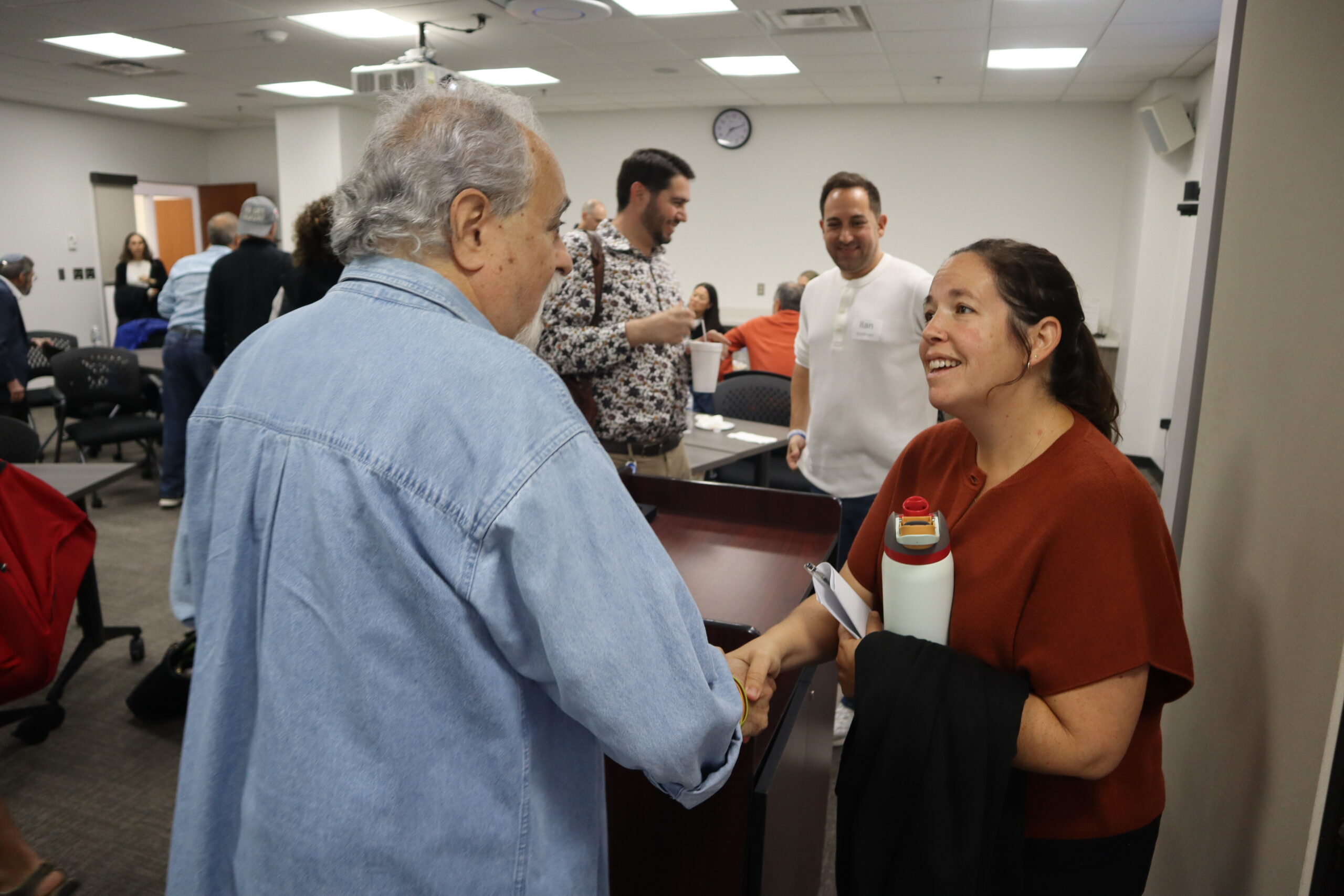
Jewish Federation of Cincinnati Community Shlicha Moria Dafni greets an attendee of ‘Unpacking the Israeli Election-Before the Vote’
By Natalie Emerson
Assistant Editor
A full room at the Mayerson JCC gathered Wednesday evening, Sept. 23, to learn about Israel’s election system, the issues facing voters and the challenges awaiting the country’s next government.
The program, “Unpacking the Israeli Election—Before the Vote,” was presented by the Jewish Federation of Cincinnati and the Mayerson JCC as part of IsraelLENS, the Federation’s initiative to foster dialogue, cultural understanding and learning about Israel.
Leading the discussion was Moria Dafni, the Federation’s new community shlicha, or Israeli emissary, who arrived in Cincinnati in August. Interest in the program was strong enough that a partition between two boardrooms had to be opened to accommodate the audience. Attendees included familiar faces from previous Israel-related programs, newcomers and people from outside the Jewish community.
Dafni, who grew up on a kibbutz in northern Israel, has spent 20 years in Jewish education. She directed programming across 60 schools in Jerusalem and later helped northern Israeli communities rebuild school systems following evacuations during the war. She came to Cincinnati with her husband, Asaf, and their children. Asaf has served more than 500 days of reserve duty since Oct. 7, 2023.
Dafni told attendees she hopes to share an understanding of Israel grounded in responsibility, resilience, education and arvut—the Jewish obligation to care for one another.
She began by explaining the basics of Israel’s parliamentary system, which differs significantly from the American system. Israeli voters select a political party rather than an individual candidate, and the country’s 120 Knesset seats are distributed proportionally according to each party’s share of the national vote.
A party must receive at least 3.25 percent of valid votes to enter the Knesset. Parties that fall short receive no seats, making the threshold an important factor in election outcomes. Using the 2022 election as an example, Dafni explained that approximately 420,000 votes went to parties that failed to meet the threshold.
Because no party has ever won an outright majority of the 120-seat Knesset, Israeli governments are formed through coalitions. Parties must work together to secure at least 61 seats, often negotiating over government ministries and policy priorities. As a result, the party winning the most seats does not necessarily determine who becomes prime minister.
Dafni also outlined six major issues shaping the campaign: military-service exemptions for much of the Haredi, or ultra-Orthodox, population; the future of Gaza and the West Bank; the relationship between Jewish identity and democratic institutions; public safety and governance; the cost of living; and the establishment of a commission to investigate the failures surrounding Oct. 7.
The military-service debate has become particularly significant as reservists have spent extended periods on duty since the Hamas-led attacks. Dafni noted the historical origins of Haredi exemptions and the importance of addressing the issue while understanding the community’s concerns about preserving religious traditions.
The cost of living also remains a concern for Israeli households. Dafni cited everyday grocery staples, including Bamba, feta and cottage cheese. In 2011, protests over cottage cheese prices helped fuel a broader movement against rising living costs.
The candidates themselves reflect the continuing impact of Oct. 7 and the war. Among those discussed was former Israel Defense Forces chief of staff Gadi Eisenkot, whose son Gal was killed in Gaza. Dafni also highlighted Yonatan Shalev, a 23-year-old former special forces soldier and reservist who helped establish the “Shoulder to Shoulder” movement, which advocates changes to military-service exemptions.
The evening concluded with continued questions and conversation, underscoring the community’s interest in hearing firsthand perspectives on Israel. Dafni noted that while information about Israel is widely available online, opportunities for direct dialogue allow participants to ask questions and gain context beyond the headlines.