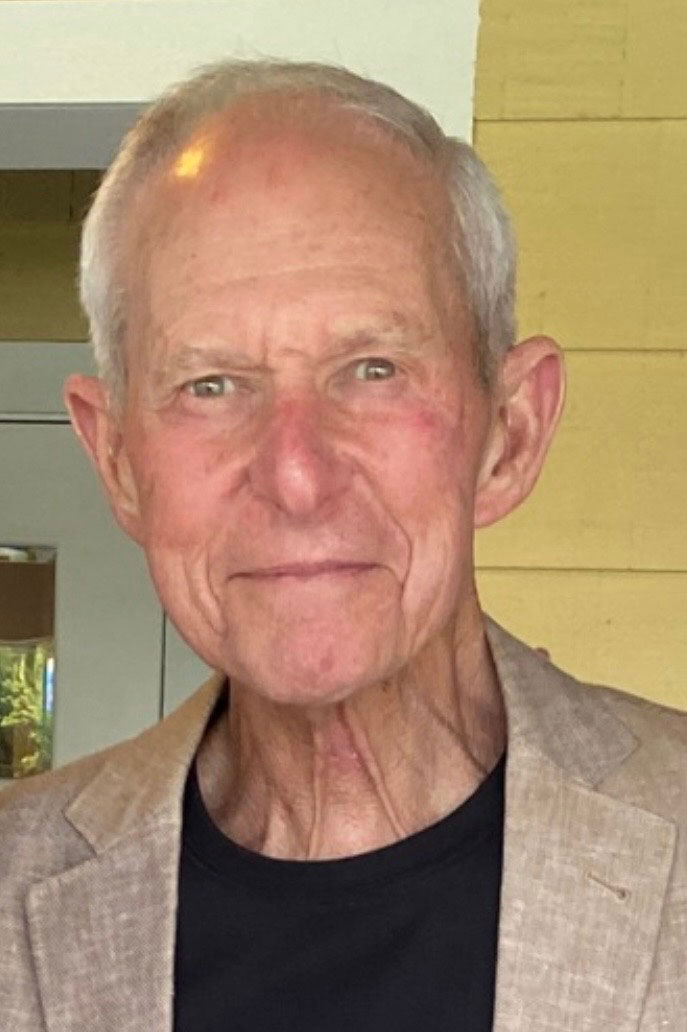
Photo credit: Courtesy of the Greenberg Family
Rabbi Solomon T. Greenberg
Submitted by the family of Rabbi Solomon T. Greenberg
There is a particular kind of grief that settles over a community when it loses someone woven into the fabric of its most important days. The grief of realizing that the person who married you, who stood beside your child on the bimah, who sat with you in the hard hours and somehow always knew what to say, is no longer with us. Not the grief of shock — but the quieter, deeper kind of grief. The one we all now feel about Sol Greenberg.
Rabbi Solomon T. Greenberg — Sol, to virtually everyone — passed away peacefully surrounded by family on April 28, 2026 at the age of 87. He was a rabbi, a civic leader, a mentor, a husband, a father and a grandfather. He was warm and funny and unflappable. He made the best hot fudge. He drove a convertible. He was, by every account of everyone who knew him, exactly the same man in private that he was in public — and that, perhaps more than anything, is what made him so rare.
He is survived by his wife of 49 years, Sue; his sons Brad (Pam) and Jeffrey (Kim); his daughters Debbie (Michael), Julie (Charlie), Margot (Howard), and Andrea (Blake); eleven grandchildren; and three great-grandchildren, with a fourth on the way. Grandpa Sol fostered a unique, personal connection to each of his grandchildren — one that continued into adulthood. A natural listener and conversationalist, they loved long talks with him about their careers, relationships, even movies and current events. The large, beautiful family he leaves behind is, in many ways, his most profound legacy.
The Only Rabbi Who Would Say Yes
When Sol arrived in Cincinnati in the mid-1960s, fresh from Hebrew Union College, he came to a Valley Temple that was barely a temple at all — a small group of families gathered in a living room on Springfield Pike, searching for a community they couldn’t yet name. Sol gave it one. Over the decades that followed, he built Valley Temple into one of the region’s most distinctive and welcoming congregations, family by family, moment by moment.
But the decision that may have defined his rabbinate was one that took real courage: at a time when interfaith marriages were considered deeply controversial in Jewish life, Sol became the first rabbi in Cincinnati willing to perform them.
His son Brad grew up watching the ripples of that decision spread outward. “Literally dozens of times in my life,” Brad recalled at the funeral, “I would meet a couple somewhere, introduce myself, and they would say: ‘Are you by chance related to Rabbi Greenberg?’ ‘Oh my God — we love your father. He married us. I’m Jewish, my wife is not, and he was the only rabbi in town who would do the ceremony.’”
“He was right to do those weddings when other rabbis wouldn’t,” Brad said. “And today, his way of acceptance and compassion is the standard in Reform Judaism.” Rabbi Sandford Kopnick, who succeeded Sol at Valley Temple, agreed: “Frequently, Sol was the last stop before a couple would abandon Judaism altogether. He saved hundreds of families — not just by saying yes, but by the way he said yes.”
Three Faiths, One Room, One Story
Terri Ungar Coughlin hesitated before making the call. Sol had retired, his health was suffering, and it felt like too much to ask. But she picked up the phone anyway — hoping he would agree to come out of retirement and travel to Arizona to marry her and her fiancé Chris, a devout Catholic. “Without hesitation,” he said, yes.” That ‘yes’ meant everything.”
Before the ceremony began, Sol gathered everyone in one room — Chris’s Catholic family, Terri’s Lutheran relatives, her father’s Jewish family. Three faiths. The kind of quiet that gathers when people aren’t sure how to be together. And then Sol told them the story of Jacob, Rachel and Leah — a story from scripture that all three traditions share. He didn’t preach. He simply told it — and whatever tension had gathered in the corners of that room dissolved. People who had walked in as strangers from different faiths walked out ready to celebrate together. “He didn’t just marry us,” Terri said. “He made us a family.” Chris’s father, a man of deep Catholic faith, later told his other son — then engaged — that everyone deserves a rabbi at their wedding.
Opening Day, and Fifty Years Later
At his funeral, Brad Greenberg turned the usual script around. “Fathers often talk about their pride in their children,” he said. “I want to talk about our family’s pride in our father.” He offered two memories, fifty years apart.
April 1974: Sol picked up seven-year-old Brad from school — in a convertible (“he was always pretty cool”) — and took him to Opening Day. They watched Gerald Ford throw out the first pitch, saw Hank Aaron tie Babe Ruth’s home run record and the Reds won in the bottom of the eleventh. May 2024: the family gathered at West Point as Brad’s son Sam — Sol’s grandson — graduated, was commissioned as an Army officer and joined the Long Gray Line. Sol was there for that, too.
“When my dad was around,” Brad said, “he always made Jeff and me and all our family feel special and important — because of the way he listened to us, and loved us.”
The Rabbi Who Fixed the Tennis Courts
Sol Greenberg never announced himself. At Goldman Union Camp, when the outdoor chapel came up short of seats, he built extra rows himself. When the tennis courts cracked, he bought the supplies and repaired them. No speech. No credit sought. Just a man who saw something that needed doing and did it.
That same quiet diligence shaped his public life: founding rabbi of the Cincinnati Reform Jewish High School, pioneer of community funding for student trips to Israel, decades of service on the Cincinnati Jewish Relations Council, mentor to generations of rabbinical students and host of early-morning Torah study for local businessmen — 7:00 a.m., regular as sunrise, for men who wanted to learn even when the world wasn’t watching.
Sue
In 1977, a mutual friend decided it was time for Sol to meet Sue Frieder. It didn’t take long. Sue became Sue Greenberg, and with her came her four daughters, a blended family, and a love story that would last 49 years. They traveled together, collected friends everywhere they went, and built a life that radiated outward. Rabbi Kopnick said it simply: “When they were apart, he was incomplete.”
Sue’s daughters took a few months to warm to their new stepfather. They called him Rabbi Greenberg at first — polite, careful. It didn’t last. Sol won them over steadily and without trying too hard: teaching each of them to drive in the temple parking lot, showing up to their games, making what the family still insists was the world’s best hot fudge. He did their b’not mitzvah and their mother’s. He did their weddings. He counseled them through decades of dilemmas. And when the grandchildren came, he was there for all their b’nei mitzvah too.
At his funeral, his daughters told the congregation something that made the whole room exhale: “The amazing civic and spiritual leader that you have all known and admired is exactly the person who we got to sit down with every night for dinner. We are so lucky.”
Get Yourself a Rabbi, and Acquire for Yourself a Friend
The Pirkei Avot teaches: get yourself a rabbi, and acquire for yourself a friend. For the thousands of people whose lives crossed paths with Sol Greenberg’s, the distinction never existed. He was rabbi and friend — to everyone, always, and without condition.
In the days after Sol’s death, his family and community gathered from across the country — and what struck everyone was the transformational imprint of Sol’s loving presence, teaching, spiritual leadership, and parenthood in their lives. We all hope and believe that Sol would have been delighted to see his family, students, friends, and community gathering in both sadness and joy rather than despair. It was exactly what he believed a family and a community could be. It was exactly what he spent his life building.