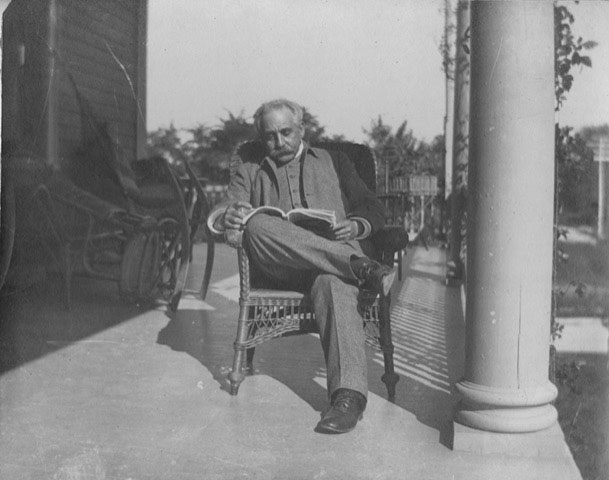
Courtesy of The Jacob Rader Marcus Center of the American Jewish Archives
Ezekiel at home of his sister, Hannah, in Avondale
Submitted by Dr. Dana Herman, Hebrew Union College
The Skirball Museum and the Jacob Rader Marcus Center of the American Jewish Archives (AJA) at Hebrew Union College will host a special program honoring Moses Jacob Ezekiel (1844–1917), the first Jewish American artist to achieve international acclaim. The event, featuring a lecture and book signing by Dr. Samantha Baskind, Distinguished Professor of Art History at Cleveland State University, will take place at the American Jewish Archives on Thursday, November 19, 2025, at 4:00 p.m.
Dr. Baskind’s newly released book, “Moses Jacob Ezekiel: Jewish Confederate, Expatriate Sculptor” (Penn State University Press, 2025), explores the life and work of this remarkable artist, whose ties to Cincinnati run deep. Following the Civil War, Ezekiel’s father relocated the family from Richmond, Virginia, to Cincinnati, where Moses’s sister Hannah had already settled after marrying Levi Workum. It was in the Queen City that Ezekiel began to develop his sculptural talents before moving to Rome, where he lived and worked for over 40 years.
Though he spent most of his life abroad, Ezekiel maintained strong connections to Cincinnati, frequently visiting family and cultivating relationships with local patrons. The Cincinnati Art Museum holds a notable collection of his work, thanks to commissions from prominent Cincinnatians such as Bellamy Storer and Maria Longworth Nichols Storer.
“Although Moses Jacob Ezekiel lived in the Queen City only briefly, his family resided in the city, and wealthy Cincinnatians visited his picturesque studio in the ancient Baths of Diocletian in Rome,” said Dr. Julie Aronson, Curator of American Paintings, Sculpture, and Drawings at the Cincinnati Art Museum.
The Skirball Museum will display several of Ezekiel’s works, including a marble bust of Isaac Mayer Wise, based on an original bronze. “Ezekiel crossed the Atlantic to model the Wise bust from life in Cincinnati,” said Baskind. “The following year he crossed the ocean again to personally deliver the completed bust to B’nai Yeshurun.” The AJA will exhibit rare archival materials used in Dr. Baskind’s research, such as photographs, letters, Ezekiel’s typed memoir, and his original will.“The AJA and the Skirball are repositories of photographs, documents, and works of art by and about Ezekiel that could have been produced nowhere but Cincinnati,” said Abby Schwartz, guest curator at the Skirball Museum. “Namely, the portrait bust of Isaac Mayer Wise or the tiny pin Ezekiel designed for the graduates of the Jewish Hospital’s nursing program.”
Ezekiel’s life was as dramatic as his art. In 1861, he became the first Jewish cadet at the Virginia Military Institute and fought for the Confederacy during the Civil War. After briefly studying medicine, he turned to art, eventually enrolling at the Royal Academy of Art in Berlin. In 1873, he became the first non-German to win the prestigious Michael Beer Prize. A smaller version of the bronze plaque that won the prize is on view at the Skirball Museum. His monument to religious liberty, the largest monument dedicated to religious freedom in the United States, was unveiled in Philadelphia for the 1876 World’s Fair.
Among his more than 200 sculptures are depictions of Franz Liszt, Eve, Homer, David, Jesus Christ, Henry Wadsworth Longfellow, Isaac Mayer Wise, and Edgar Allan Poe. His Confederate memorial monument, “New South,” was dedicated at Arlington National Cemetery in 1912, which is set to be returned after its removal in 2023.
Ezekiel was honored throughout his life with awards and titles from Germany and Italy, including being named an “Officer of the Crown of Italy” by King Victor Emmanuel III. Upon his death in 1917, he was eulogized by President Warren G. Harding.