
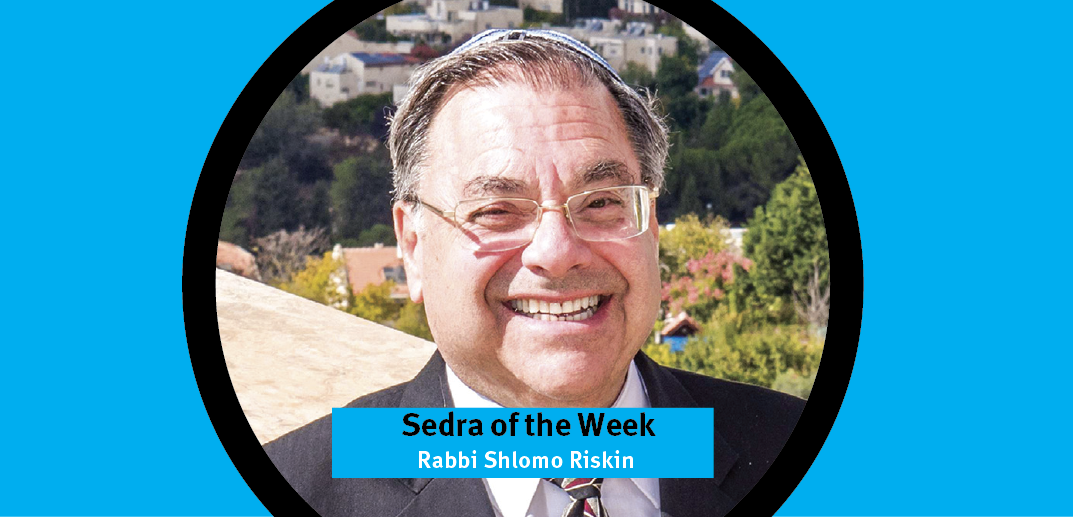
Efrat, Israel – “Now the Lord said unto Abram, get out of your country, and from your kindred place, and from your fathers house, unto the land that I will show you. And I will make of you a great nation, and I will bless you, and make your name great; and you shall be a blessing.” (Genesis 12:1–2)
The article below is from Rabbi Riskin’s book Bereishit: Confronting Life, Love and Family, part of his Torah Lights series of commentaries on the weekly parsha, published by Maggid
In these words we have the first of Abraham’s ten tests – the difficult divine demand that the first Jew leave hearth and home and follow God into a strange and unknown land. In return, there is the divine promise of ultimate national greatness and international leadership. But why does God single out Abraham?
At this fateful moment, the Torah seemingly takes Abraham’s faith and religious quest for granted without providing a clue as to how, where and why this particular nomad is worthy of divine trust and blessing. In the closing verses of Noach, we read about his genealogy, the names of his father, brother, nephew and spouse. We are provided with dry facts, travelogue locations on a map, ages at time of death. But there is nothing substantive telling us how the initiator and prophet of ethical monotheism arrived at the point where he even had a relationship with God. Is this the first time God speaks to him? And if it is, what makes the Divine believe that Abraham would heed His call?
What seems to be absent from the text is made up for in a charming and famous midrash which identifies Abraham’s father, Terah, not only as an idolator, but also as a wealthy businessman who actually trafficked in idols. His son Abram discovered the God of the universe by his own faculties of reason at a very young age. When Terah had to go on a business trip, he left his young son Abram in charge of the idols store. The proprietor returned to find all of his idols but one smashed to smithereens. Abram explained that a woman had brought food for her favorite idol, whereupon all of the other idols fought over the sumptuous dish. The strongest one was the victor, having vanquished all the others. When Terah expressed skepticism, Abram mocked his father’s belief by proving to him that even he was aware of the limitations of the works of his hands.
Terah’s shop was not some fly-by-night affair rented in temporary quarters near the busiest section in town to get the crowd before the holidays. It was rather a thriving center for the idol arts – more like the luminescent chambers in any large museum with spotlights and acres of space to dramatize the repose of the idols and to explain the philosophy of idolatry. Abraham’s action was not a mere childish prank. It was a revolutionary stroke which changed the way humanity perceived its own reality and the reality of the universe for all subsequent generations. In this midrash, Terah is seen as a primitive representative of an outmoded religion, whose iconoclast, revolutionary son broke with his father to create a new faith commitment which would ultimately redeem the world. ‘Get out of your father’s house,’ says God to the ‘born again’ Abraham.
But what if there is another way of looking at Terah more in accord with the biblical text itself? What if Terah had discovered God first – and so Abram was not so much a path breaker as he was a path follower? Perhaps Abraham was not so much a rebellious son as he was a respectful son, who continued and built upon the road laid out for him by his father?
After all, there is every reason to believe that when God tells Abraham to go forth from his country, his birthplace, to a land that God will reveal, God is communicating to a man who was already in an advanced state of God consciousness, a mind-set that was most probably based on a religious awareness first glimpsed at home. Terah himself may at one time have been a believer in idol power but may slowly have turned to the One God while Abraham was yet a very young lad, or even before Abraham was born. I suspect that a subtle clue testifying to the correctness of this position is to be found in an otherwise completely superfluous verse, especially when we remember that the Torah is not in the practice of providing insignificant travelogues.
“Terah took his son Abram, his grandson Lot the son of Haran and his daughter-in-law Sarai, the wife of his son Abram, and they set out together from Ur of the Chaldeans for the land of Canaan; but when they had come as far as Haran, they settled there. The days of Terah came to 205 years; and Terah died in Haran.” (Genesis 14:18–20)
Why is it that Terah sets out for Canaan, the very place where Abraham himself ends up at the relatively advanced age of seventy-five at the behest of a call from God? Could Abraham have been completing the journey his father had begun decades earlier? And what was special about Canaan? Why would Terah have wished to journey there and why does the Torah believe the journey significant enough to be recorded even though Terah never made it to Canaan?
Further on in this parasha, Abram wages a successful war against four despotic kings in order to save his nephew Lot, who had been taken captive by them. The text then cites three enigmatic verses, which record that Malkizedek, the King of Shalem, a priest of God on High, greets Abram with bread and wine, and blesses him:
“Blessed be Abram to God on High, possessor of heaven and earth, and blessed be God on High, who delivered your enemies into your hand.” (Genesis 14:19–20)
Abram then gives Malkizedek a tribute of one tenth of his spoils. Now the city of Shalem, JeruSalem, was the capital city of Canaan – and this is the first time it is mentioned in the Bible. Malkizedek literally means the King of Righteousness, and Jerusalem is biblically known as the City of Righteousness [Isaiah 1:26]. From whence did this Malkizedek, apparently older than Abram, hear of God on High (El Elyon)? Nahmanides maintains that from the very beginning of the world, the monotheistic traditions of Adam and Noah were preserved in one place in the world – Jeru-Salem, Canaan. Indeed, the flood never damaged Canaan. Their king, Shem son of Noah, also known as Malkizedek, was a priest to God-on-High, teaches Nahmanides. If this is the case, it seems logical to suggest that Terah was someone who had come to believe in this One God even in the spiritual wilds of Ur of the Chaldeans – and therefore set out for Canaan, the land of monotheism, where he wished to raise his family. He may even have had personal contact with Malkizedek, who greets the son of his friend with religious words of encouragement to the victor of a religious battle in which right triumphed over might, a victory of the God of ethical monotheism. Like so many contemporary Jews who set out for Israel, Terah had to stop half way and didn’t quite make it. But all along God was waiting for Terah’s son to embrace the opportunity to continue where his father had left off.
The common view of Terah has Abraham defy his father’s way of life as he creates his own way, becoming in effect a model for many mod- ern day penitents who radically break away from non-believing parents, rejecting everything from their past. In the alternate view that I propose, Abraham follows in his father’s footsteps, builds on his father’s foundation, redefines his father’s way of life and for the first time in history paves the way for himself as well as others to move up the spiritual lad- der by not only continuing but also advancing. Abraham is the model for those spiritual idealists who – upon embarking on a journey of religious hope – look at their pasts with an eye for reinvesting what is salvageable, attempting to improve rather than reject. Whose path survives, thrives and becomes a link to the next generation? The revolutionaries, the evolutionaries, or a combination of both? It depends probably on who and what your parents happened to have been.
Shabbat Shalom
Rabbi Shlomo Riskin
Chancellor Ohr Torah Stone
Chief Rabbi – Efrat Israel