Courtesy of JTA. Photo credit: Jens Büttner/picture alliance via Getty Images
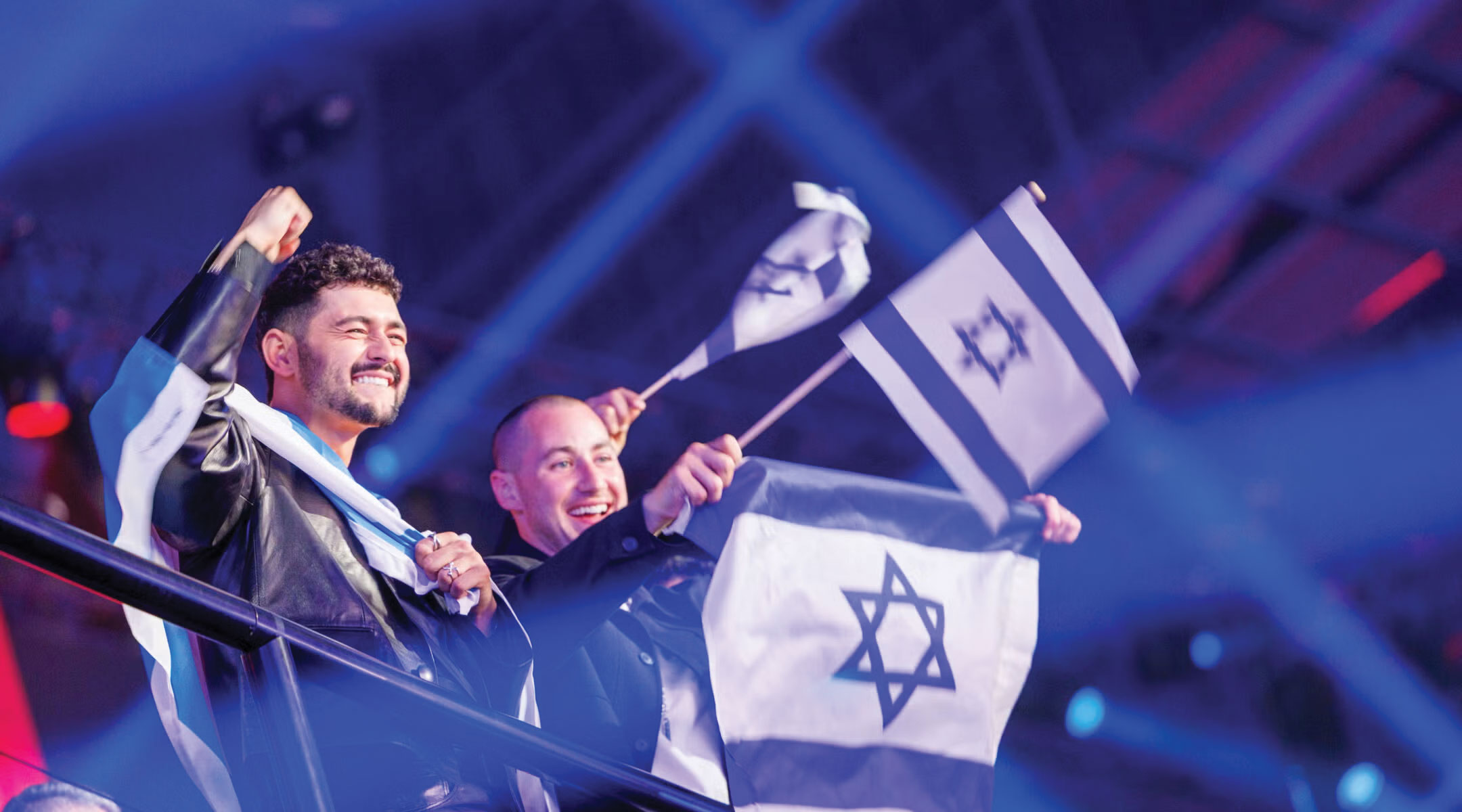
Noam Bettan from Israel celebrates reaching the final of the 70th Eurovision Song Contest in the Stadthalle in Vienna, May 12, 2026
(JTA) — As alternative Eurovision events gathered momentum across Europe in protest of Israel’s participation in the famously schmaltzy singing contest, Israeli candidate Noam Bettan, fresh off the semifinals in Vienna, said he chose to look past the boos that marred his performance and focus instead on the “huge wave of love and support,” including from non-Israelis in the crowd and online.
Bettan performed “Michelle” at the Wiener Stadthalle on May 13 amid audible heckling from protesters, prompting security to remove four people from the arena. Bettan said he registered the noise — which included chants of “Stop the Genocide” — but quickly turned his attention to the crowd’s support.
“There was booing at the beginning, but a second passed and immediately I felt a huge wave of love and support,” he told the Jewish Telegraphic Agency in a Zoom interview on May 14. “It carried me, you know, on stage.”
Alongside the Israelis cheering him on was a sizable group of spectators Bettan said were not Israeli, judging by their faces and by the flags of other countries some were waving. “I felt a lot of love from them and I chose to see this side of this story,” he said.
The European Broadcasting Union, the alliance of public broadcasters that runs Eurovision, allowed Israel to remain in the contest — Europe’s largest live television event — despite months of pressure to bar it over the Gaza war. The decision led to the contest’s biggest boycott yet, with five countries, with Spain, Ireland, the Netherlands, Slovenia and Iceland withdrawing from participation. Nemo, the Swiss singer who won Eurovision in 2024, returned their trophy to the EBU in protest.
The backlash has also produced parallel programming across Europe, including alternative Eurovision events in several countries, including those not officially boycotting the contest, among them Italy, Austria and Germany. The controversy also spilled into Eurovision’s fan spaces, where Israel was initially left out of an official cafe initiative showcasing competing countries through food and music before a local cafe stepped in with falafel and bagels with lox, and, according to AP, security detail outside.
Critics of Israel’s inclusion have accused the EBU of hypocrisy for expelling Russia after its 2022 invasion of Ukraine while allowing Israel to remain. Amnesty International secretary general Agnès Callamard called the decision an “act of cowardice” that serves to “deflect attention from and normalize [Israel’s] ongoing genocide.”
Israel’s President Isaac Herzog said EBU’s decision demonstrated “solidarity, fellowship, and cooperation,” and that the country “deserves to be represented on every stage around the world.”
As was the case in the last two years, pro-Palestinian marches took place outside the venue, with more planned for the May 16 final, which Israel advanced to alongside nine other qualifying countries.
The New York Times drew on last year’s voting controversy, arguing that Israel had turned Eurovision into a soft-power platform. In an article whose original online headline said Israel had “co-opted” Eurovision before it was later changed, the Times reported that Israel had spent more than $1 million over several years on campaigns that included social media ads urging people to use all their votes to influence the results.
But critics of the charge say it is not only selective — the Times itself noted that other countries have also mobilized diaspora communities to vote — but treats as scandalous what Eurovision was built to do: allow countries to sell a version of themselves through music and national branding.
“When the Times accuses Israel of using Eurovision as a soft-power tool, it is accusing Israel of participating in Eurovision,” Hen Mazzig, a writer and pro-Israel activist, wrote on social media.
The EBU sent Israel a formal warning over the weekend for sharing promotional videos featuring Bettan in several languages urging viewers to give Israel the maximum 10 votes, saying it was “not in line with our rules nor the spirit of the competition.”