By Community Health Contributor
Every generation hopes to leave the next one a little better off than they were.
For some families, that means passing down traditions, values, and faith. For others, it means creating opportunities through education, experiences, or simply being present for life’s important moments. Health has always been part of that legacy, and often the decisions we make today shape our children’s confidence and well-being for decades to come.
Orthodontic treatment may seem like one of those ordinary milestones—a rite of passage somewhere between losing baby teeth and getting a driver’s license. Yet behind every smile is a remarkably complex combination of biology, growth, function, and long-term health.
As orthodontics continues to evolve, so too should the questions families ask when choosing who will guide that journey.
Today’s orthodontic care is about much more than straight teeth.
“The real goal isn’t simply creating a beautiful smile,” says Dr. Terry Gruelle. “It’s creating a healthy foundation that supports someone for the rest of their life. Every patient is unique, and every treatment plan should be too. Sometimes the right recommendation is comprehensive orthodontic treatment. Sometimes it’s a simple correction. Sometimes it’s no treatment at all. Often there are multiple paths to a successful outcome. Our job is to help patients understand those options and choose the one that best aligns with their goals, priorities, and budget. Our responsibility is to recommend what is truly best for the patient—not simply the biggest treatment.”
That foundation extends well beyond aesthetics. The position of the teeth influences how we chew, how we speak, how our jaws function, how our teeth wear over time, and even how easily they can be maintained throughout life. In many cases, orthodontic treatment can help preserve natural teeth, improve overall oral health, and reduce the need for more complex treatment in the future.
A beautiful smile may be the visible result. A healthy foundation is the lasting one.
That distinction reflects a larger philosophy shared by many of today’s leading healthcare providers: expertise brings with it a responsibility to continue learning.
Medicine and dentistry are constantly advancing. New research challenges long-held assumptions. Technology improves diagnosis. Treatment options become more refined. The professionals who remain students of their craft are often the ones best equipped to care for future generations.
According to Dr. Jerrod Dempsey, that commitment never ends.
“Our profession is always evolving,” he says. “Research changes. Technology changes. Techniques improve. If we’re asking patients to trust us, we owe them the responsibility of continually learning so every recommendation reflects today’s best evidence—not yesterday’s.”
That dedication to lifelong learning has become a defining characteristic of exceptional specialty care. Beyond treating patients throughout the Greater Tri-State, Dr. Gruelle, Dr. Dempsey, and Dr. Ashley Mencarelli have devoted significant time to teaching, advanced clinical education, and continuing research within orthodontics. Their work reflects the understanding that experience alone is valuable—but experience strengthened by continual education provides patients with something even more meaningful: confidence that treatment recommendations are informed by both years of practice and the latest scientific evidence.
Perhaps the biggest misconception surrounding orthodontics today is that all treatment has become interchangeable.
Clear aligners and braces have both transformed patient care. Digital scanning has replaced uncomfortable impressions. Three-dimensional imaging provides extraordinary precision. Sophisticated software allows orthodontists to visualize treatment in ways unimaginable only a generation ago.
Yet technology has never replaced judgment. It simply gives experienced clinicians better information from which to make thoughtful decisions.
Dr. Ashley Mencarelli encourages families to look beyond the appeal itself.
“Braces and clear aligners are both incredible tools,” she explains. “The conversation shouldn’t begin with asking which one is better. It should begin by asking what will provide the healthiest, most stable outcome for this individual patient. Every person is different, and every treatment plan should reflect that.”
That perspective changes the conversation entirely.
The best orthodontic care isn’t about fitting every patient into the same solution. It’s about understanding facial development, jaw relationships, bite function, periodontal health, airway considerations, long-term stability, and the personal goals of each individual.
The most successful treatment plans recognize that every patient arrives with different biology, different aspirations, different priorities, different timelines, and different financial considerations. Truly individualized care respects every one of them.
Two patients with similar-looking smiles may require completely different treatment approaches to achieve equally successful outcomes.
It is one of the reasons many healthcare professionals encourage patients to seek second opinions when making important medical decisions.
Far from being a sign of uncertainty, a second opinion often provides reassurance, perspective, and confidence. Sometimes it confirms the original recommendation. Occasionally it reveals another option. Either way, the patient benefits from a more informed decision.
“The best decisions are made when patients fully understand their options,” says Dr. Gruelle. “Our responsibility isn’t simply to recommend treatment. It’s to educate families, explain every reasonable option, and help them choose the path that best fits their health goals, lifestyle, and priorities. When patients understand why a recommendation is being made, they can move forward with confidence—whether that recommendation is comprehensive treatment, a minor correction, or simply continued observation.”
Healthcare has always been built on trust. Trust is earned through knowledge, honesty, humility, and a willingness to place the patient’s interests ahead of everything else.
Throughout their years of caring for families across the Greater Tri-State Area, Dr. Gruelle, Dr. Dempsey, and Dr. Mencarelli have found that the conversations patients remember most rarely revolve around technology or appliances. They remember feeling heard. They remember understanding why a recommendation was made. They remember having choices explained rather than being sold a solution.
Those moments matter.
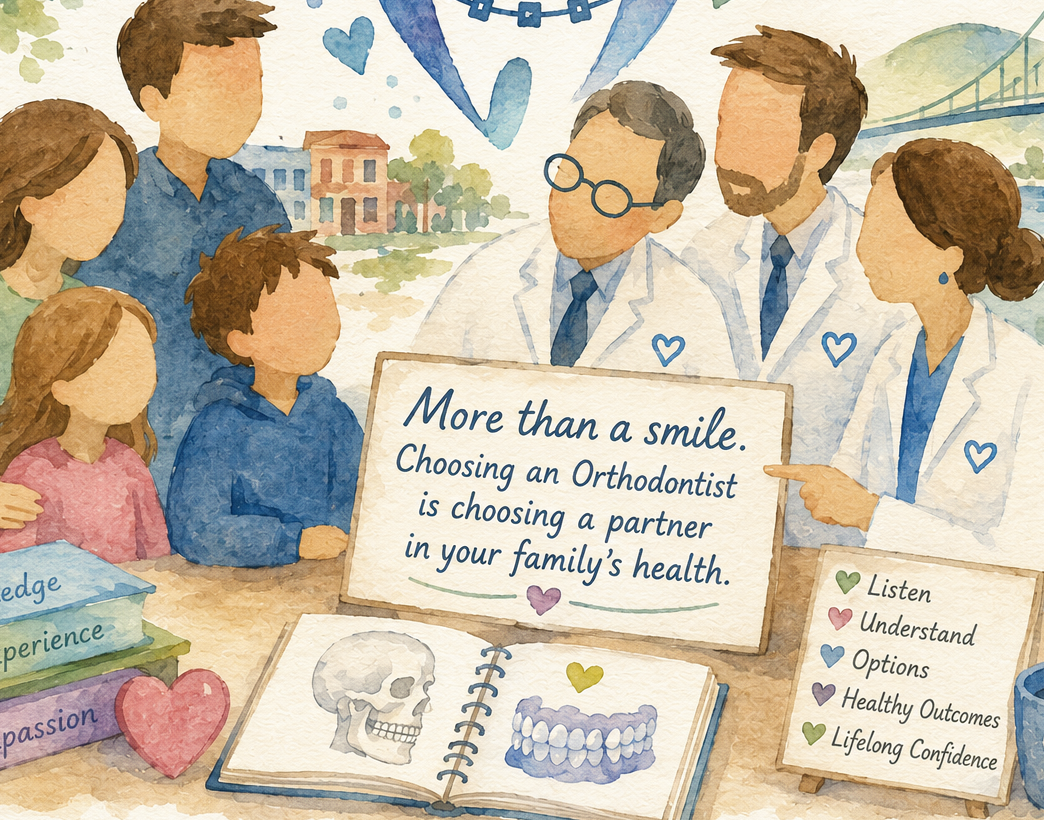
Because the best healthcare doesn’t begin with treatment, it begins with relationships. It begins with listening. It begins with understanding that every patient is someone’s child, someone’s parent, someone’s spouse, or someone’s grandparent. Every recommendation affects not only one person, but an entire family.
Those values resonate far beyond orthodontics.
Strong communities have always been built on trust, education, service, and a commitment to caring for one another. We naturally seek professionals who combine knowledge with humility, who continue learning long after formal education ends, and who see their profession not simply as a career, but as an opportunity to improve the lives of others.
Orthodontics may begin with a smile. But at its best, it is about something much deeper. It is about preserving health, building confidence, strengthening families, and helping people move through life knowing they were cared for by professionals who never stopped asking how they could provide an even better outcome.
Long after the braces come off or the final aligner is tucked away, that is what families remember.