
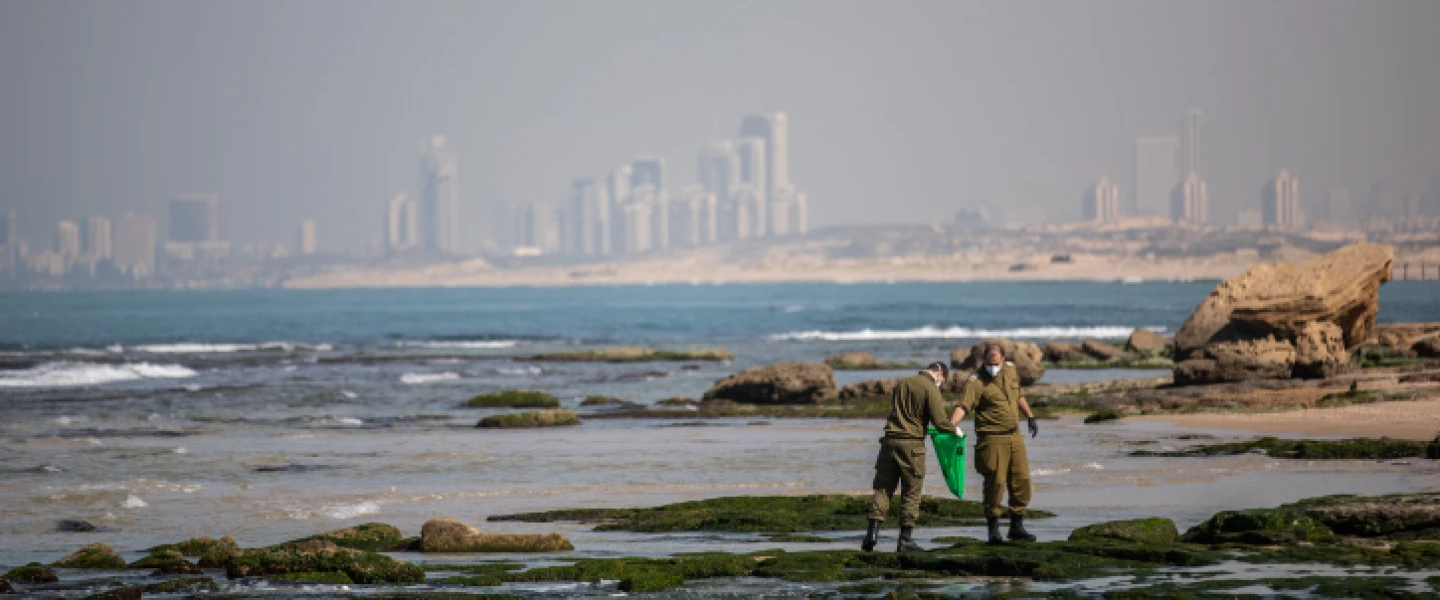
Courtesy of JNS. Photo credit: Yonatan Sindel/Flash90.
Israeli soldiers clean tar off the coast of the Palmachim beach from an offshore oil spill that affected most of Israel’s coastline, Feb. 22, 2021
(JNS)—This is the first article in a new JNS series, “Made in Israel,” highlighting Israeli scientific and technological innovations that are making an impact around the world and explaining the science behind them.
In February 2021, black lumps of tar began washing onto beaches along Israel’s Mediterranean coast. The pollution eventually affected a large stretch of the eastern Mediterranean shoreline, leaving beaches coated with petroleum residue and prompting a major cleanup effort. For a country with only about 195 kilometers of Mediterranean coastline, and much of its population and critical infrastructure concentrated near it, the episode was a reminder that an oil spill far offshore can quickly become a problem on land.
The first hours after such a spill are often a race against the sea itself. Most oils float, spreading across the surface while winds and currents carry them away from the point of release. Responders can surround parts of the slick with floating barriers and then use specialized vessels to skim oil from the surface. Other materials can be deployed to soak it up. But waves, currents and rough weather complicate the work, and the farther the slick spreads, the more difficult it becomes to contain.
Even if containment is successful, responders immediately face a further challenge: What happens to the oil afterward?
Mechanical cleanup usually removes petroleum from the sea rather than destroying it. Oil collected by skimmers must be stored, separated from water and eventually recycled or disposed of. Oil-soaked cleanup materials pose a similar problem. Other methods reduce the need for disposal while introducing their own environmental trade-offs. Chemical dispersants break a slick into much smaller droplets that enter the water, while controlled burning can destroy part of a surface spill under suitable conditions. Each has its own role and limitations.
Researchers at Ben-Gurion University have been working on a different approach: a material designed not only to capture petroleum but to help nature break it down afterward. In laboratory experiments, the researchers showed that these two processes—physical capture and biological degradation—could be combined.
To understand how, it helps to begin with the unusual material at the center of the system: an almost weightless, highly porous solid capable of pulling many times its own mass in petroleum out of water.
The material at the center of the Ben-Gurion University system is an aerogel, a solid built around an extraordinarily open microscopic structure. Rather than resembling a dense block, an aerogel is more like a delicate three-dimensional framework filled mostly with empty space. That makes it extremely light while providing a vast internal surface on which other substances can collect.
The researchers built theirs from cellulose, the structural material found throughout plants and familiar from products such as paper. The cellulose is converted into a carbon-rich, highly porous aerogel, producing a material with a crucial property for oil-spill cleanup: It strongly resists being wetted by water.
That distinction matters because an oil adsorbent deployed at sea faces an obvious challenge: It is surrounded by vastly more water than petroleum. A useful material must therefore do more than simply soak up liquids indiscriminately. The carbonized aerogel is designed so that water largely stays outside while petroleum spreads through and clings to its porous structure.
In laboratory tests, that structure proved highly effective.