
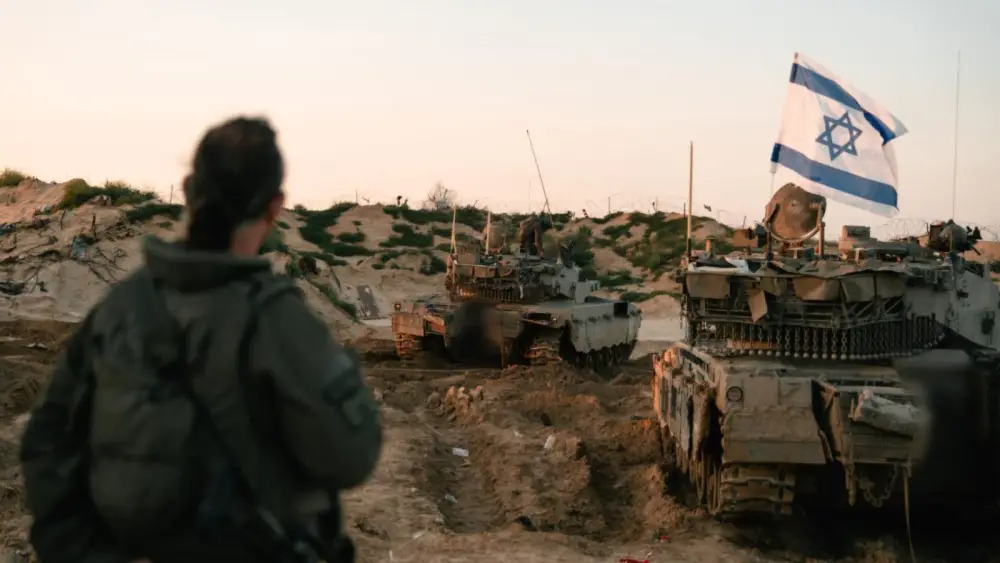
Courtesy of JNS. Photo credit: IDF.
Israeli soldiers and tanks from the IDF’s 252nd Division operate in the northern Gaza Strip as the unit completes its months-long mission, June 3, 2026
(JNS)—The Israel Defense Forces on Thursday issued a detailed rebuttal of claims made in the documentary “NAZA,” accusing its filmmakers of presenting a “distorted, misleading and disingenuous” account of how the military selects and strikes targets in the Gaza Strip.
The documentary features anonymous testimony from 24 Israeli military and intelligence personnel and alleges that the IDF used intelligence systems and artificial intelligence in ways that contributed to civilian deaths in Gaza. Interviewees also allege that the military deliberately targeted civilians and permitted large numbers of civilian casualties in attacks on terrorist operatives.
The IDF rejected those allegations, saying the film’s narrative “is based on substantial factual errors stemming from manipulative misrepresentations of reality.”
According to the military, binding IDF directives distinguish between terrorists and uninvolved civilians, prohibit deliberately targeting civilians and require commanders to minimize the risk of civilian harm to the greatest extent feasible.
The IDF said it had never planned, approved or carried out a strike in Gaza in which 500 civilians, or anything approaching that number, were expected to be killed, contrary to
It also rejected claims that artificial intelligence independently selects targets for attack.
“Artificial intelligence has never independently selected targets to strike in the IDF,” the military said.
According to the IDF, authorized intelligence officers identify potential targets, relevant professionals plan strikes, and operational commanders make the final decision on whether to attack.
The military also disputed the film’s characterization of “Lavender,” an artificial intelligence-assisted system used by Israeli intelligence.
“‘Lavender’ is not a database of targets approved to strike, but a database that assists intelligence analysts,” the IDF said.
The military denied that its rules established automatic civilian-casualty thresholds, including claims cited in the film that strikes against junior terrorists could automatically be approved when 20 civilians were at risk, or that 200 civilians could be endangered in an attack on a senior commander.
The IDF also rejected the contention that once civilians were warned to evacuate an area, troops were free to strike without considering those who remained.
The military said assessments of possible civilian casualties remain part of the targeting process after evacuation warnings have been issued.
The IDF further rejected claims that it failed to examine the aftermath of strikes, saying it had reviewed hundreds of incidents during the war, including cases involving unintended civilian casualties, to determine what happened and draw operational lessons.
It acknowledged that mistakes occurred during complex combat operations and said suspected violations of Israeli or international law are examined and, when warranted, can lead to disciplinary measures or criminal investigations.
One of the documentary’s fundamental shortcomings, according to the Israeli military, was its reliance on intelligence personnel who were familiar with only part of the targeting process.
The interviewees described as having served in intelligence roles “usually refer to only limited, initial stages dealing with intelligence, rather than the much broader process of planning and approving strikes,” according to the IDF.