Courtesy of JNS. Photo credit: IDF
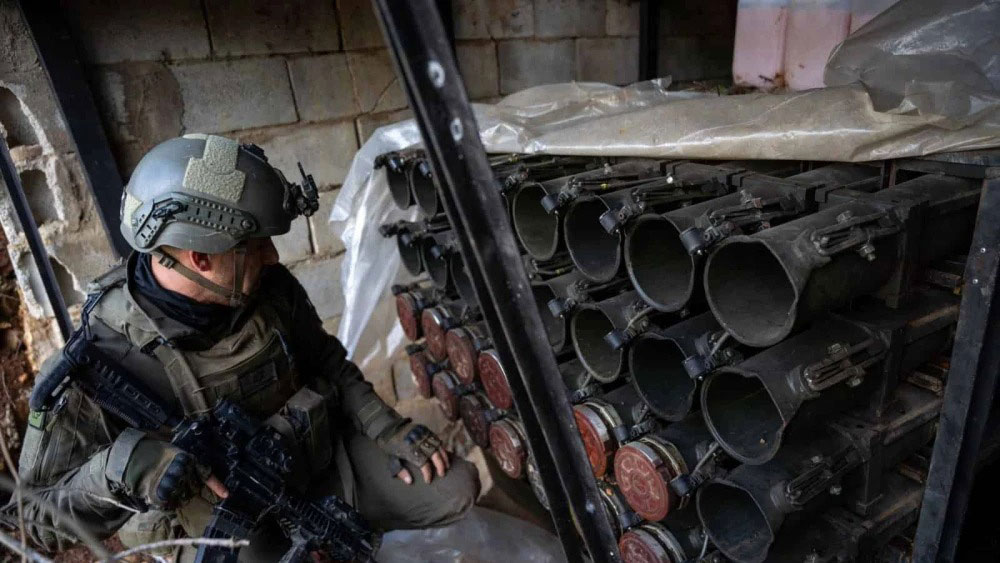
An Israeli soldier examines anti-tank ordnance seized from Hezbollah’s Radwan Force in Southern Lebanon, Dec. 28, 2024
(JNS) — As the Israel Defense Forces pushes deeper into Lebanon, residents of northern Israel remain concerned about the possibility of a ground infiltration by Hezbollah’s Radwan Force.
While Hezbollah’s military capabilities have been heavily degraded over the past three years, the Iranian-backed Lebanese terror army — and specifically its Radwan unit — remains dangerous. Following Hezbollah’s decision to join the fighting between Israel and Iran on March 2, the IDF has launched intense defensive and offensive measures to counter the threat.
“We assess that the Radwan unit, which was deployed mainly north of the Litani River and in the Bekaa during the ceasefire, received an instruction, with Hezbollah joining the fighting on March 2, to mobilize some of its forces to the area south of the Litani and deploy with a low signature in a sort of ‘defense strip’ in the Southern Lebanon area, at a distance of up to about 10 kilometers [6.2 miles] from the border,” Tal Beeri, head of research at the Alma Center, stated on March 15.
“From this area, the unit’s operatives try to hit IDF forces operating on Lebanese soil, from effective ranges for anti-tank and mortar fire, combined with Unmanned Aerial Vehicle launches from more rear lines,” he added.
The Radwan Force is deployed in small squads along the entire sector south of the Litani and operates autonomously in the field, said Beeri.
To maximize the effectiveness of these autonomous cells, Hezbollah is relying on operatives with intimate geographic knowledge. “To our understanding, the squads number up to 10 operatives with a preference for Radwan operatives who are ‘locals’ who know the area well,” said Beeri.
Consequently, he said, “The squad commanders [have] great independence in making quick tactical decisions in the field.”
Ultimately, Beeri assessed that while the major strategic threat of a Hezbollah invasion has been blunted, a localized threat remains.
Cmdr. Eyal Pinko, a researcher at the Begin-Sadat Center for Strategic Studies and a former Israeli Navy and intelligence officer, argued that Hezbollah’s Radwan Unit maintains a concentrated, significant presence in southern Lebanon.
Given the nature of the terrain and the enemy’s tactics, Pinko warned that tactical surprises remain a constant danger. “It will be very difficult to be one hundred percent prepared,” he told JNS.
While IDF units are highly trained and vigilant, the subterranean domain provides Hezbollah with a distinct tactical advantage, he added.
“I assume there is a very high alertness level, but they [Hezbollah] also operate underground,” Pinko noted. “In my estimation, their hiding places and the tunnels are unknown.”
On March 16, IDF International Spokesperson Lt. Col. Nadav Shoshani confirmed that the military has witnessed hostile maneuvering by Radwan operatives.
“We’ve seen Hezbollah try and expand its fire towards us. We’ve seen Hezbollah try and send terrorists down towards the border area,” Shoshani added.
Consequently, Shoshani emphasized that the presence of IDF troops in the border area is not merely preventative, but actively necessary for immediate security.
“That is why it’s essential that our troops are in the border area for defensive measures, holding the defense lines, preventing any type of attack towards Israeli civilians whether it’s anti-tank, RPG or even try attempts to infiltrate Israel,” he emphasized.
On March 12, Shoshoni told journalists that “there’s no contradiction between the fact that we heavily diminished Hezbollah in the last three years and the fact that they are still a relevant, dangerous force.”
He recalled how on the eve of Oct. 7, 2023, Hezbollah had amassed an arsenal of hundreds of thousands of projectiles, noting that “even when you diminish a large amount of that, they still remain a relevant and dangerous force. We spoke about the fact that Hezbollah is still a dangerous force that needs to be dealt with, and that needs to be disarmed.”