Courtesy of JTA. Photo credit: Grace Yagel
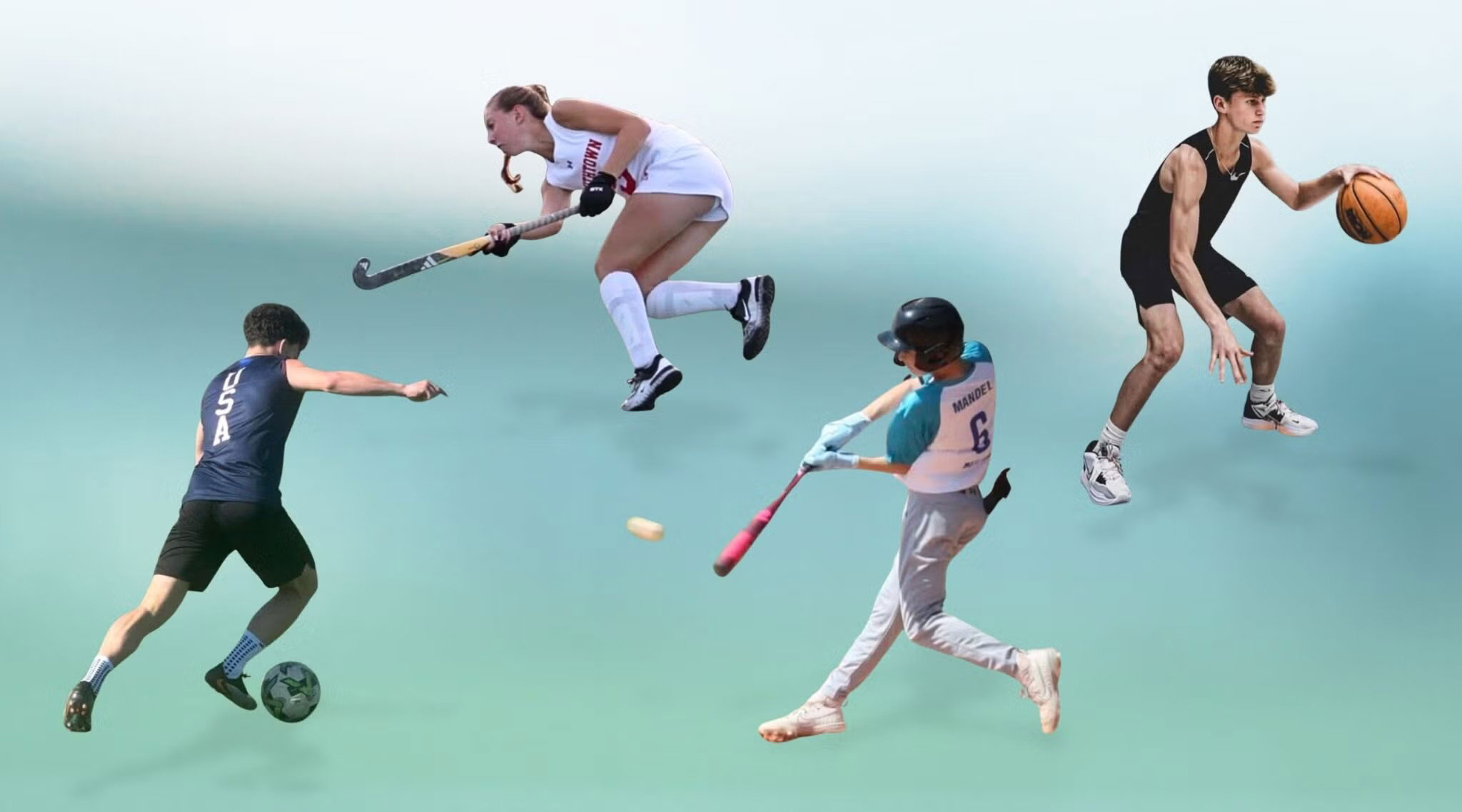
Clockwise from top left: field hockey defender Sydney Wetstein, basketball player Ariel Zeltzer, pitcher Josh Mandel and soccer player Aiden Barnea
(JTA) — When the 2025 Maccabiah was cancelled amid a spasm of Middle East violence, teen athletes mourned but also relished an extra year of training for the competition that brings thousands of Jewish athletes together in Israel.
Now, the athletes are getting ready for the games once again under the shadow of another war, with uncertainty about what Israel will look like when the competition is set to kick off on June 30.
But teen athletes from the New York City area say they’ve already felt the impact of the games, whether or not they go off as planned: Just training for them has strengthened their sense of Jewish pride, which has been tested by polarizing debates over Israel that have left many Jewish teens feeling targeted.
“The extra year gave me more time to improve, but it also made me realize how meaningful the opportunity is,” said Aiden Barnea, 17.
These athletes have been playing their respective sports their entire lives and hope to be recruited so they can continue their careers in college.
The additional year gave Team USA basketball player Ariel Zeltzer more time to prepare. The guard from Manhattan, a junior at Abraham Joshua Heschel School, has been working on his shooting and finishing at the rim.
Zeltzer said playing in the games is especially exciting because of the atmosphere. “Playing in front of thousands of people who know that America is the best basketball country makes me and my teammates extremely excited to get out there,” he said.
For Zeltzer, the chance to wear the American jersey represents more than just basketball. “It’s so meaningful to connect my two most important commitments: basketball and Israel,” he said.
Both Zeltzer and Barnea look up to and admire Israeli Jewish NBA player Deni Avdija, seeing him as a role model for their skill and for representing Jewish athletes at the highest level of basketball.
Often referred to as the “Jewish Olympics,” the Maccabiah Games are the largest Jewish sports event in the world. The event takes place once every four years in Israel and includes 45 sports, more than 80 countries and over 10,000 athletes.
The games were first established as a means of promoting Jewish unity and strength. This tradition began in 1932, but due to harsh antisemitism in the following decades, and cataclysm of World War II, no games were held until 1950. Since then, the Maccabiah Games have evolved from a small competition into a large international event while continuing to serve as a platform for Jews to display their athletic excellence.
Last year’s postponement also gave U.S. national team soccer player Aiden Barnea, 17, additional time to get stronger and sharpen his skills.
The junior midfielder from Manhattan sees the games as a message that Jewish culture continues to thrive despite conflict. “This Maccabiah feels more emotional to me than any other event has before, given the war,” Barnea said.
Barnea looks forward to embracing his identity at a time when debates over Israel have seen growing anti-Zionist and antisemitic rhetoric. “I feel very proud to not only represent America but represent Jewish America,” he said. “This is a great way to stand up for Jewish America while also doing something that I love.”
This 15-day tournament carries symbolic meaning beyond athletics, where players have the opportunity to come together and show their pride in being Jewish.
Manhattan native Josh Mandel, 17, who attends the Calhoun School, will pitch for USA’s baseball team in the Maccabiah Games. The extra period allowed him to reflect and gain a different outlook on the opportunity.
The cancellation gave Mandel a perspective on the larger importance of the event. Although he had been excited to visit Israel last summer, the war made him realize that “this competition is bigger than baseball.” He added that “we have to come together as a Jewish community and be strong through times of antisemitism and Jew-hatred.”
Mandel feels a dual, but not conflicting obligation playing for the United States while also supporting Israel. “It means a lot to be representing the U.S. because it’s where I am from and I have a deep attachment to it. I also have a deep attachment to Israel, so it means a lot being able to represent both.”
While the political situation in Israel remains complicated, with security issues and international tensions, these athletes focus on competition, and not political debate.
Although field hockey defender Sydney Wetstein, 15, of Long Island, New York, was disappointed by the postponement of the 2025 Games, she used the time off to focus on strength training and skill development.
“I train every day,” the Smithtown East High School Freshman said. “I am always at the gym getting work in,” she said, reflecting on her preparation for the competition.
But not everyone in Wetstein’s community thinks traveling to Israel is a good idea. “Some people in my family don’t think it’s safe,” she said, but that hasn’t affected her decision to participate. “I am more excited than anything,” she added. Although the war has slowed, Israel remains in an ongoing conflict, which could potentially scare athletes.
Wetstein acknowledges that Israel is a different place than it was last year. “All the hostages are back, so everyone has a different attitude. But everyone still has the same amount of pride,” she said.
Zeltzer, the basketball player, agrees that he and his teammates will use the extra time to their advantage. “Myself and athletes around the world are going to be hungrier for that gold medal,” he said.