Courtesy of JNS. Photo credit: Wikimedia Commons
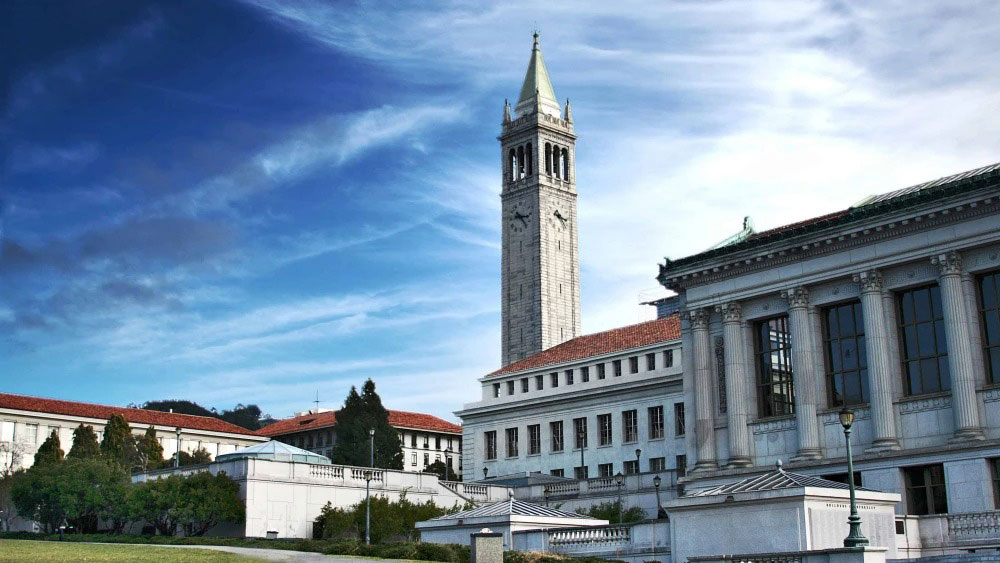
University of California, Berkeley campus, showing the Doe Memorial Library as well as Sather Tower, in Berkeley, Calif.
(JNS) — The University of California, Berkeley and Louis D. Brandeis Center for Human Rights Under Law said on Mar 19 that they settled a lawsuit alleging that the public school failed to address rising Jew-hatred adequately.
Under the settlement terms, Berkely will stop student groups from banning speakers and limiting “officers, board members or speakers based on a category that is protected under federal or state law.”
Berkeley also commits to consider the International Holocaust Remembrance Alliance’s working definition of Jew-hatred when probing complaints of antisemitism and to update its website to state that while Zionism isn’t a protected category in its anti-bias policies, “for many Jewish people, Zionism is an integral part of their identity and their ethnic and ancestral heritage.”
Discriminating against and harassing Jews under the pretext of decrying Zionism would violate school policies, Berkeley will also note.
The Brandeis Center filed the suit against the school in November 2023. The suit alleges that Berkeley failed to respond to nine student groups at its law school which passed bylaws stating that they would never invite Zionist speakers to campus.
Under the settlement, Berkeley must provide annual, mandatory training on discrimination, including antisemitism, for all incoming students, student leaders, faculty and staff and reimburse the Brandeis Center in attorney fees and litigation-related costs.
Kenneth Marcus, chairman and CEO of the center, stated that “what happened at Berkeley is a cautionary tale.”
“Universities, unions, corporations and political parties cannot create an anti-Zionist exception to their conduct codes,” he said. “They cannot silence Jewish Americans on the pretext of advancing their own political agendas.”
“As we have now seen time and again, if left unaddressed antisemitic bigotry, whether or not masked as anti-Zionism, only continues to expand,” Marcus stated. “We will fight this bigotry wherever and whenever we find it, and we will win.”
The university is not admitting fault under the agreement. Eckles told JNS that “this is a standard way that settlements get done.”
“You don’t see people or institutions in settlements themselves admitting wrongdoing. The key is, what are they agreeing to do?” he said. “I don’t think they would have agreed to all of these reforms and all the changes if there wasn’t a recognition that they had a problem.”
Other notable reforms that the university is taking under the agreement include improving campus security as well as agreeing to hire a Title VI coordinator to oversee compliance with federal civil rights law and yearly reporting of statistics on how cases were handled and the disciplinary outcomes of those cases, according to Eckles.
He said that the university had already started implementing some of these reforms before the agreement was finalized, but “this lawsuit was the driving force behind all of these reforms and changes.”
“The settlement collectively and everything in it is an important step and milestone in addressing the antisemitism problem on the campus,” Eckles said.
Eckles told JNS that “what comes next is equally important, because it’s ultimately how they implement these reforms and whether they truly embrace them and take proactive steps to protect and improve the experiences of the Jewish students that’ll be the most important.”
“As part of the agreement, we will be having annual meetings with them for the next five years to go over implementation issues and making sure that they are following through on their obligations under the agreement,” he said.