By Natalie Emerson
Assistant Editor
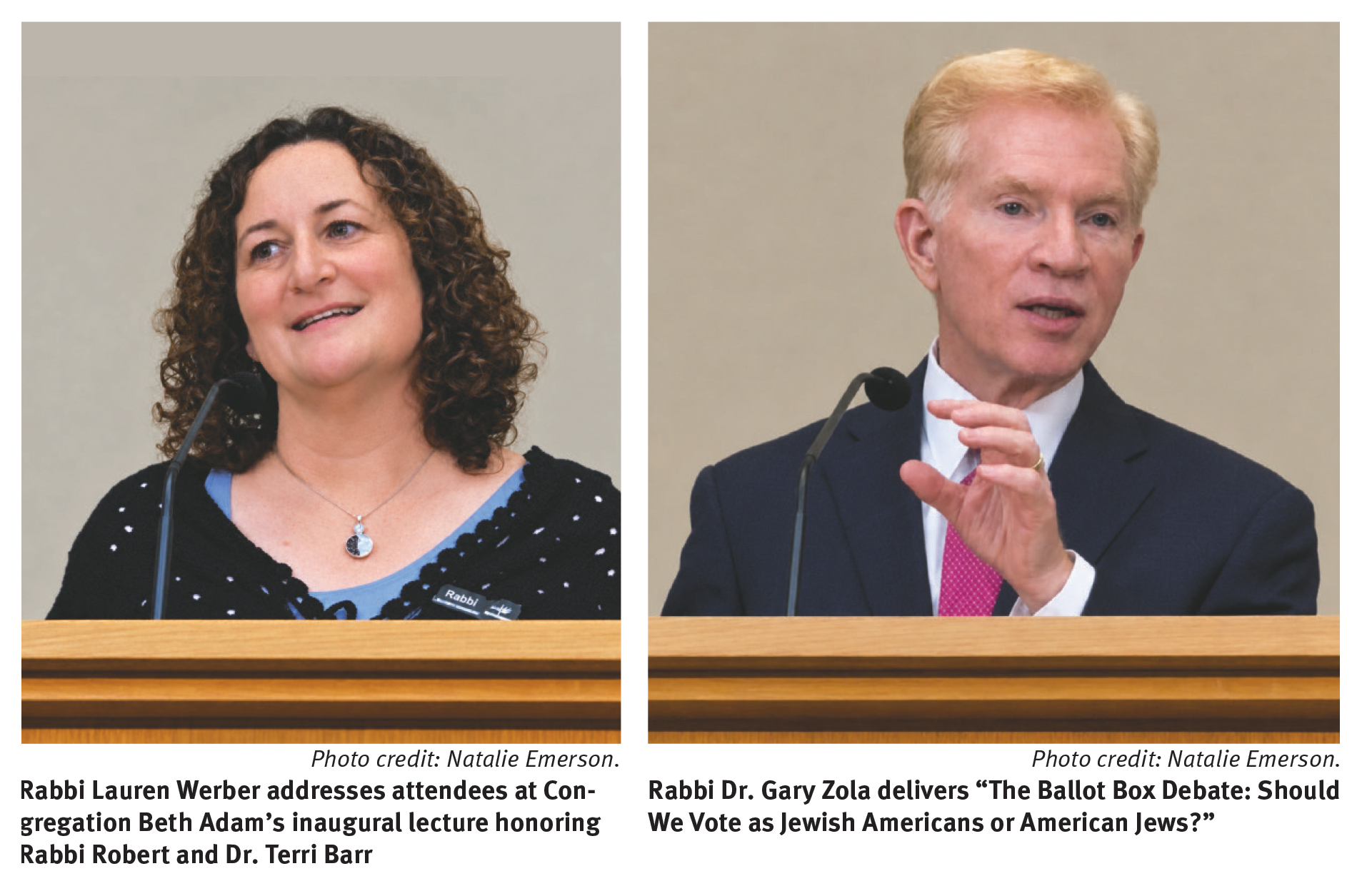
Jewish Americans or American Jews? Zola explores identity and voting. Two phrases, the same two identities—but does their order change how a person votes? That question brought Jewish identity and American civic responsibility into focus at Congregation Beth Adam on Wednesday, October 14, when Rabbi Dr. Gary Zola delivered “The Ballot Box Debate: Should We Vote as Jewish Americans or American Jews?”
The evening inaugurated the Robert and Terri Barr Lecture Series, honoring Rabbi Robert and Dr. Terri Barr, who helped establish Beth Adam in 1980. The series is intended to bring prominent voices in Progressive American Judaism into conversation with the wider community.
Zola traced a longstanding disagreement into an anxious present: How should Jewish voters rank their responsibilities to their community and their country when they perceive a conflict? Following the Hamas-led attacks of October 7, 2023, the ensuing war and rising concerns about antisemitism, he explained, that debate has acquired renewed urgency.
The distinction in his title concerned more than word order. “Jewish Americans” places Jewish identity as a modifier of American identity; “American Jews” places Jewish identity at the center, qualified by citizenship. Reconciling multiple identities and obligations, Zola noted, is an American challenge shared by other communities.
He explored the tension through Philip Roth’s The Plot Against America, which imagines Charles Lindbergh defeating Franklin Roosevelt and Jewish families confronting an increasingly threatening country. Its fictional rabbi, Lionel Bengelsdorf, supports Lindbergh despite other Jews’ fears—a literary example of political divisions with real historical counterparts.
One especially revealing dispute involved Ulysses S. Grant’s 1868 presidential candidacy. Six years earlier, Grant had issued General Orders No. 11, expelling Jews as a class from his military department. President Lincoln intervened to have the order revoked, but its insult endured.
Cincinnati’s Rabbi Isaac Mayer Wise opposed Grant and urged Jews to defend their dignity. Chicago’s Rabbi Liebmann Adler argued that Jewish ethics required him to support the party he believed would best advance human rights and the country’s welfare, even when its candidate had ordered Jews expelled.
Zola gave extended attention to Adler’s reasoning. Adler regarded voting for the nation’s welfare as an expression of his Jewish obligations. In a startling hypothetical, he declared that even if his preferred party nominated Haman, the villain of the Purim story, while its opponents nominated the Messiah and appointed Moses chief justice, he would vote for the party he trusted to serve the nation.
Zola described a broadly universal outlook influential among American Jews in the decades following World War II. Supporting democracy, justice and the rights of others was understood as a way to protect Jewish life as well. An America faithful to its founding ideals would provide security for its minorities.
But the national climate has changed, he argued. Social media, political tribalism and increasingly isolated communities have altered how Americans weigh their loyalties and responsibilities. For Jews, he said, the aftermath of October 7 intensified pressure to put communal protection first.
Referencing journalist Franklin Foer’s 2024 essay, “The Golden Age of American Jews Is Ending,” Zola discussed fears that antisemitism had become more socially acceptable. He also cited Gallup’s February 2026 polling, in which 65 percent of Democrats sympathized more with Palestinians and 17 percent with Israelis, as evidence of shifting political attitudes.
Zola illustrated one response by displaying a photograph of Alan Dershowitz alongside his explanation for registering as a Republican after a long affiliation with the Democratic Party. “Good people must prioritize support for Jews and their nation-state at this time,” Dershowitz wrote.
Zola also displayed the words of Halie Soifer, CEO of the Jewish Democratic Council of America, who argued for weighing Israel alongside other Jewish priorities. Soifer wrote that JDCA opposed attempts to justify antisemitic violence and efforts to withhold weapons sales to Israel, while maintaining that Jewish voters should support candidates aligned with their values across a range of issues.
Those concerns included defending democracy, expanding economic opportunity and affordability, protecting freedom, pursuing justice and combating antisemitism and other forms of bigotry. Her position presented support for Israel as part of a broader political commitment.
The presentation then turned to Jeremiah 29:7, which urges the exiles to seek the welfare of the city where they live, connecting their own welfare with that of the surrounding community. The biblical passage brought the relationship between communal well-being and civic responsibility into the discussion.
Beth Adam’s Rabbi Lauren Werber closed the evening by bringing those responsibilities together. “May we remember who we are as a people, and imagine what we can yet be as a nation,” she said. “And may we carry both in our hearts, and carry both out into our actions.”