Courtesy of JNS. Photo credit: Serkan Gurbuz/U.S. State Department
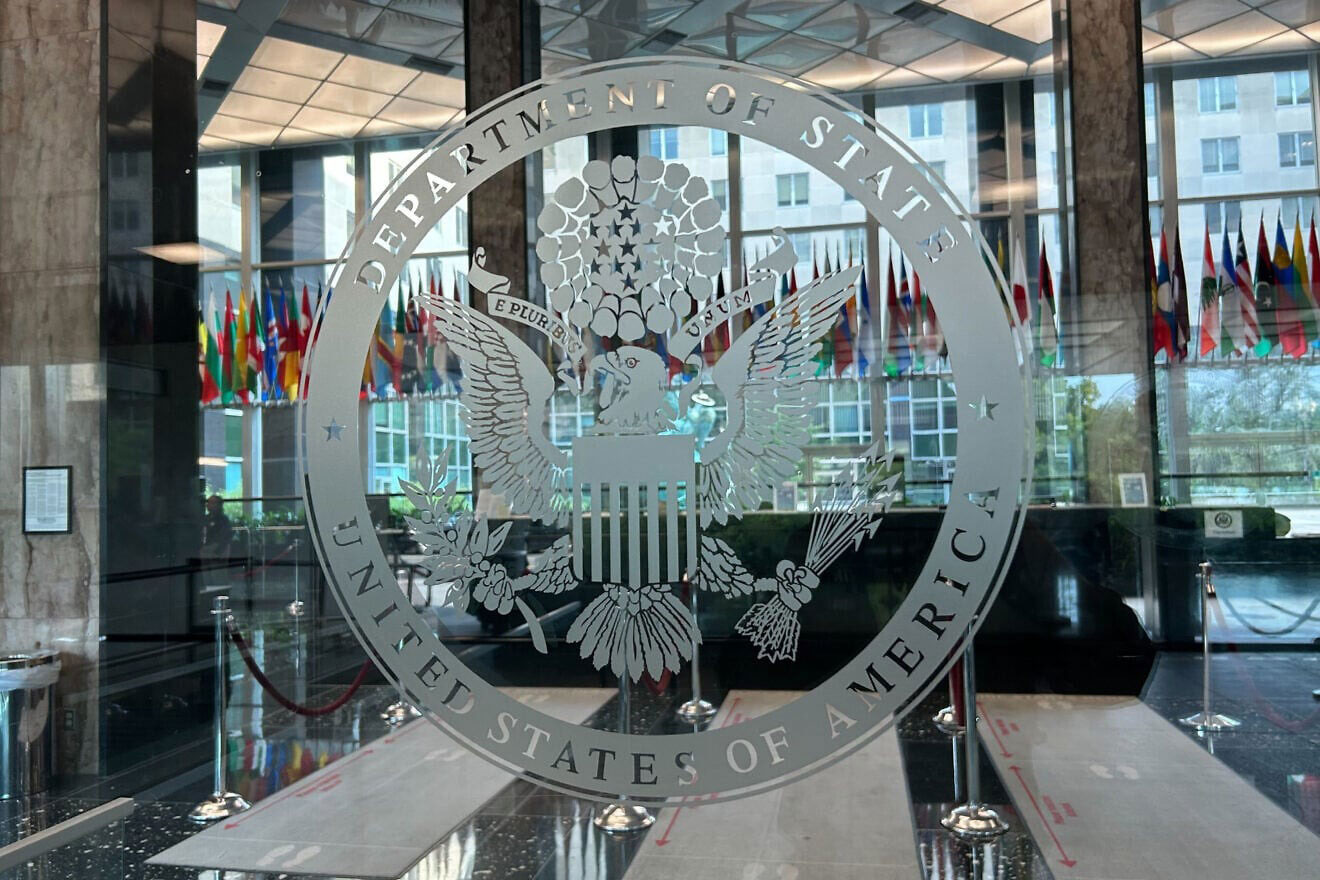
The U.S. Department of State seal is seen by the entrance to the lobby of the Harry S. Truman building in Washington, D.C., June 30, 2025
(JNS) — The U.S. State Department pledged to give $2 billion to the United Nations for humanitarian aid on Dec. 29, partnering with an agency that has come under fire from Israel for repeated misstatements and inaccurate data about the Israel-Hamas war.
“This new model will better share the burden of U.N. humanitarian work with other developed countries and will require the U.N. to cut bloat, remove duplication and commit to powerful new impact, accountability and oversight mechanisms,” stated Marco Rubio, the U.S. secretary of state.
The $2 billion figure is far less than past U.S. contributions but is notable during a period of much tighter controls on humanitarian aid by the Trump administration.
Data from the United Nations shows U.S. humanitarian-aid contributions to the global organization ran as high as $17 billion annually recently, with $8 billion to $10 billion of that given as voluntary contributions, apart from annual assessed dues.
The State Department announced its pledge in conjunction with Tom Fletcher, a former British diplomat who now serves as U.N. under-secretary-general for humanitarian affairs and emergency relief coordinator.
Fletcher, who leads the U.N. Office for the Coordination of Humanitarian Affairs, or OCHA, accused Israel of committing genocide in Gaza during a U.N. Security Council meeting. He later claimed on CNN that 14,000 babies in Gaza would die within 48 hours without increased humanitarian aid.
Israeli officials called for Fletcher to apologize. He later issued a correction.
Fletcher also claimed, again on CNN, that 10,000 trucks of humanitarian aid were waiting outside Gaza for permission from Israel to enter. A U.N. spokesman later clarified that there was enough humanitarian aid available to fill 10,000 trucks.
Israel refused to renew Fletcher’s visa in July, and he was barred from entering Gaza until the United States asked Israel to acquiesce as part of the Gaza ceasefire announced in October.
OCHA has provided what some analysts said was incomplete, inaccurate and misinterpreted data, which played a part in faulty projections of famine in Gaza. (JNS sought comment from the Israeli mission to the United Nations.)
On Monday, Fletcher told reporters that the $2 billion pledge is “a very, very significant landmark contribution, and a month ago, I would have anticipated the number would have been zero.”
Fletcher will give the funding to pre-determined agencies and countries.
A total of 17 countries will be initially targeted for assistance, including Syria. While Yemen suffers through a long-standing humanitarian crisis, it is not included on Washington’s OCHA list due to the Trump administration’s concerns over aid diversions to the Houthi rebels.
The Palestinians are also excluded, though U.S. officials say funding will come from Trump’s Gaza peace plan.
“The piggy bank is not open to organizations that just want to return to the old system,” Jeremy Lewin, the State Department’s point person on foreign assistance, said at a press conference on Monday. “President Trump has made clear that the system is dead.”
U.S. officials said the $2 billion pledge is not the end, but a first installment to assist OCHA’s annual funding appeal.
“This humanitarian reset at the United Nations should deliver more aid with fewer tax dollars, providing more focused, results-driven assistance aligned with U.S foreign policy,” said Mike Waltz, U.S. ambassador to the United Nations.