Courtesy of JNS. Photo credit: Courtesy of Gideon Sa’ar/X
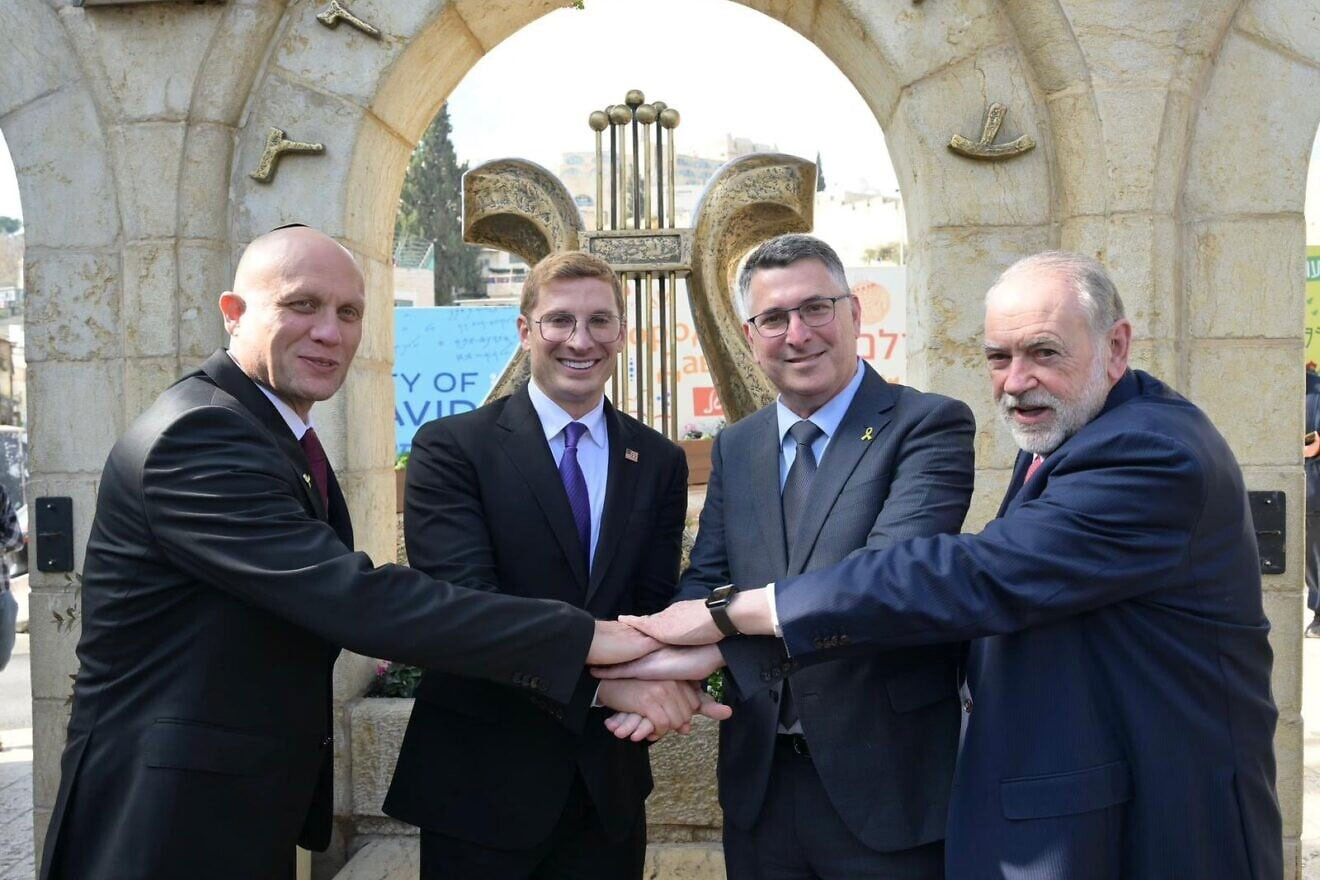
(From left) Israeli National AI Agency Director Brig. Gen. (res.) Erez Askar, U.S. Undersecretary of State for Economic Affairs Jacob Helberg, Israeli Foreign Minister Gideon Sa’ar and U.S. Ambassador Mike Huckabee at the City of David, Jerusalem, Jan. 16, 2026
(JNS) — Senior U.S. and Israeli officials gathered in Jerusalem on Jan. 16 to launch a new strategic partnership on artificial intelligence, research and critical technologies, underscoring the two allies’ intent to deepen cooperation in fields increasingly seen as central to national security and economic power.
The ceremony, held at the City of David, brought together Israeli Foreign Minister Gideon Sa’ar, U.S. Ambassador to Israel Mike Huckabee, U.S. Under Secretary of State for Economic Affairs Jacob Helberg, and Israeli National AI Agency Director Brig. Gen. (res.) Erez Askar, along with senior defense, technology and diplomatic officials from both countries.
The joint declaration formalizes cooperation in artificial intelligence, advanced research, energy, space, semiconductors and other emerging technologies. Israeli officials said the agreement builds on Israeli Prime Minister Benjamin Netanyahu’s recent decision to establish a National Artificial Intelligence Directorate, aimed at positioning Israel as a global leader in AI development and application.
Speaking at the event, Sa’ar said the partnership marked “another milestone in our unbreakable alliance,” arguing that technological leadership has become inseparable from national security.
He described Israel as a strategic asset for the United States, citing intelligence cooperation, innovation and shared security threats posed by Iran, Hamas, Hezbollah and the Houthis.
“Leading in technology is essential for national security in today’s world,” Sa’ar said. “Israel is an asset here, too.”
Helberg said the agreement falls under a broader U.S.-led framework known as Pax Silica, designed to strengthen trusted AI and technology supply chains among allied nations.
He described Israel as an anchor partner in that effort, citing its innovation ecosystem and capacity to produce “asymmetric outcomes” despite its small size.
“The next era of prosperity and security will be shaped by those who build the critical technologies that power modern life,” Helberg said, pointing to artificial intelligence, semiconductors, robotics and energy as pillars of future strength.
Askar said the agreement would be implemented immediately, including the establishment of joint U.S.-Israel applied AI laboratories in Israel. The labs are intended to allow researchers and companies from both countries to develop and test advanced AI systems using shared data and infrastructure.
He said Israel plans to sign similar agreements with additional countries over the coming year to reinforce its role as a global AI hub.
Huckabee framed the partnership as an extension of the long-standing U.S.-Israel alliance, arguing that technological cooperation could help advance regional stability and prosperity.
“There is nothing artificial about the partnership of the United States and Israel,” Huckabee said. “It is real and it is beneficial to both nations.”
The ceremony concluded with the formal signing of the joint declaration, followed by a reception overlooking the Israeli capital, as officials from both countries emphasized that the partnership was intended not only to spur innovation but to reinforce shared democratic values and long-term strategic alignment.