Courtesy of JTA. Photo credit: Theo Wargo/Getty Images for Tony Awards Productions
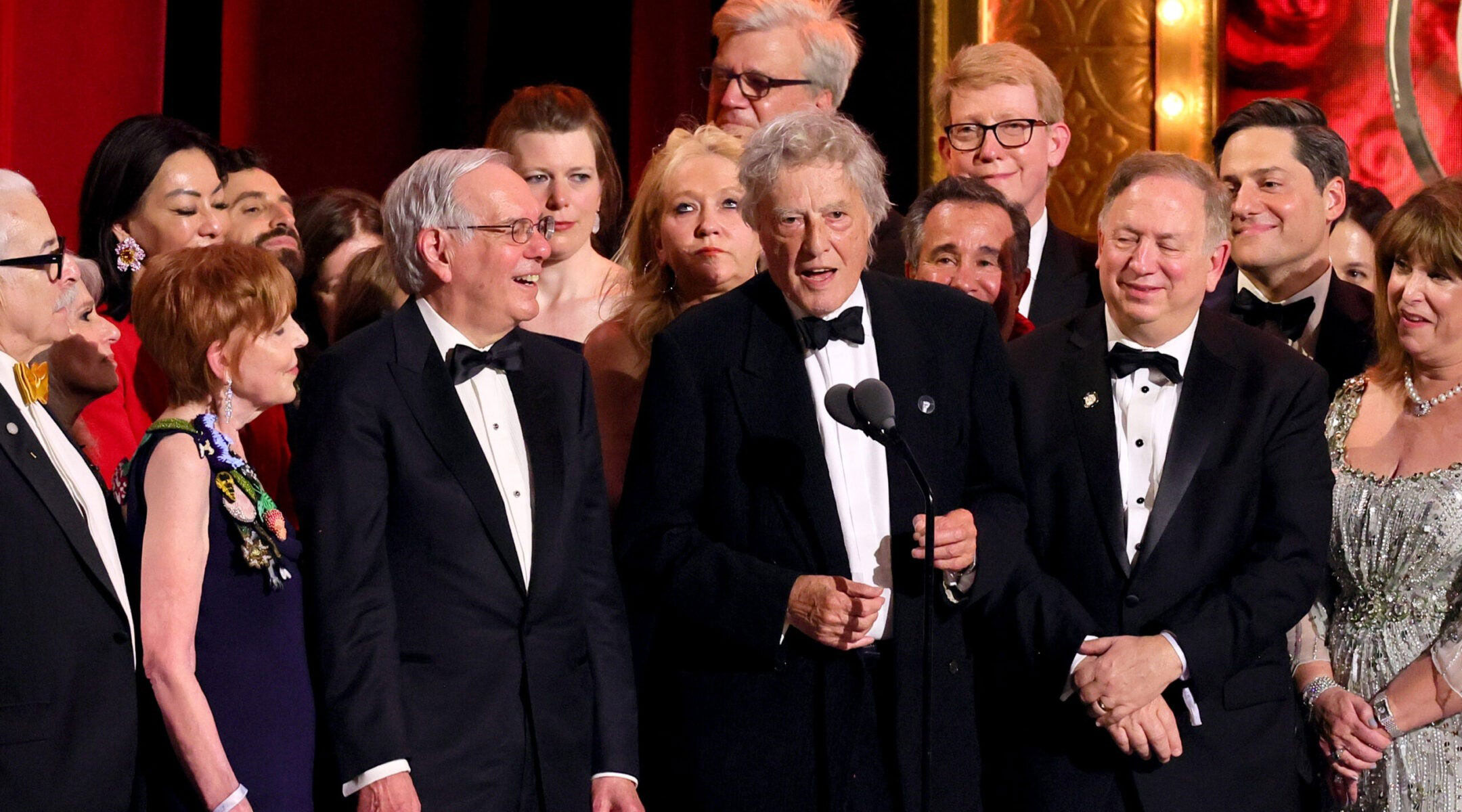
Tom Stoppard accepts the award for best new play for “Leopoldstadt” onstage during The 76th Annual Tony Awards at United Palace Theater in New York City, June 11, 2023
(JTA) — Tom Stoppard had already won four Tony Awards during his prolific career as a playwright when he penned what would be his final staged work, dealing with his family’s Holocaust history.
Already in his 80s, Stoppard wrote “Leopoldstadt” to explore a past he said he had thought was not relevant to his life — until he realized that it was. The play, which portrayed a Jewish family grappling with how to respond to rising antisemitic ferment in their native Vienna, won the Tony for best play after it opened on Broadway in 2022.
“I thought that the subject of the Jews through the war had been done and done,” Stoppard told the “Jewish Telegraphic Agency” at the time. “But actually, not really!”
The prize bookended more than five decades of awards for Stoppard, who died Saturday at 88.
“He will be remembered for his works, for their brilliance and humanity, and for his wit, his irreverence, his generosity of spirit and his profound love of the English language,” his family said in a statement announcing his death at home in Dorset, England.
Born in 1937 in what was then Czechoslovakia, Stoppard emerged from a wartime ordeal that claimed his father and — although he would not know it for years — saw all four of his grandparents murdered in Nazi concentration camps to become one of the world’s most productive and celebrated playwrights.
Stoppard authored dozens of plays throughout his career, sometimes premiering more than one a year on London’s West End. Five later won best play when they transferred to Broadway in New York City.
He also won the Academy Award for best screenplay in 1998 for “Shakespeare in Love” and was nominated for the prize another time, in 1985 for “Brazil.”
A sign of possible Jewish connection came in 1986, he organized a demonstration in London on behalf of Soviet Jews that included other British celebrities and the U.S. senator Bill Bradley. But he said he replied to letters thanking him as a Jew that he was “not really Jewish.” It was not until after the fall of the Soviet Union that he would learn about the depth of his own Jewish identity.
In 1993, he would later recount, a relative from the new, free Czech Republic named Sarka wrote to his mother saying that she would like to reconnect. At a meeting in London — whose location his mother selected to avoid her husband, who Stoppard said harbored many prejudices — Sarka sketched out a family tree that Stoppard had never seen.
The occasion prompted an exchange that would shape Stoppard’s final work. “How Jewish were we?” he said he asked Sarka, having grown up being told that the Nazis targeted anyone with a Jewish grandparent. “You were completely Jewish,” she told him, shattering what he said he had been “almost willful purblindness, a rarely disturbed absence of curiosity combined with an endless willingness not to disturb my mother by questioning her.”
Sarka revealed the grim toll of the Holocaust on Stoppard’s family. His mother’s brother had survived, but their three sisters were murdered, two at Auschwitz. Both sets of his grandparents, too, had been killed — his mother’s parents sometime in 1942 and his father’s parents at Terezin in 1944.
“It’s not a very elegant phrase, but I could say I didn’t factor in my Jewishness,” he told the “New York Times Magazine” in 2022. “I just live my life and let the Jewishness take care of itself.”
Yet that was not always the case for those around him. In an essay published last year, the playwright recalled that his adoptive father had asked him to drop the Stoppard name after he first began demonstrating the “tribalism” of Jewish identity back when he demonstrated on behalf of Soviet Jews. By then, he was firmly established as one of the world’s greatest living playwrights. “I wrote back,” he recounted, “that this was not practical.”
Stoppard, who was married three times, is survived by his wife, four children and several grandchildren.