Courtesy of JTA. Photo credit: Courtesy of Amal
The Yigal Alon school in Ramle, one of just a few mixed Arab-Jewish schools in Israel, offers a rare and tangible model for how to bolster coexistence in Israel
(JTA) — In the heart of the central Israeli city of Ramle, where Jews and Arabs live side by side, the Yigal Alon Multidisciplinary High School is trying to spearhead a quiet revolution.
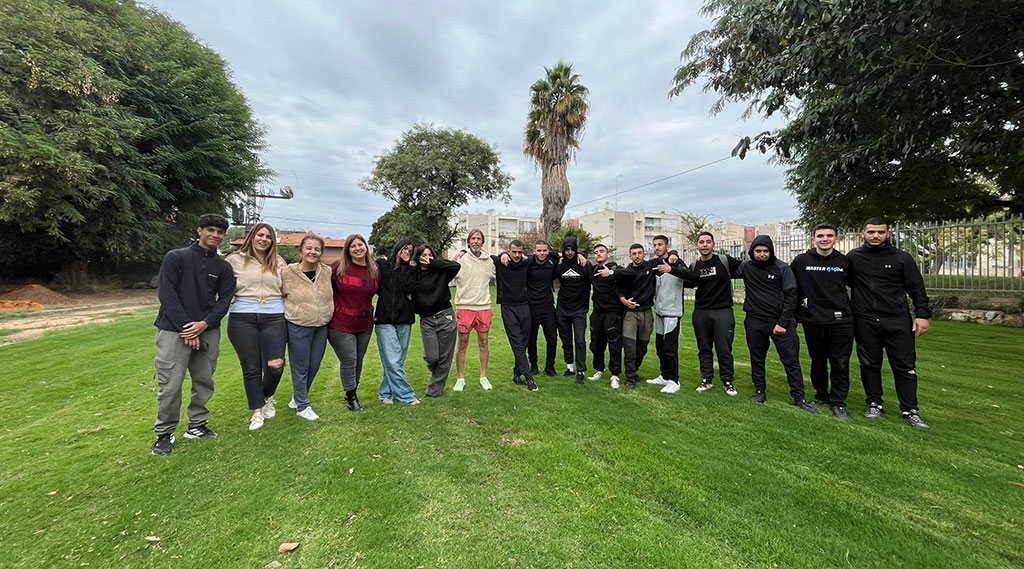
The student body reflects the full tapestry of Israeli society, with students who are Jewish, Muslim, and Christian, religious and secular, native-born and immigrant. The school has a particularly large Ethiopian-Israeli population, and students with special needs. In Israel, such diversity is often treated as a problem to be managed. At Yigal Alon, it is treated as an opportunity, one that was especially important during Israel’s two-year war.
The school, one of 50 in the Amal educational network, offers a rare and tangible model for how to bolster Arab-Jewish coexistence and build a society rooted in shared humanity, administrators said.
“This school is a home not just for students, but for families,” said principal Barak Friedman, himself a school alumnus and Ramle native. “Everyone belongs. Everyone matters.”
In Israel, only eight out of 250 municipalities are considered mixed Jewish-Arab. Almost all public schools are segregated along ethnic and religious lines. Yigal Alon is one of Israel’s very few mixed Arab-Jewish public schools.
“Once people saw this as a liability,” Friedman said. “I see it as a wonderful opportunity.”
Staff at the school try to weave the values of shared humanity into academic life. During the war, students met weekly in conversation circles where Jewish and Arab classmates spoke openly about how the conflict was affecting their families. They worked together on projects like murals and performances to express their emotions.
Older students tutor younger ones, often across language and cultural lines, and 11th graders complete community service work in both Jewish and Arab institutions. The school also has a large group of Shinshinim — Israeli volunteers from pre-military academies who work alongside teachers.
Jewish and Arab students and teachers work side by side.
“Students aren’t interested in the ethnic background or origin stories of fellow students; what matters to them is their relationships with each other,” Friedman said. “At a time of growing extremism in Israeli society, the connections between these youths is quite unique and inspiring.”
These connections flourished even during the war.
Within the Amal network — whose diverse portfolio of schools ranges from vocational schools that serve traditionally marginalized Israeli populations including immigrants, Arabs, and haredim to science & technology schools in Israel’s biggest cities — 45 alumni were killed in the war, many of them siblings or cousins of current students. Schools were struck by missiles, relocated due to being in conflict zones or absorbed evacuees. Some students had relatives taken hostage to Gaza, and many had parents or siblings in combat. Everyone was affected.
“The loss is not only in the fallen,” said Asher Ben Shoshan, Amal’s head of human resources. “Many of our students and staff were living with traumas.”
Amal’s schools responded by expanding trauma-related programming, offering counseling, and creating spaces for students to process emotions through dialogue and creativity.
“We’re not just teaching algebra or English,” Ben Shoshan said. “We’re helping young people hold their lives together. That is the mission now.”
Traditionally a network of vocational schools, Amal has focused in recent years on turning its schools into centers of science and technology while also trying to heal Israel’s societal rifts and strengthen democratic values among its more than 3,000 teachers and 26,000 students.
“We believe that education is not just about knowledge but about citizenship,” said Tamar Peled Amir, Amal’s deputy director general for education, technology and R&D. “Our classrooms are where the future of Israel is being written — not just with math equations or essays, but with empathy, resilience and an unwavering commitment to building a shared society.”