Courtesy of JNS. Photo credit: Bahareh Asadi/Student News Agency via Wikimedia Commons
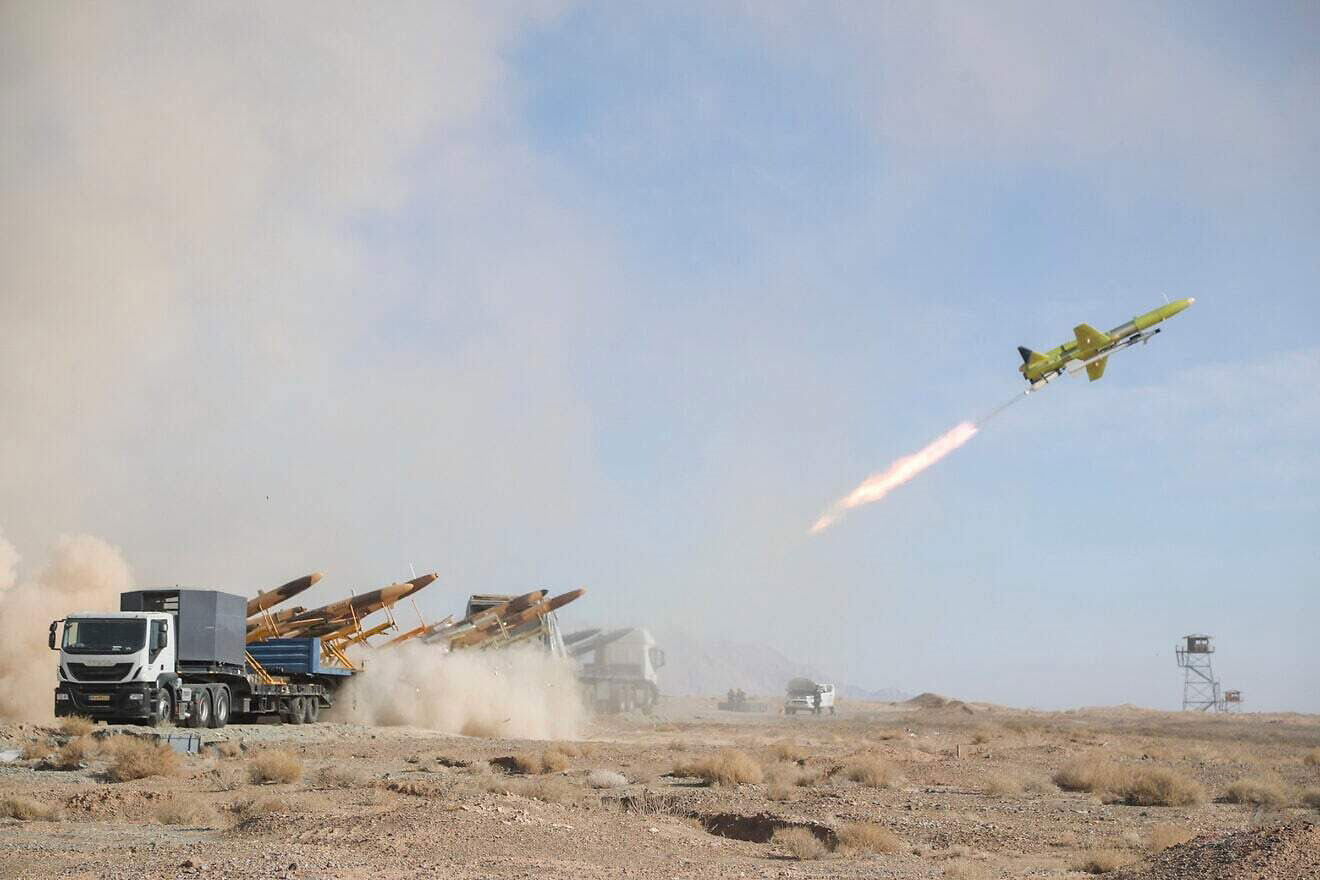
An Iranian military drone exercise in the Semnan desert, Jan. 7, 2021
(JNS) — Saudi Arabia’s government on Mar. 2 shut down the Ras Tanura refinery, one of the Middle East’s largest with a capacity of 550,000 barrels per day, following a drone attack from Iran. It marked an escalation in the regional spillover of the military conflict between the Islamic Republic and the U.S.-Israel alliance.
At the time of the shutdown on Mar. 2, which Saudi authorities were quoted as calling precautionary, none of the region’s countries had declared taking offensive action against Iran, despite repeated strikes by Iran on targets with strategic and symbolic significance.
The drone strike that triggered the shutdown was one of many strikes that Iran launched against at least six of its neighbors besides Israel and Saudi Arabia: Bahrain, Iraq, Jordan, Kuwait, Qatar and the United Arab Emirates. Iranian state media said the strikes were against U.S. bases in those countries, but other targets were also hit.
Most oil production in Iraqi Kurdistan, which in February exported about 200,000 barrels per day to Turkey, was shut down over the weekend as a precaution, Reuters cited field operators as saying.
In Kuwait, the defense ministry said “several” U.S. aircraft had crashed, resulting in no casualties. Footage from Kuwait that CNN had localized to that country showed a pilot parachuting near a crash site.
Explosions have been heard in Gulf cities, including Dubai and Abu Dhabi in the UAE, and Doha in Qatar, CNN reported. On Mar. 1, the Zayed Port in Abu Dhabi, the UAE, was hit, resulting in a large fire.
The UAE suspended diplomatic relations with Iran and recalled its ambassador from there in connection with strikes in its territory, in which at least one person died Saturday, its government said.
On Mar. 1, Saudi Arabia summoned Iran’s ambassador to the kingdom to its foreign ministry, the Saudi News Agency reported. Saudi Deputy Foreign Minister Waleed Elkhereiji conveyed the kingdom’s “strong dissatisfaction and condemnation of the attacks,” the Saudi Press Agency reported, and said that Riyadh would “take all necessary measures to defend its security and protect its territory.”
Majed Al Ansari, a spokesperson for Qatar’s Ministry of Foreign Affairs, told CNN on Monday that Iranian projectiles targeted civilians and civilian infrastructure, including an airport, and “not only American bases.” About 20 people have been injured from this in Qatar, he said.
Bahrain, Jordan, Kuwait, Qatar, Saudi Arabia, the United Arab Emirates and the U.S. on Mar. 2 released a joint statement “on Iran’s missile and drone attacks in the region.”
“The Islamic Republic’s actions represent a dangerous escalation that violates the sovereignty of multiple states and threatens regional stability. The targeting of civilians and of countries not engaged in hostilities is reckless and destabilizing behavior,” they said.
The statement condemned “Iran’s indiscriminate and reckless missile and drone attacks against sovereign territories across the region.”
Drones were intercepted in or near the Ras Tanura facility, starting a fire from interception debris, the Saudi News Agency quoted the defense ministry as saying. Nobody was hurt in the incident but the interception debris caused a fire, the report said. Online videos from the site showed thick black smoke rising after the attack.
On Mar. 1, Hezbollah, Iran’s proxy terrorist army in Lebanon, joined the fighting and fired rockets into Israel for the first time since Israel forced Beirut in November 2024 to accept a ceasefire under terms that stripped the group of much of its forward deployment. Israel struck targets in Lebanon in response to the strikes, which were not reported to have resulted in loss of life or major damage.