
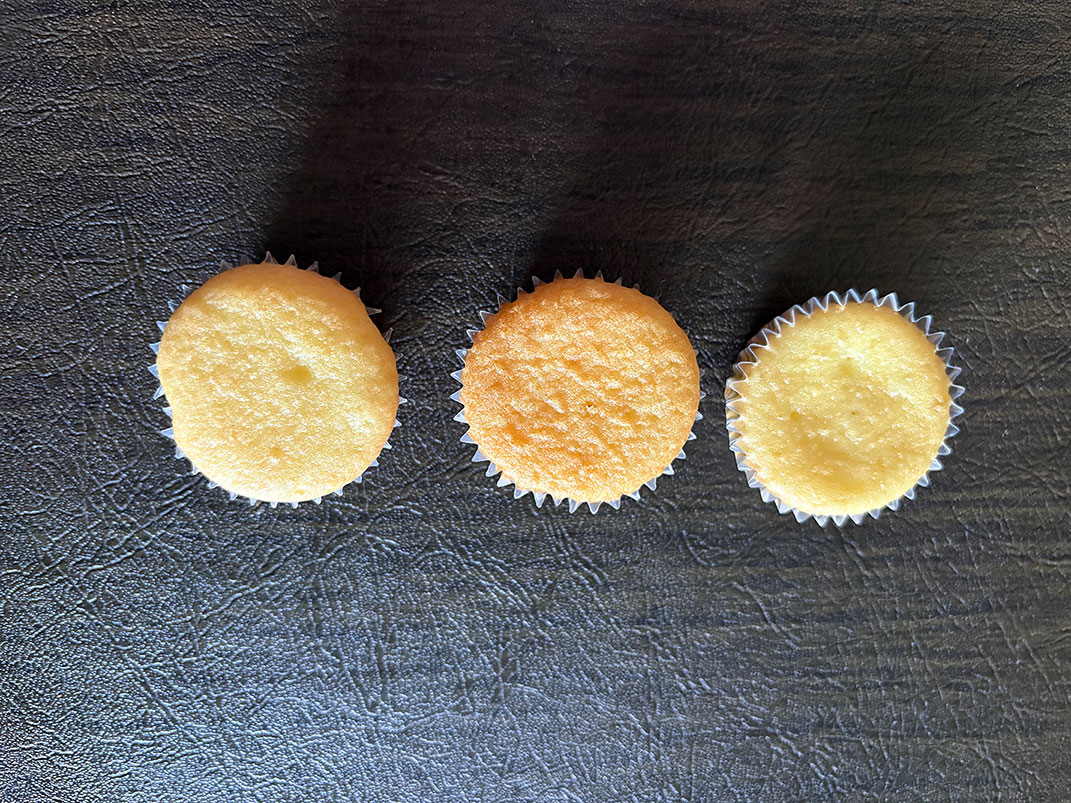
Cupcakes — left to right — made with tofu, a baking powder mixture, and seltzer
The egg is an enduring symbol in the Jewish religion. It is the beytzah on our Passover tables. It’s mentioned in the Talmud as a symbol of mourning. It also represents fertility, rebirth and new beginnings. Eggs give challah its traditional yellow hue and add creaminess to your Bubbe’s kugel. But oy, what a rollercoaster the price of eggs has been this year! One of the most versatile, inexpensive and parve proteins around has undergone remarkable price swings this year, suddenly become something we may find ourselves thinking twice about buying.
You may recall back in 2015 when egg prices spiked due to a bird flu outbreak. That increase was brief — nothing like the extended rise we saw this year. According to the U.S. Bureau of Labor Statistics, the average price of a dozen eggs reached an all-time peak of $6.23 in March. Last year the price was less than $2. Hopefully, we won’t revisit March’s record highs, but with current prices hovering around $2.80 a dozen, prices are almost back to “normal.”
A few months ago when egg prices were still very high, I wondered: is there a suitable and affordable alternative to eggs? I suppose if you’re vegan, this is an ingredient you’re already used to substituting. For me, it was unfamiliar territory. A little research led me to the University of Maine Cooperative Extension’s guide on egg substitutes for baking and cooking, and to the website for the Asthma and Allergy Foundation of America, which offers helpful suggestions for kids with egg allergies.
Don’t get me wrong, I would never suggest you give up eggs entirely. For recipes that rely heavily on eggs — say, three or more in a batch — you will certainly notice a difference if you try to replace all of them. But these substitutes can be helpful if you’re looking to cut grocery costs or lifesavers when you’re missing just one or two eggs. Who among us hasn’t found themselves halfway through a recipe, out of eggs and with no neighbor home to save the day?
I found nearly a dozen options for egg replacements and tested several to find out which ones work best and for what need. My rainy-day kitchen experiments focused on pancakes and cupcakes. Why? Because they’re simple, familiar, and rely on eggs for different functions: pancakes need structure and binding, while cupcakes benefit from binding and lift.
For pancakes, I tested mashed banana and full-fat plain Greek yogurt. I made two batches of batter where everything was the same except for the egg substitutes. Each pancake was 1/4 cup of batter to make them as identical as possible. Both yielded good results, but with noticeable differences. The yogurt pancakes were fluffy, tender on the inside, and slightly crispy on the outside. I honestly doubt most people could tell the difference between these and traditional pancakes. A thoroughly mashed banana has the same consistency as a beaten egg, so I assumed the texture of the pancakes made with banana would be very similar to those made with egg. While these pancakes were tasty and moist, they were softer and slightly thinner due to the banana’s higher moisture content. Unavoidable, of course, was the banana flavor being very present. If you want a more traditional pancake, use the Greek yogurt. Banana pancakes were often a weekend treat when our kids were young, so I like this option. (I think applesauce would work well here also, although I didn’t test it.) If you’re using a pre-made pancake mix, it will already have a leavening agent in it, so your pancakes should still be fluffy no matter which you use.

The top pancakes were made with plain Greek yogurt, bottom with mashed banana. Banana pancakes spread more and were thinner than the yogurt pancakes
For cupcakes, I tested seltzer, blended silken tofu, and a mixture of oil, water, and baking powder. I chose to use a boxed cake mix for this experiment, thinking that most of us would be more willing to use a substitute in a boxed mix rather than in a made-from-scratch recipe. The differences were more dramatic here. The silken tofu produced the best-structured cupcakes that held up after baking and even the next day. The seltzer cupcakes were soft and light but lacked structure, making them prone to crumbling. These were very hard to get out of the cupcake liners in one piece. The oil-water-baking powder mix browned faster and had a tendency to fall apart, too. My recommendation? Use blended tofu for boxed mixes and save the seltzer or baking powder mixture for scratch cakes where you can better control the other ingredients.

Left to right — Tofu, baking powder, and seltzer cupcakes cut down the middle
Here’s a useful price comparison for several egg substitutes, based on prices from my local Kroger as of June 2025:
(for reference, one Grade A large egg = 24 cents)
1/4 cup plain Greek yogurt = 32 cents
1/4 cup silken tofu = 28 cents
1/4 cup applesauce = 25 cents**
1 tablespoon chia seeds + 3 tablespoons water = 21 cents
1 1/2 tablespoons vegetable oil + 1 1/2 tablespoons water + 1 teaspoon baking powder = 14 cents*
1/4 cup mashed banana = 11 cents**
1/4 cup seltzer = 6 cents*
1 tablespoon ground flaxseed + 3 tablespoons warm water = 5 cents**
* Use when leavening is needed (University of Maine Cooperative Extension)
** Use when binding is needed (Asthma and Allergy Foundation of America)
So, whether you’re trying to save a little money or just don’t want to run back to the store, there are solid egg-free options that can work beautifully in a pinch — or even on purpose. And these substitutions are not just for cakes. A traditional Jewish dish that tends to be egg-heavy is kugel, with many recipes having as many as six eggs. Believe it or not, there are delicious, satisfying kugel recipes that don’t contain any eggs at all. I have recipes for potato and noodle kugel to share with you. Give them a try and let me know what you think! Until next month — from my kitchen to yours!
Please send feedback or suggestions to recipes@americanisraelite.com.
Egg-Free Noodle Kugel
You won’t miss the eggs since ricotta adds creaminess. You can use regular egg noodles in this recipe if you’re only avoiding egg as an ingredient.
Ingredients:
1 16 oz package wide egg-free noodles
1/4 cup unsalted butter
16 oz sour cream
16 oz ricotta cheese
1/2 cup sugar
1/2 cup golden raisins (optional)
1 teaspoon cinnamon
1/2 teaspoon vanilla
Salt
Directions:
Preheat oven to 350°F.
Cook noodles according to package and drain.
Put hot noodles in a 3-quart baking dish. Add the butter an stir until melted and evenly coated.
In a medium bowl, combine all remaining ingredients and mix. Add this to the buttered noodles and mix until evenly blended.
Bake for about 45 minutes to an hour, until the top is browned.
Egg-Free Potato Kugel
If you’re not comfortable with the method of pouring oil into a hot dish, just make sure you grease your baking dish thoroughly.
Ingredients:
3 pounds russet potatoes, peeled if desired and coarsely grated
1 large white or yellow onion, peeled and coarsely grated
4 tablespoons freshly ground flaxseed + 6 tablespoons water
1/2 cup potato starch (or cornstarch)
3 teaspoons nutritional yeast
1 1/2 teaspoons sea salt
Freshly cracked black pepper, to taste
3 teaspoons coconut oil or high-heat oil of choice
1/2 teaspoon each, garlic and onion powder
Pinch of sea salt
Directions:
Place a 16×9 inch baking dish in the oven and preheat to 400°F (ceramic or metal pan recommended, not glass.)
In a small bowl, mix the ground flaxseed and water and let sit.
Wash, peel (if you like), and grate your potatoes, either with a food processor or a box grater using the large size holes. Also grate the onion in the same way. Squeeze excess water out of potatoes and onion in a colander.
In a large bowl, combine grated potatoes, grated onion, and flaxseed mixture and mix well with your hands. Rinse your hands, then add the potato starch, nutritional yeast, sea salt, and black pepper and again mix well with your hands.
In a small bowl, mix the coconut oil, garlic powder, onion powder, and pinch of salt. Be careful during this next step, the oil may splatter. Carefully take the pan out of the oven and quickly pour the mixture over. Use a silicone basting brush or spatula to quickly and carefully spread the mixture over the pan. (If you didn’t preheat with the pan in the oven, add the mixture now, then add the potato mixture. Bake for 10 minutes longer than indicated below.)
Immediately add the potato mixture, it will also sizzle. Use the back of a wooden spoon to press the mixture evenly and firmly into your pan. Put the pan back into the oven.
Bake uncovered for 40-45 minutes until the top is nicely browned. You can broil 5 minutes after if you’d like a browner top. If you notice the top burning before the 45 minutes is up, cover it with foil so the top doesn’t burn before the inside is fully cooked.
Serve topped with parsley, sour cream, or anything else you like. Refrigerate leftovers in an airtight container up to 5 days.