
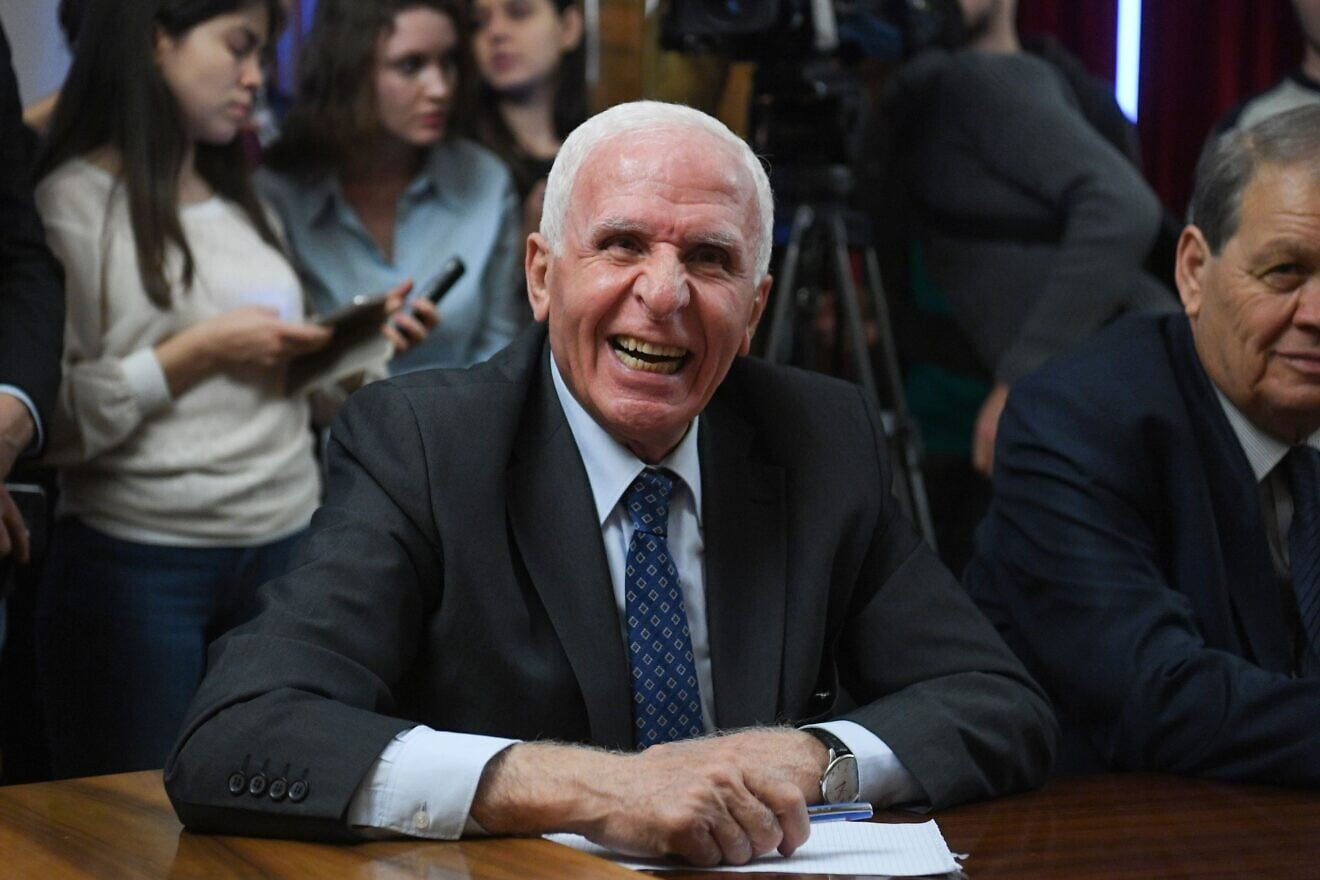
Courtesy of JNS. Photo credit: Kirill Kudryavtsev/AFP via Getty Images
Fatah official Azzam al-Ahmad attends a meeting with Russian Foreign Minister Sergey Lavrov and representatives of Palestinian terror groups in Moscow, Feb. 12, 2019
(JNS) — Azzam al-Ahmad, the secretary-general of Mahmoud Abbas’s Palestine Liberation Organization, on Feb. 23 declared that the PLO opposes the disarmament of Hamas, which he said was “not a terror organization.”
In an interview with Egypt’s Al Shorouk newspaper, al-Ahmad slammed U.S. demands that the terrorist organization that led the Oct. 7, 2023, massacre disarm and cede its power in Gaza.
“They don’t want Hamas to have any role in the Strip,” explained the veteran official in Abbas’s Fatah Party, adding: “We completely reject this, because Hamas is part of the Palestinian national movement.”
Though Hamas has “not yet” joined the PLO, the body has held a “continuous national dialogue with them in order to fulfill the requirements for their entry into the organization,” he said.
The PLO, recognized worldwide as the representative of the Palestinian people, sets overall policy through its Executive Committee, headed by al-Ahmad. It also appoints the leadership of the Palestinian Authority, which administers limited self-rule in parts of Judea and Samaria.
Al-Ahmad stressed Feb. 23 that the PLO has “always rejected decisions issued by international institutions or governments to classify [Hamas] as a terror organization, as they are part of the Palestinian national fabric.”
“Everything that is said about disarming Hamas and that it is a terrorist group is rejected by us; Hamas is not a terror organization,” he added.
Hamas’s Oct. 7 massacre was a “strategic mistake that inflicted immense damage on Gaza, and we paid a heavy price,” he emphasized.
According to the secretary-general, the PLO has held talks with the goal of having Hamas and Islamic Jihad — the Iranian terror subsidiary that is the second-largest faction in Gaza — join the body in the near future.
Al-Ahmad said he had also been negotiating with the Popular Front for the Liberation of Palestine (PFLP) following the Marxist terror group’s 2018 decision to boycott meetings of the PLO Executive Committee.
“We have begun … with the comrades in the Popular Front, and made significant progress with them so that they’ll return to engagement. An agreement has also been reached with the Democratic Front,” he said.
The PFLP and the DFLP are terror groups that have murdered and maimed many hundreds of Israelis and Americans since the 1960s.
Regarding American demands that the Palestinian Authority reform its education system and remove incitement against Jews and their state, al-Ahmad told Al Shorouk, “We will not allow them to be modified.”
“What they are calling for is fabricated reform, and we tell them that we have minds and educated people more than you do, and we have more scholars than they do — some of whom America relies upon,” he said.
The PLO official also expressed pride that members of the P.A. police have carried out terrorist attacks against Israelis, adding: “We challenge anyone who says that the security services are pursuing resistance fighters.”
The Israeli Prime Minister’s office and the U.S. State Department did not immediately respond.
Nickolay Mladenov, who serves as the high representative for the Gaza Strip on behalf of U.S. President Donald Trump’s Board of Peace that oversees the truce, last week established a liaison office with the Palestinian Authority.
The liaison office will ensure “that communications can be received and conveyed through a clear institutional process” and that “all aspects of transitional administration, reconstruction, and redevelopment in the Gaza Strip are carried out with integrity and effectiveness,” he stated.
Mladenov’s announcement was welcomed by P.A. deputy chief Hussein al-Sheikh, who urged the implementation of Trump’s peace plan and U.N. Security Council Resolution 2803, which adopted the proposals.
Several top Hamas leaders, including Khaled Mashaal and Musa Abu Marzouk, have rejected key parts of the peace plan in recent weeks, including disarmament, despite having agreed to it in October.