Courtesy of JNS. Photo credit: STR via Flash90
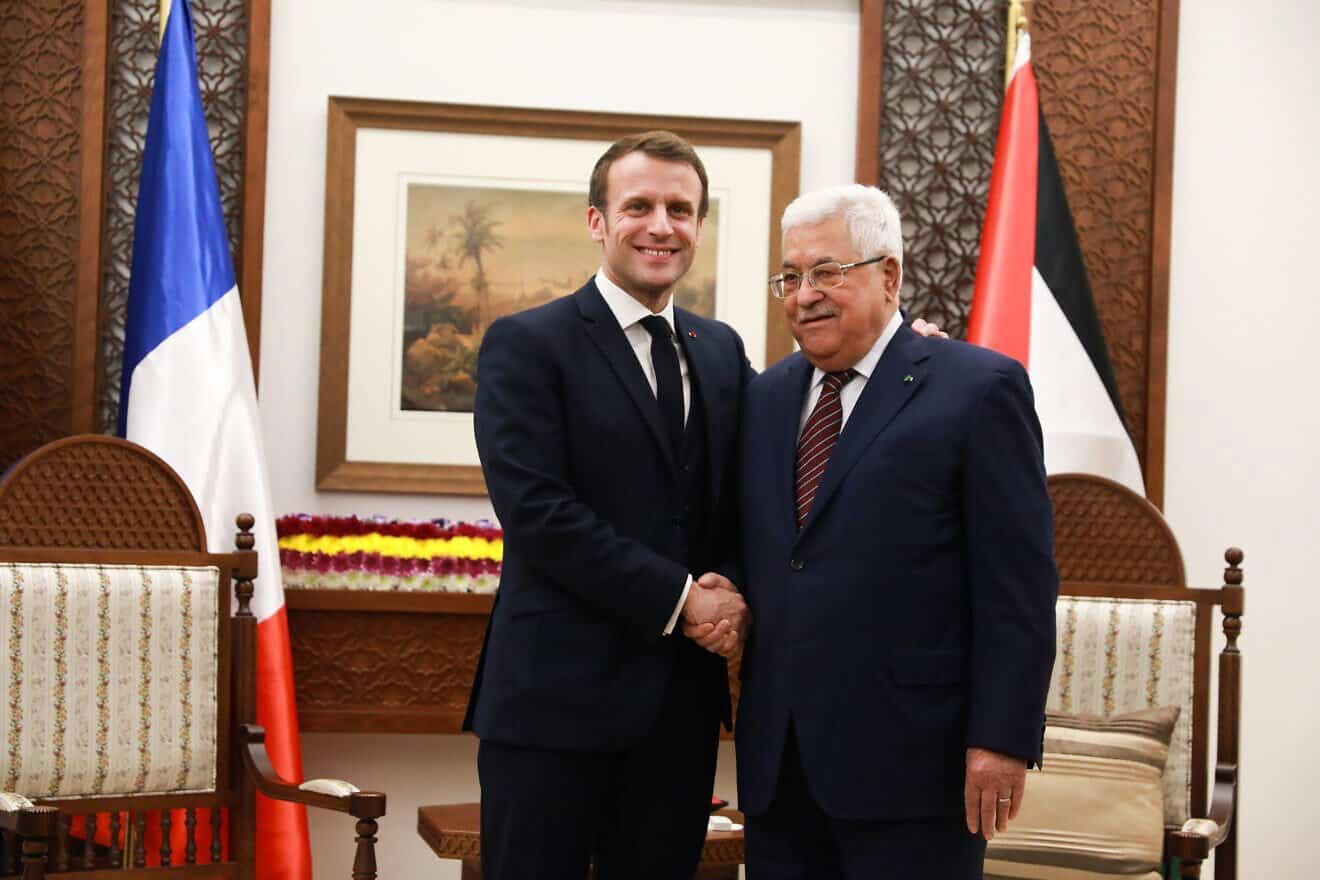
Palestinian Authority leader Mahmoud Abbas hosts French President Emmanuel Macron in Ramallah, Samaria, on Jan. 22, 2020
(JNS) — The European Union is changing its approach toward the Palestinian Authority. In a meeting with senior P.A. officials toward the end of last month, senior E.U. officials who are friendly to Israel raised the issue of the P.A.’s violation of agreements regarding continued payments to terrorists, and demanded that they stop transferring funds to those who carried out attacks against Israelis and Jews.
During discussions in Brussels ahead of the meeting of the Palestine Donor Group, in which many European countries participate, the P.A.’s progress in implementing the structural reforms it committed to was examined.
During the discussions, several E.U. representatives confronted P.A. representatives with evidence that they continued to transfer funds to terrorists through alternative channels, and expressed dissatisfaction with the violation of the commitment.
The officials stressed that the transfer of some of the funds sent to the P.A. is conditional on fulfillment of Palestinian commitments to stop paying salaries and stipends to terrorists and their families. The P.A. once more promised in February to stop the flow of funds to terrorists and their families, but in recent months, it has been reported that payments were transferred by alternative means.
In Israel, it was further revealed that the P.A. changed the payment mechanism to one based on socioeconomic criteria, rather than on the number of years of imprisonment, as was the case in the past. This change led to the cessation of payments to some terrorists in prisons, but not to all, and thus continued payment to terrorists and their families.
The E.U., which is the largest financial donor to the P.A., has conditioned its financial support, amounting to hundreds of millions of euros per year, on the implementation of comprehensive reforms in the P.A. The E.U. awarded the P.A. a grant of between €1.2 billion and €1.6 billion (between $1.4 billion and $1.87 billion) for the years 2025-2027, subject to the gradual implementation of reforms, whose main focus is fighting corruption and building stable and proper governance.
The conditions of E.U. aid include a Palestinian commitment to stop paying salaries and stipends to terrorists as a reward for attacks they carried out, as well as stopping incitement in textbooks that the P.A. distributes to Palestinian educational institutions. In recent months, it was revealed in Israel Hayom that Palestinian textbooks continue to incite against Israel and Jews, and encourage terrorism.
The P.A. prefers to postpone the implementation of the education reform to next year, although, after it became clear that it is not keeping its promises, pro-Israel officials in the E.U. are expected to increase the pressure for change.
In response to the accusations against them, senior P.A. officials claimed that in January, the new payment system was supposed to be implemented, which would create transparency, and payments to terrorists would stop. The P.A. also fired the finance minister after accusing him of transferring the funds.
According to a spokesperson for the European Commission, the step the Palestinians took to stop payment to terrorists “was a step forward and marked the P.A.’s commitment to implement far-reaching reforms. However, we understand that a payment was recently made to prisoners’ families under a previous plan. We very much regret this decision, as it appears to contradict previous statements.
“We requested clarifications on the matter from the P.A., and the Committee for the Promotion of Palestinian Policy provided the opportunity to discuss the matter openly. The P.A. reaffirmed its commitment to fully implement the Social Protection Law and also confirmed that a contract has been signed for an audit of the new payment system, which is expected to begin in January. Within this framework, verification will be carried out to assess that there are no parallel payment programs and to provide evidence that the system is now based only on genuine needs,” the spokesperson said.