Courtesy of JTA. Photo credit: Robin van Lonkhuijsen/ANP/AFP via Getty Images
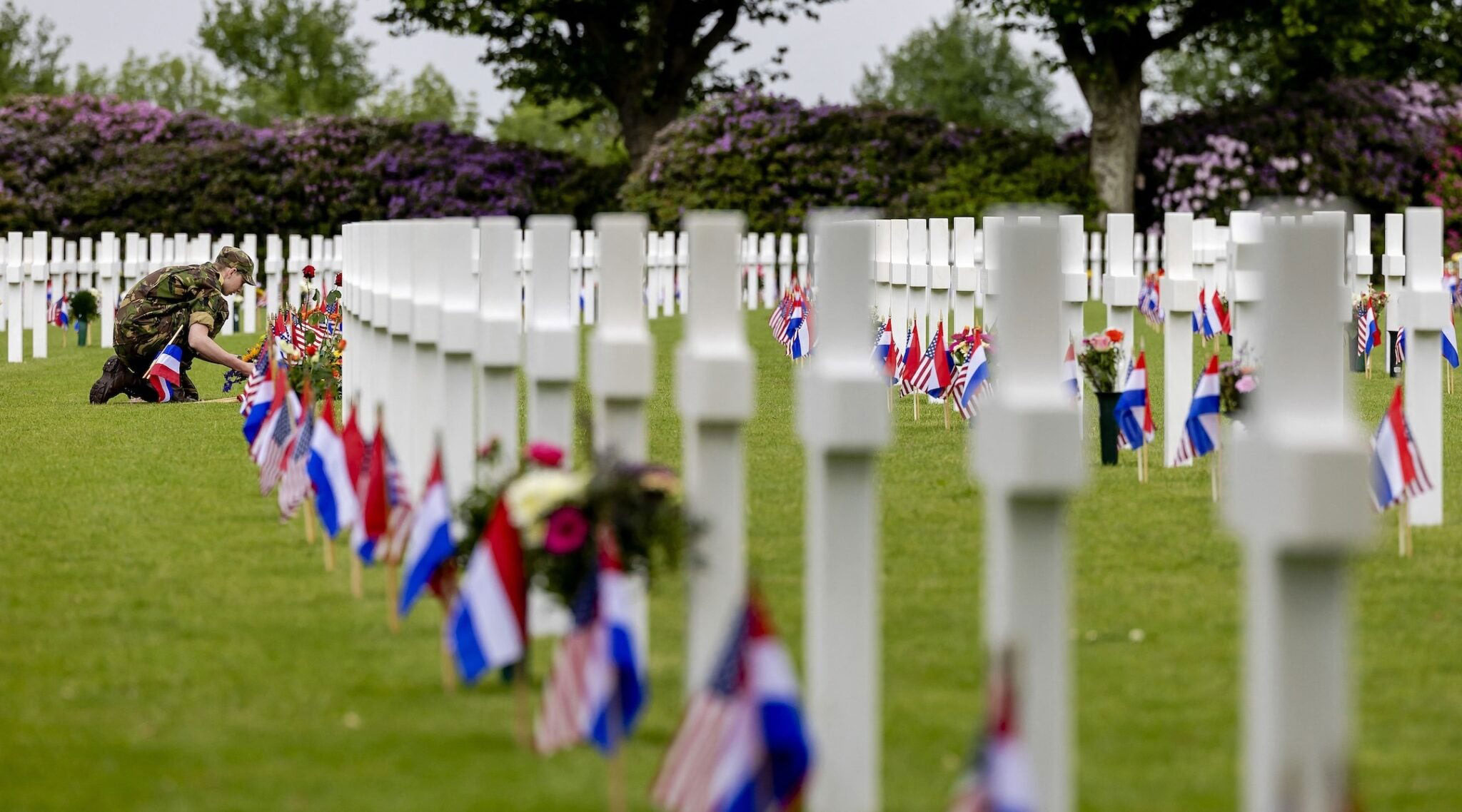
A soldier makes final preparations before the annual Memorial Day commemoration at the American cemetery in Margraten, on May 29, 2022
(JTA) — When visitors and local researchers in the Netherlands realized earlier last month that two panels honoring Black American soldiers who helped liberate Europe from the Nazis had disappeared from the U.S. military cemetery at Margraten, the reaction was swift.
Local officials demanded explanations, historians raised concerns, and the story quickly spread through Dutch and international media. The country’s leading Holocaust museums and World War II memorial centers issued a joint letter urging the United States to restore the displays, and more than 30 members of the U.S. Congress sent their own letter seeking answers.
But the explanations publicly offered were only partial. The American Battle Monuments Commission, which manages Margraten and all overseas U.S. military cemeteries, said the exhibits were simply part of a routine rotation in a limited visitor-center space. Officials did not directly address why one of the removed panels — the one explaining that the U.S. Army was segregated during World War II and describing the racism Black soldiers faced at home — had been taken down.
Now, internal emails obtained by the Jewish Telegraphic Agency through a Freedom of Information Act request reveal, for the first time, how the decision unfolded inside the agency. They show that the head of the monuments commission at the time, Charles Djou, was closely monitoring a flurry of executive orders issued by President Donald Trump after his return to the White House.
The records indicate that Djou hoped to keep his small agency out of Trump’s crosshairs and moved quickly to avoid attracting negative attention from the new administration.
On March 19, the day Trump signed an executive order banning foreign-facing agencies from promoting what he called “discriminatory equity ideology,” Djou instructed his staff to ensure the monuments commission was in full compliance, even though, he noted, the order didn’t specifically apply to the agency.
Under the subject line, “Foreign DEI,” Djou asked whether the agency’s internal databases cataloging fallen African-American and Native American troops could now pose a problem, and whether any displays at overseas visitor centers might “get us in trouble.”
One exhibit in particular drew his concern: a panel at the Netherlands American Cemetery and Memorial, where more than 8,000 Americans who helped liberate Europe from the Nazis are buried. Installed the previous year, the panel explained that the U.S. military was segregated during World War II and highlighted the Black troops who fought both the Germans abroad and racism at home.
A senior staffer replied that he had already scrubbed the agency’s website of potentially noncompliant material and warned that the Margraten panel was indeed “a problem.” Djou’s deputy, Robert Dalessandro, went further: “I agree on the Netherlands. That panel should go. Frankly, it never should have been there in the first place.”
Djou ordered the panel removed “to avoid raising any ire of the administration.” In a follow-up email, he suggested keeping it in storage at least until “a new admin in 2029.”
The proactive maneuvering reflected the atmosphere of the moment, as Trump overseers replaced agency heads and purged federal agencies of perceived ideological disloyalty. And Djou may have felt especially vulnerable. He was not just a holdover from the previous administration — he was a former Republican who had publicly criticized Trump for years and ultimately endorsed Joe Biden in 2020.
But Djou’s efforts to comply with the administration’s agenda didn’t save him. Just weeks after the panel came down, Djou was out of the job.
“We had a secretary who was appointed by Biden, and fearful that he was going to lose his job, so he over-complied whenever he could, so he didn’t draw attention, and that’s just a fact, and that was a problem,” Dalessandro, who became the acting head of the agency after Djou’s departure, said in an interview.
Djou didn’t respond to a request for comment.