Courtesy of JTA. Photo credit: Satellite image (c) 2025 Maxar Technologies
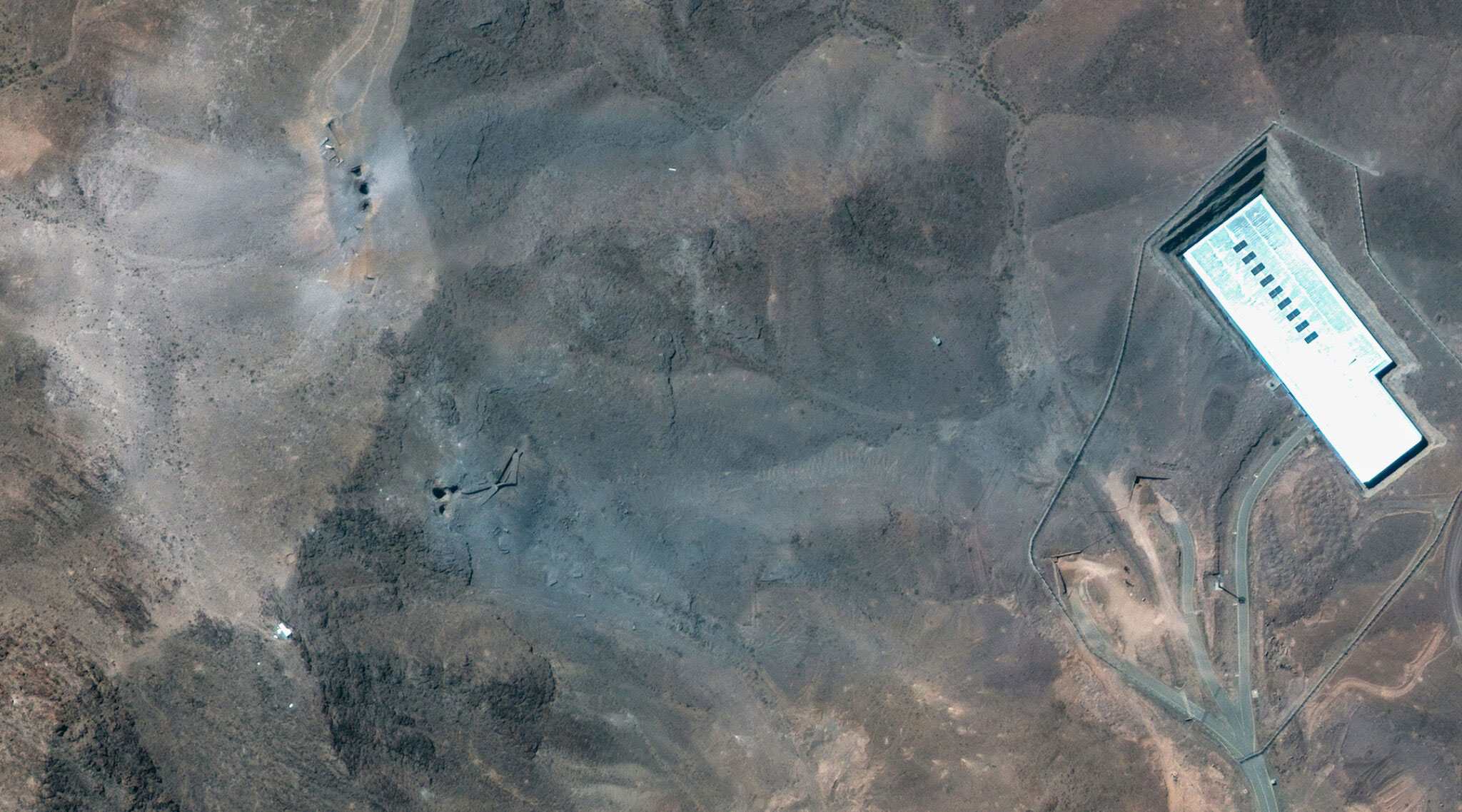
Maxar Satellite Imagery shows the ridge above the Fordow complex in Iran post-strike; multiple impact craters and a wide grey-blue ash layer are visible across the ridge, suggesting direct hits to the overburden covering the underground facility
(JTA) — As Iran and Israel enter a ceasefire following 12 days of heavy bombardment between the countries, the leaders of Israel and the United States are hailing the strikes on Iranian nuclear facilities as a victory.
But as the smoke clears, some experts are questioning the extent of the damage to Iran’s nuclear program.
An assessment by the Defense Intelligence Agency, first reported Tuesday by CNN, showed the Saturday night strikes by U.S. bombers on Iranian nuclear sites did not “obliterate” the country’s nuclear enrichment program, as President Donald Trump claimed, but instead set it back “a few months.”
“So the [DIA] assessment is that the U.S. set them back maybe a few months, tops,” one anonymous source briefed on the report told CNN. Another individual told CNN that Iran’s centrifuges, which are used in the enrichment process, are largely “intact.”
Trump and his allies pushed back hard against the assessment by the DIA, an intelligence agency within the U.S. Department of Defense, with Trump saying Wednesday that the report was inconclusive.
“The intelligence says, ‘We don’t know, it could have been very severe’ — that’s what the intelligence says,” Trump told reporters as he attended meetings at a NATO summit.
“The original word that I used — I guess it got us in trouble, because it’s a strong word — it was ‘obliteration.’ And you’ll see that — and it’s going to come out. Israel is doing a report on it, I understand. And I was told that they said it was total obliteration,” Trump said.
The conflict began on June 13 with Israel carrying out strikes on Iranian nuclear sites and targeting the country’s leading nuclear scientists. On Saturday, the United States entered the conflict, bombing three key nuclear sites in Iran — Fordow, Natanz and Esfahan.
In an address following the United State’s strikes, Trump stated that “Iran’s key nuclear enrichment facilities have been completely and totally obliterated,” and the two countries entered a ceasefire announced by Trump Monday evening.
Israeli Prime Minister Netanyahu also hailed the success of the military campaign, saying in a video address that U.S. forces had “destroyed” the underground Fordow enrichment site and that “we sent Iran’s nuclear program down the drain.”
On Wednesday, the White House published a statement attributed to the Israel Atomic Energy Commission the stated that Iran’s ability to develop a nuclear weapon had been pushed back “by many years.”
“The devastating U.S. strike on Fordow destroyed the site’s critical infrastructure and rendered the enrichment facility inoperable. We assess that the American strikes on Iran’s nuclear facilities, combined with Israeli strikes on other elements of Iran’s nuclear program, have set back Iran’s ability to develop nuclear weapons by many years,” read the statement. Netanyahu’s office released an identical statement one hour later.
In the wake of the United State’s strikes, Iran’s Atomic Energy Organization confirmed their validity, but said the strikes would not stop Iran from advancing its nuclear program.
White House press secretary Karoline Leavitt told CNN in a statement that the reported DIA assessment was “flat-out wrong,” adding that “everyone knows what happens when you drop 14 30,000 pound bombs perfectly on their targets: total obliteration.”