
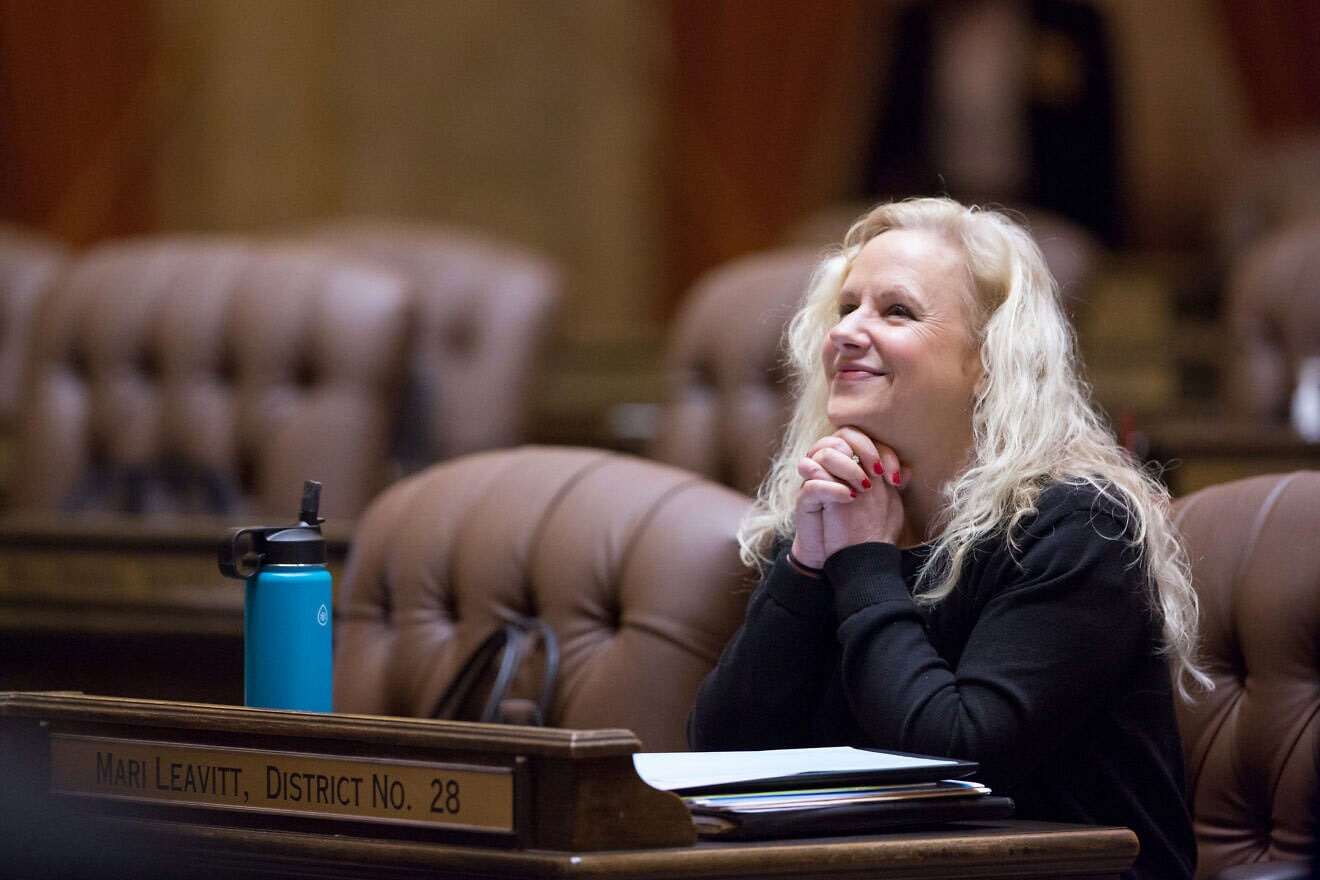
Courtesy of JNS. Photo credit: Courtesy
Washington state representative Mari Leavitt, a Democrat
(JNS) — Washington state representative Mari Leavitt, a Democrat, is advancing a bill that would require organizers to seek permission from universities 21 days before setting up protest encampments on campuses and would hold unauthorized groups liable for damages and the costs of removing encampments.
HB 2589 had a first reading on Jan. 20, and on Jan. 28, the state House Committee on Postsecondary Education and Workforce heard a public reading. It is scheduled to be discussed in an executive session of the committee on Feb. 3.
The bill states that “no person or organization may use an institution of higher education’s campus to camp” and that “an institution may authorize or deny the encampment request based on the time, place or manner of the encampment.”
Leavitt, who is not Jewish, told JNS prior to the Jan. 28 reading that the legislation “doesn’t ban encampments on campus.”
Institutions have a right to ensure that first responders can enter an area, to determine where encampments can occur and to keep students and professors safe “to go about their business in the course of the work that they’re there for,” she told JNS.
“I hope the impact for Jewish students will be the same as for all students,” the lawmaker said. “That students feel safe and welcome to be on campus and navigate around campus in a safe way and not be impeded.”
Codifying the law will help institutions make determinations of what’s best for their campuses and “for Jewish students and other students who may not have felt safe on campus, I think for good reason,” Leavitt said.
The state representative asked the Council of Presidents, an association of the state’s six public, four-year colleges and universities, for advice and drew on feedback from the University of Washington, she told JNS.
Leavitt has supported the Jewish community and has stood against antisemitism vocally.
“I’ve spoken out because I think it’s the right thing to do,” she told JNS. “I did that when we had a place of worship for our Muslim community in my district targeted.”
“I have a large population of Jewish folks in my district, and certainly across Washington, and when I see individuals harmed in that manner, I get concerned,” she said. “Recognizing and protecting our communities is what we’re supposed to do as elected officials.”
JNS asked how she hopes her Democratic colleagues will receive the legislation. Leavitt said that she did not have time to find co-sponsors for the bill, but “I hope it’s received well.”
“This is not about a particular perspective. This is about institutions keeping their students safe, and I think everyone would want that,” she said. “It is in alignment with many policies across the state across institutions who have time, place and manner restrictions.”
‘Increase in violence, harassment’
StandWithUs stated on Jan. 26 that the bill “simply provides clear, neutral rules that give universities more oversight to ensure that the learning environment remains safe and accessible to all students at all times.”
“When encampments take over central spaces, other students lose access to places they rely on for learning and daily life,” stated the organization’s northwest division. It encouraged supporters to sign up to testify in favor of the bill at the Jan. 28 hearing.
According to the state House committee, 496 people signed up to testify at the hearing, 252 for the bill and 244 against it.
At the hearing, Leavitt said that “the impact of an encampment depends on the degree to which it disrupts study scholarship or free movement around campus.”
“Overnight camping and setting up tents on campus grounds are generally not considered protected speech under the First Amendment,” she said at the hearing.
Regina Sassoon Friedland, director of the American Jewish Committee in Seattle, told JNS that only student groups in good standing with the university can apply to set up an encampment.