Courtesy of JNS. Photo credit: Knesset website
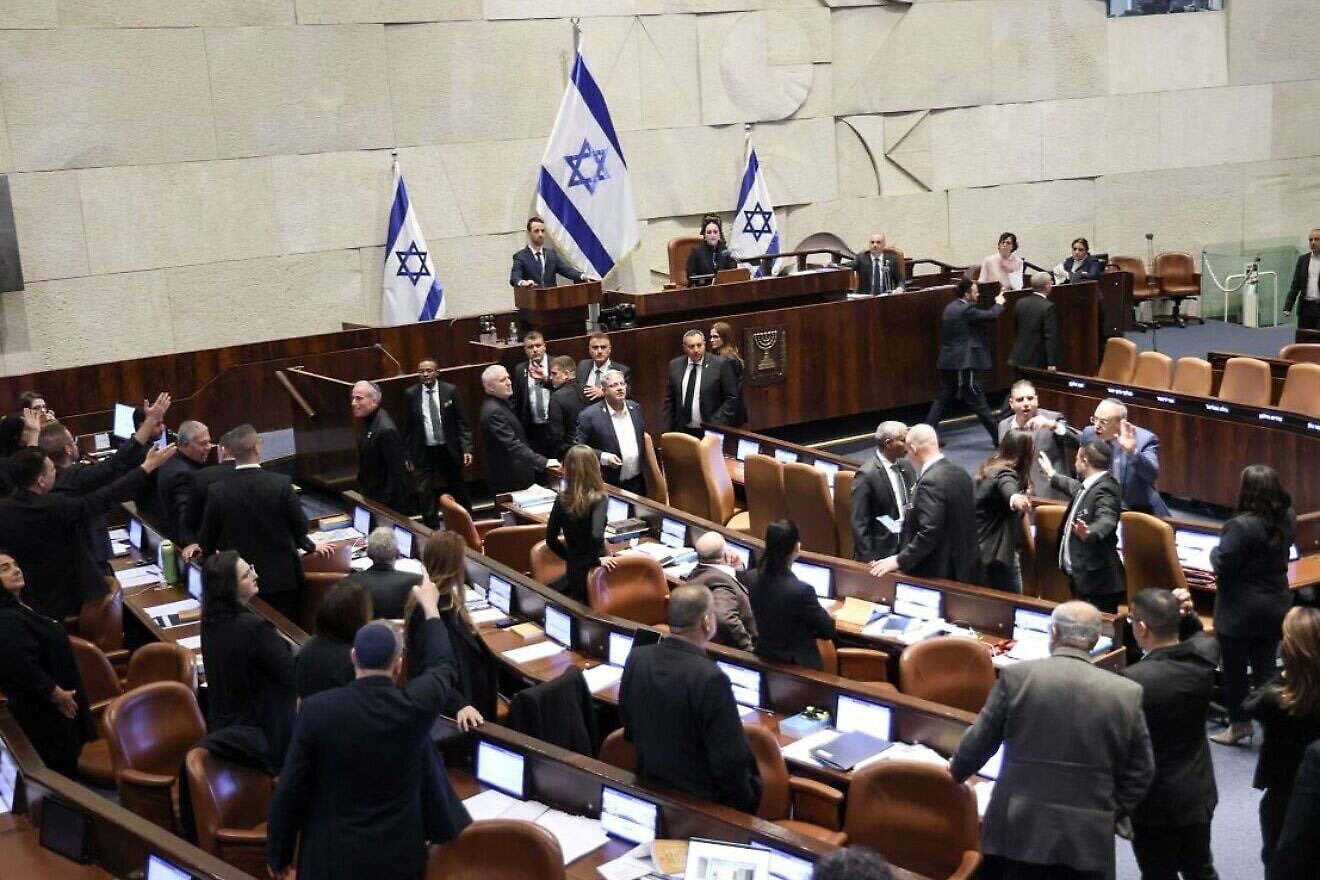
The Knesset debate during the first reading of a bill to establish a “special state commission of inquiry” into the events of Oct. 7, 2023, Dec. 24, 2025
(JNS) — The bill to establish a “special state commission of inquiry” into the Oct. 7, 2023, Hamas-led massacre passed a preliminary reading in the Knesset plenum on Wednesday, with a majority of 53-48.
“The people need a committee of the nation. Large segments of the people have no faith in the Supreme Court, and in particular in [Court President] Judge [Isaac] Amit. You want a commission of inquiry as a tool for political assassination — and it won’t happen,” said Likud MK Ariel Kallner, who proposed the bill, while addressing opposition members in the Knesset.
Typically, the president of the Supreme Court is called upon to appoint members of a commission of inquiry, as defined in the Commissions of Inquiry Law, which was enacted in 1968.
The Netanyahu government has insisted that such a commission would be biased, especially one whose members were chosen by Amit, who has a reputation as an anti-government, activist judge.
Kallner’s speech was interrupted throughout by catcalls from opposition MKs, who shouted “shame” and tore up copies of the bill in protest.
Opposition leader Yair Lapid of the Yesh Atid Party said from the Knesset podium: “The whole purpose of this proposal is to help the prime minister escape responsibility. He was prime minister on Oct. 7. Don’t dodge it.
“The opposition will not cooperate with this shameful farce. … In the first month of the next government, we will establish a real state commission of inquiry,” Lapid said.
According to the bill, a “special state commission of inquiry” would be established to examine the events of the October 2023 massacre, which will submit a report to the government. The report will also be made public.
The range of subjects of the investigation will be defined by the government, and it will be authorized to widen or reduce them at the request of the commission.
The committee will consist of six or seven members and will be established by way of agreement between the coalition and opposition factions, with the approval of a majority of 80 Knesset members.
The bill calls for the selection of three members by the coalition and three members by the opposition. It is to include experts in security, academia and law.
Four observers drawn from families of fallen soldiers will be appointed. They will be entitled to participate in deliberations, pose questions and submit written comments before the publication of the report.
The committee would be vested with all the powers granted under the Commissions of Inquiry Law. Its deliberations would be conducted in public and broadcast, except in cases where the committee decides to hold closed-door sessions.
Coalition members have compared the special commission to the one U.S. President George W. Bush created in late 2002 to investigate the attack on the Twin Towers in New York City on Sept. 11, 2001.
Kallner told Israel’s Channel 14 last week that the 9/11 Commission only had 10 members and is “considered one of the most successful committees in the history of investigative committees in the world.”
“Following the greatest disaster in our history, we are acting exactly as the United States acted after the greatest disaster in American history,” said Israeli Prime Minister Benjamin Netanyahu on Dec.22.