Courtesy of JTA. Photo credit: JTA photo
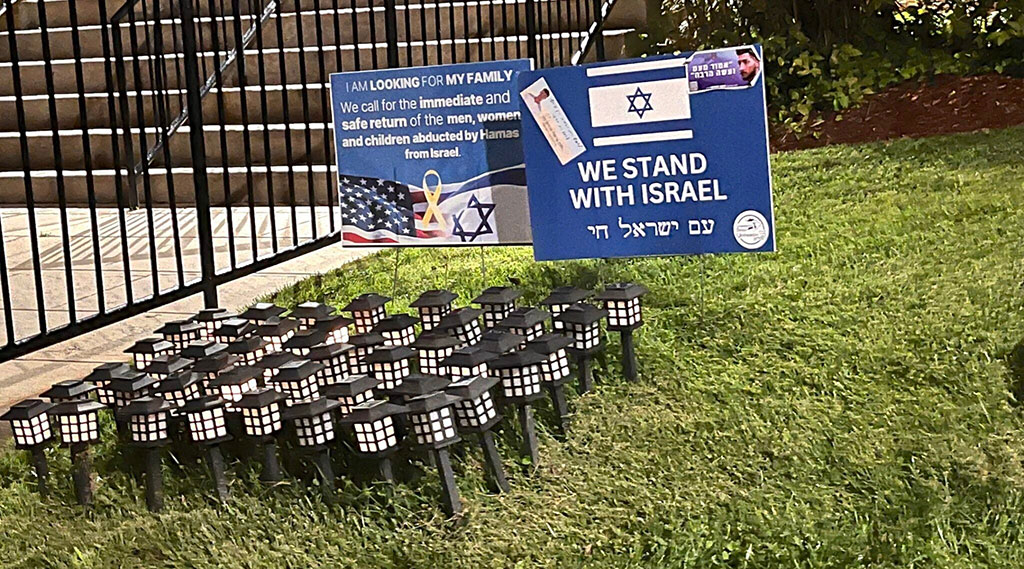
A synagogue in Teaneck, New Jersey displays lanterns representing the hostages still alive in Gaza and the bodies of those who are also slated to be returned under a deal between Israel and Hamas, Oct. 8, 2025
(JTA) — Jewish organizations across the ideological spectrum offered cautious optimism following the announcement of the first phase of a Gaza peace agreement, expressing profound relief at the planned return of hostages living and dead and tentative hopes that the plan might lead toward lasting regional peace.
As for what such a lasting peace might look like, only groups that have consistently advocated for a two-state solution offered a specific vision, putting their hopes in a solution that is implicit in the Trump administration’s 20-point peace plan, but which Israeli Prime Minister Benjamin Netanyahu rejects adamantly.
Nearly all the organizations noted that the war began with Oct. 7, 2023, and urged “vigilance” that Hamas would uphold its side of any agreement.
“This development represents a hopeful step toward resolving the conflict, securing the release of all hostages, and establishing the conditions for lasting peace and security in the region,” read a statement by Betsy Berns Korn and William C. Daroff, the chair and CEO, respectively, of the Conference of Presidents of Major American Jewish Organizations. “This moment demands unity, resolve, and the moral clarity to ensure that peace and security endure and every hostage returns home.”
Federations similarly welcomed the deal for its humanitarian implications, with the Jewish Federations of North America saying “our prayers are answered — not completely, for the pain of loss remains — but with the long-awaited promise of healing, renewal, and hope.”
The American Israel Public Affairs Committee said in its statement that it “applauds President Trump and his negotiating team for this tremendous achievement and for working together with Israel to broker this peace plan.”
AIPAC also framed the last two years as an affirmation of the “enduring partnership between the United States and our ally Israel,” despite cracks that showed during the Biden administration and to a lesser extent under Trump.
A lobbying group that tends to reflect the policies of the sitting Israeli government, AIPAC also spoke in brief of what some are calling “the day after,” saying that the peace deal “creates a tremendous opportunity to forge a better future for Israelis, Palestinians, and people across the Middle East.”
J Street did not mention the two-state solution in a statement by its president, Jeremy Ben-Ami. But Ben-Ami did urge the parties to take steps toward realizing the “full US-backed 20-point plan — one that ensures Israel’s security, ends Hamas’s reign of terror, delivers a massive surge of humanitarian aid and sets the region on a path toward a comprehensive and permanent peace.”
In the 19th point of its 20-point plan, the White House suggested that “the conditions may finally be in place for a credible pathway to Palestinian statehood.”
Other groups were more explicit in reiterating the two-state solution. The Israel Policy Forum, founded to advance the idea of two states, said it hoped the agreement might pave the way for “rekindled Israel-Arab diplomacy, a reformed Palestinian Authority with new, empowered, and legitimate leadership, an eventual expansion of the Abraham Accords that advances Israel’s integration in the Middle East, and the pursuit of a viable political horizon to the Israeli-Palestinian conflict based on two states.”
The Reform Movement, in a statement signed by the leaders of its rabbinical, congregational and seminary arms, also hoped the ceasefire would create the conditions for renewing a solution which the statement acknowledged “feels remote at this point.” Nevertheless, according to the statement, “a two-state solution in some configuration must remain the worthy, long-term goal for Israelis and Palestinians as they contemplate a future with safety, dignity and hope for all.”
While few right-leaning groups commented on the deal in the hours after its announcement, Religious Zionists of America-Mizrachi welcomed the news, calling it “a potentially hopeful step toward restoring calm and securing the release of Israeli hostages.”