
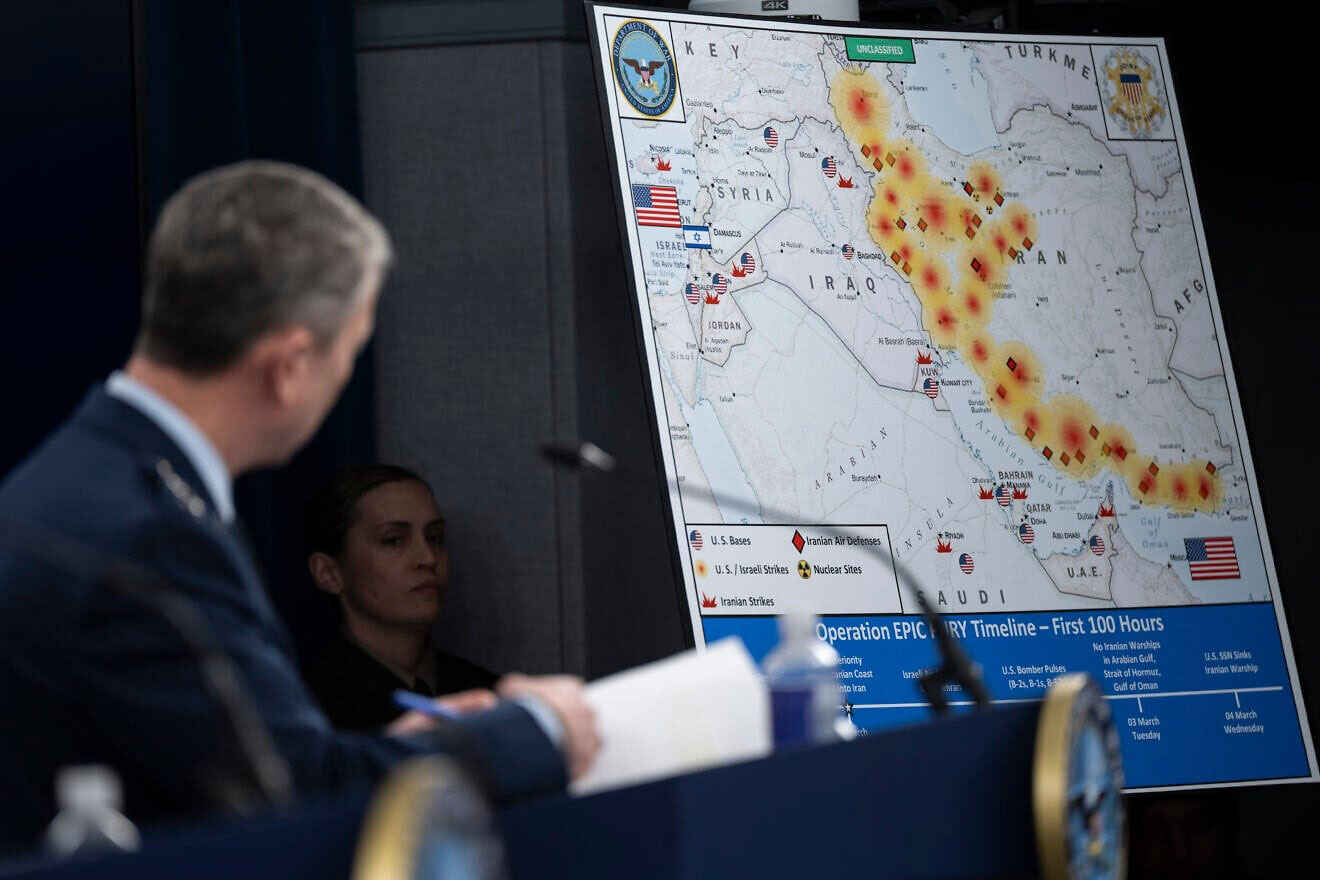
Courtesy of JNS. Photo credit: U.S. Navy Petty Officer 1st Class Alexander Kubitza/U.S. Defense Department
Defense Secretary Pete Hegseth (not pictured) and Chairman of the U.S. Joint Chiefs of Staff Gen. Dan Caine conduct a press briefing at the Pentagon on “Operation Epic Fury,” March 4, 2026
(JNS) — On the sixth day of the U.S.-American alliance’s operations in Iran, that country’s military capabilities are diminishing in key aspects as the democratic allies increase their strength, Israeli and American commanders of the operation said on Mar. 5.
The Israel Air Force struck dozens of missile launchers in Iran on Mar. 5 on its 113th wave of attacks since the operations’ launch Feb. 28, bringing the tally of neutralized Iranian launchers and ballistic defense arrays to about 300, the IDF Spokesperson’s Unit said.
Adm. Brad Cooper, commander of U.S. Central Command, said in a briefing at the Pentagon with Secretary of Defense Pete Hegseth that over the past 72 hours, U.S. bombers hit nearly 200 targets, including ballistic missile launchers and Iran’s equivalent of Space Command, while enemy missile attacks have dropped 90% and drone attacks 83% since the operation began.
“Our strikes against the Iranian Navy have intensified,” Cooper said. “We’re now up over 30 ships,” he said, referenced Iranian Navy ships sunk.
“And in just the last few hours, we hit an Iranian drone carrier ship roughly the size of a World War II aircraft carrier. As we speak, it’s on fire,” Cooper added.
“Our munition status only increases as our advantage increases,” said Hegseth, who spoke before Cooper. “Our capabilities — we have only just begun to fight, and fight decisively,” Hegseth said of the joint U.S.-Israeli operation, which the allies have codenamed “Epic Fury” and “Roaring Lion,” respectively.
The Israeli strikes have focused on central and western Iran, the IDF said. The strikes by the Israeli Air Force were on 200 targets, “including Iranian regime sites and ballistic missile launchers,” and in them “several Iranian terror regime operatives” had been targeted, the IDF statement said.
Hegseth said, “The amount of combat power that’s still flowing — that’s still coming — that we’ll be able to project over Iran is in multiples of what it currently is right now, when you add up our capabilities and those of the Israeli defense forces.
“Our munitions are full up, and our will is ironclad, which means our timeline is ours and ours alone to control as long as it takes, to ensure the United States of America achieves these objectives,” he added.
Cooper said, “We are fighting to win through combined U.S. and Israeli combat power. We will continue decimating Iran’s ability to project power outside its borders.”
Asked about what the U.S. is doing to help the Iranian opposition replace the ayatollah regime, Hegseth said both the U.S. and Israel are targeting regime individuals in charge of oppressing the population.
“Both we and the Israeli military are targeting those individuals responsible for attacking protesters. The more you erode their will and capabilities, the more opportunity you create for people to stand up,” Hegseth said.
Cooper added, “For now, the best thing civilians can do is stay home and stay out of the way. There’s a lot of U.S. and Israeli capacity coming in, and we’re hitting many targets.”
A reporter asked Hegseth to comment on Iran’s targeting of Middle East countries. None has announced retaliatory measures against Iran, but Hegseth said the Iranian strikes on those countries are creating a greater willingness to fight.
Gulf states “and others saying: We’ll shoot with you, fly with you, defend with you, and allow additional basing. That unity is strengthening,” Hegseth said.