Courtesy of JTA. Photo credit: khamenei.ir via Wikimedia Commons
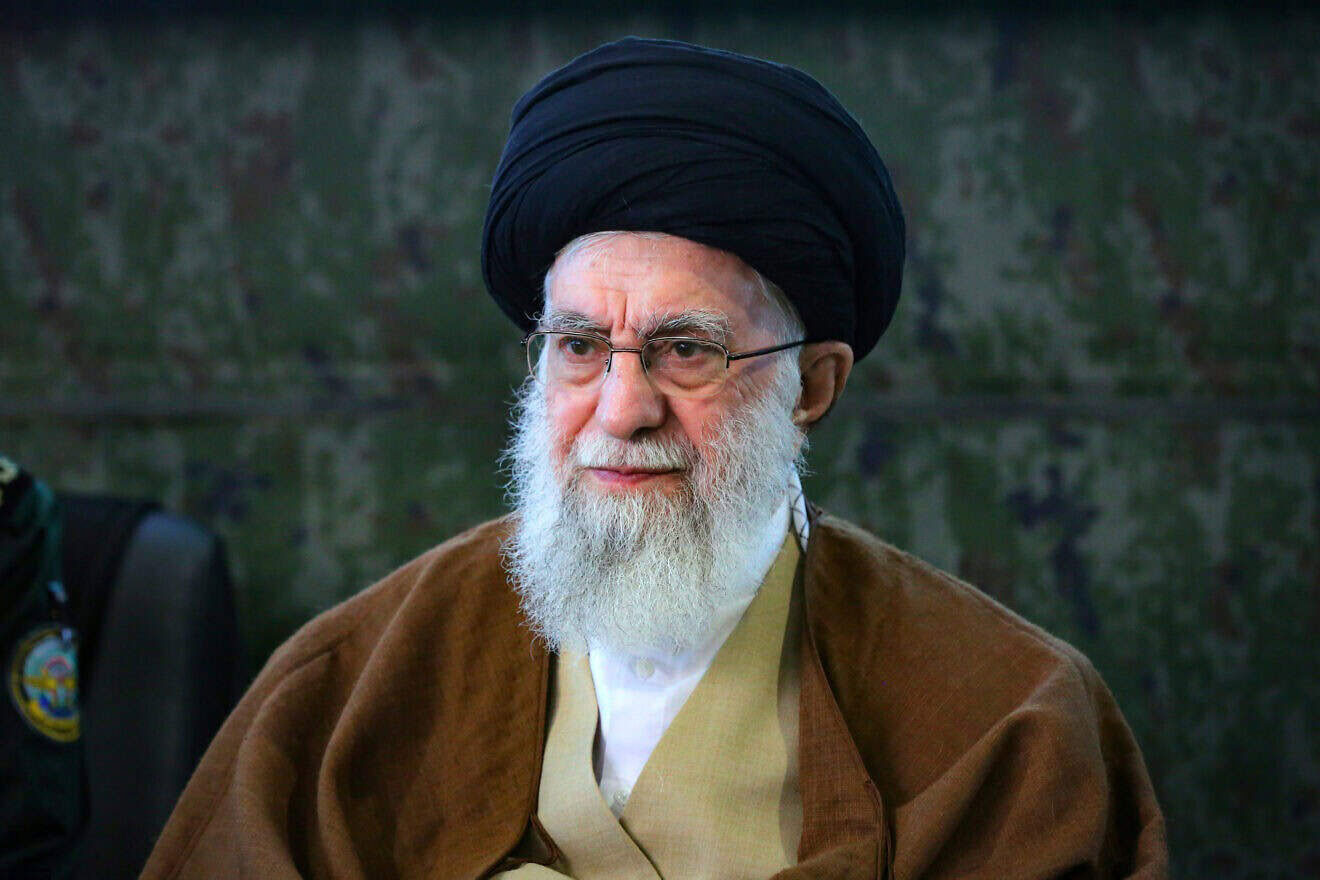
Iranian Supreme Leader Ayatollah Ali Khamenei visits the exhibition of achievements of the IRGC Aerospace Force in Tehran, Nov. 19, 2023
(JTA) — U.S. President Donald Trump directly confronted Iran’s leader, Ali Khamenei, on Jan. 17, following Khamenei’s accusation that Trump was responsible for the unrest sweeping Iran.
In an interview with Politico, Trump openly called for an end to Khamenei’s 37-year rule.
Arab commentators across the Middle East assess that the current Iranian regime would struggle to survive a direct military confrontation with the Trump administration. While the recent wave of protests in Iran has temporarily subsided due to harsh repression, analysts believe it is only a matter of time before unrest resurfaces and that the issue is far from resolved.
According to these assessments, the fall of Bashar Assad’s regime in Syria and the successful U.S. operation in Venezuela, which led to the capture of President Nicolás Maduro, demonstrated to Tehran that it cannot rely on Russia and China for protection.
Iran’s strategic partnership with both powers is viewed as fragile and transactional, driven solely by their respective interests rather than genuine alliance commitments.
Senior political officials in Jerusalem believe that Trump has reshaped the international landscape by applying direct and unrestrained pressure on countries worldwide.
Senior security officials describe the current moment as a critical test for the Iranian regime — one that challenges its endurance and forces it to fight for survival. During the 12-day “Rising Lion” war with Israel in June, Iran lost much of its air defense capability.
Its primary remaining strategic asset is its ballistic missile arsenal, estimated at approximately 2,000 missiles, which must now serve as its main deterrent against American and Israeli military power.
The war also exposed the regime’s inability to protect its nuclear infrastructure, which was reportedly destroyed by Israel and the U.S. In addition, a significant portion of the senior leadership of the Revolutionary Guards was eliminated in what security officials describe as a highly effective Mossad operation.
Israeli intelligence networks inside Iran are believed to remain active and to be assisting efforts aimed at destabilizing the regime.
The convergence of widespread public discontent, a deepening economic crisis and severe security failures poses a tangible threat to the regime’s survival. Iran’s missteps have eroded much of the deterrence it once enjoyed in the Middle East.
According to senior security officials, despite the defiant rhetoric emanating from Tehran, an internal reckoning has begun within Iran’s political elite — particularly among senior figures in the reformist camp led by President Masoud Pezeshkian.
The regime’s attempt to open a secret backchannel with Washington to negotiate a new nuclear agreement is seen as a sign of weakness. Trump publicly exposed the channel and then froze the talks, citing the violent suppression of protesters, thereby humiliating the Iranian leadership.
Real military power, however, remains in the hands of the Revolutionary Guards, the central pillar protecting the leadership of Khamenei.
Security officials outline two potential scenarios that could destabilize the regime. The first involves sustained American military pressure combined with a popular uprising that the regime fails to suppress. The second entails a decision by the military establishment that Khamenei’s leadership has become a liability and must be replaced to prevent total collapse.
Senior officials believe Trump may not seek to topple the Iranian regime through outright military action, fearing that an uncontrolled collapse could trigger internal chaos, regional instability, or even the fragmentation of Iran. Instead, they assess that he is likely to pursue a strategy aimed at accelerating regime change through calibrated military and popular pressure, while avoiding a complete breakdown of the state.