Courtesy of JNS. Photo credit: Nicolas Tucat/AFP via Getty Images
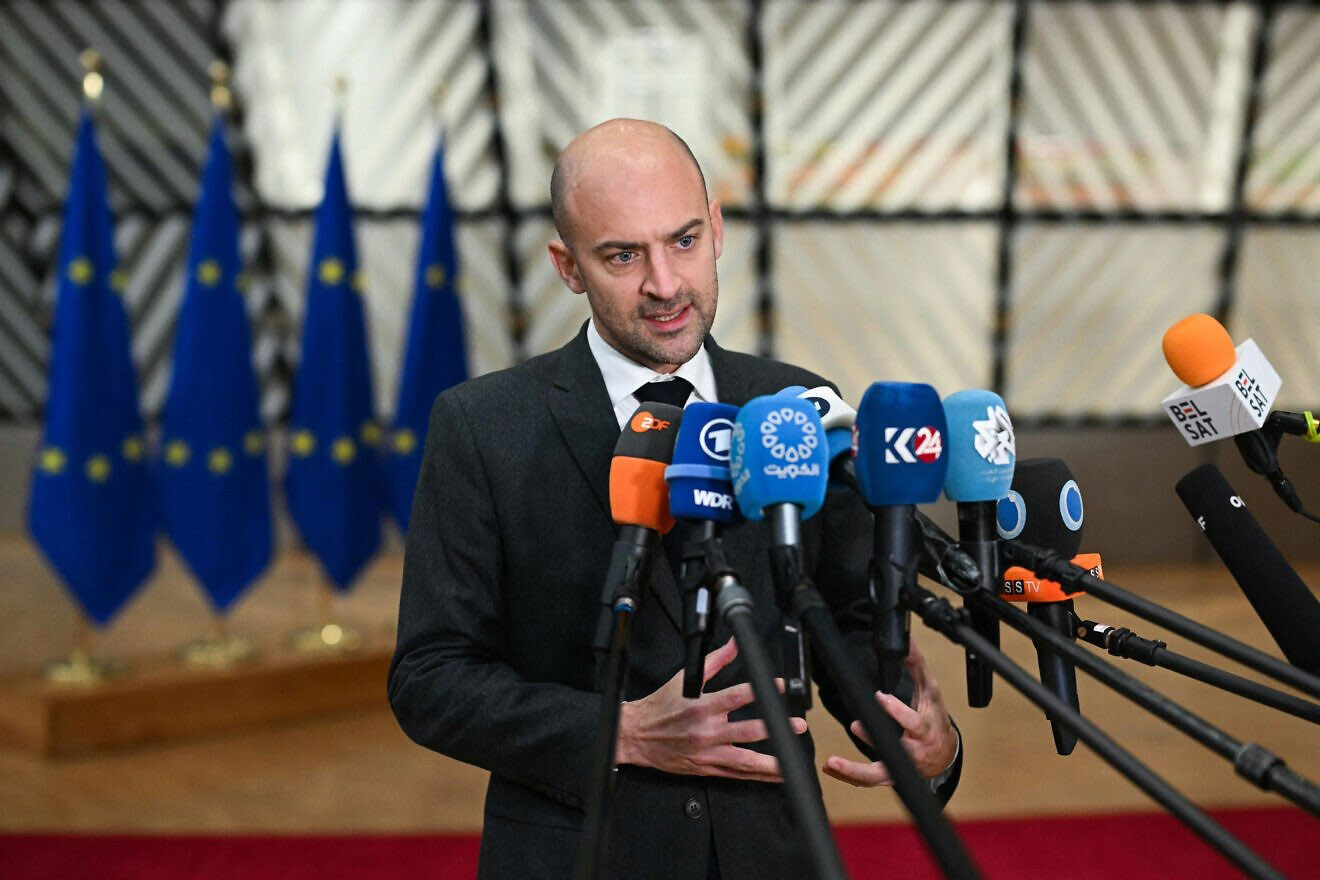
France’s Foreign Affairs Minister Jean-Noel Barrot speaks to the press as he arrives for a Foreign Affairs Council meeting at the EU headquarters in Brussels, on Nov. 20, 2025
(JNS) — French Foreign Minister Jean-Noël Barrot will meet with his Iranian counterpart Abbas Araghchi in Paris on Wednesday to discuss the Islamic Republic’s nuclear program, among other topics, the French Foreign Ministry said on Monday.
“This will be an opportunity for us to call on Iran to comply with its obligations towards the IAEA and for a swift resumption of cooperation with the agency,” said Barrot.
The two men are also set to discuss the fate of two French nationals who remain confined to the French embassy in Tehran after their release from Iranian custody.
Iran’s Foreign Ministry spokesperson confirmed the planned talks, adding that Araghchi will also raise the case of an Iranian student given conditional release by French authorities in October. At the time, Tehran pledged to press for the student’s full freedom. The student, Mahdieh Esfandiari, who resides in Lyon, was arrested earlier this year by French authorities over anti-Israel posts on social media.
The International Atomic Energy Organization’s 35-nation Board of Governors passed a resolution on Nov. 20 demanding that Tehran provide answers regarding and grant access to its bombed nuclear sites and enriched uranium stockpile “without delay.”
The measure follows a critical IAEA report on Iran that was circulated to member states the previous week.
Tehran has yet to grant international inspectors access to nuclear sites struck by Israeli and U.S. forces in June, the report notes.
“The Agency’s lack of access to this nuclear material in Iran for five months means that its verification … is long overdue,” it continues.
“It is critical that the Agency is able to verify the inventories of previously declared nuclear material in Iran as soon as possible in order to allay its concerns … regarding the possible diversion of declared nuclear material from peaceful use.”
Under the Non-Proliferation Treaty, Tehran is required to submit detailed information on these facilities “without delay,” but it has yet to comply, blocking IAEA inspectors from resuming visits.
Before the bombing, Iran held 440.9 kilograms of uranium enriched to 60%, an amount the IAEA says could potentially produce 10 nuclear bombs if further refined.
In September, Iran and the IAEA agreed to resume nuclear inspections, including at sites struck by the United States and Israel during the 12-day war in June.
But Araghchi said the deal would be voided if France, Germany and the United Kingdom pursued “snap back” sanctions against Iran at the U.N. Security Council under Resolution 2231, which formalized the 2015 Joint Comprehensive Plan of Action, commonly known as the Iran nuclear deal.
The three countries initiated the sanctions in August, citing Iran’s failure to comply with the deal’s terms, and U.N. nuclear sanctions on Iran were reimposed in late September.
Iran’s security chief threatens Israel
Ali Larijani, secretary of Iran’s Supreme National Security Council, called for a “direct confrontation” with Israel on Sunday following an Israeli strike in Beirut that killed a top Hezbollah commander earlier in the day.
Jerusalem and the Iranian terror proxy both confirmed that the attack, which targeted Haytham Ali Tabatabai — Hezbollah’s No. 2 leader after Secretary-General Naim Qassem—was successful.
In a post in Arabic on social media, Larijani wrote that Israeli Prime Minister Benjamin Netanyahu “continues his adventurism to the point that everyone reaches the conclusion that there is no path left except direct confrontation with Israel.”