Courtesy of JTA. Photo credit: Flash 90
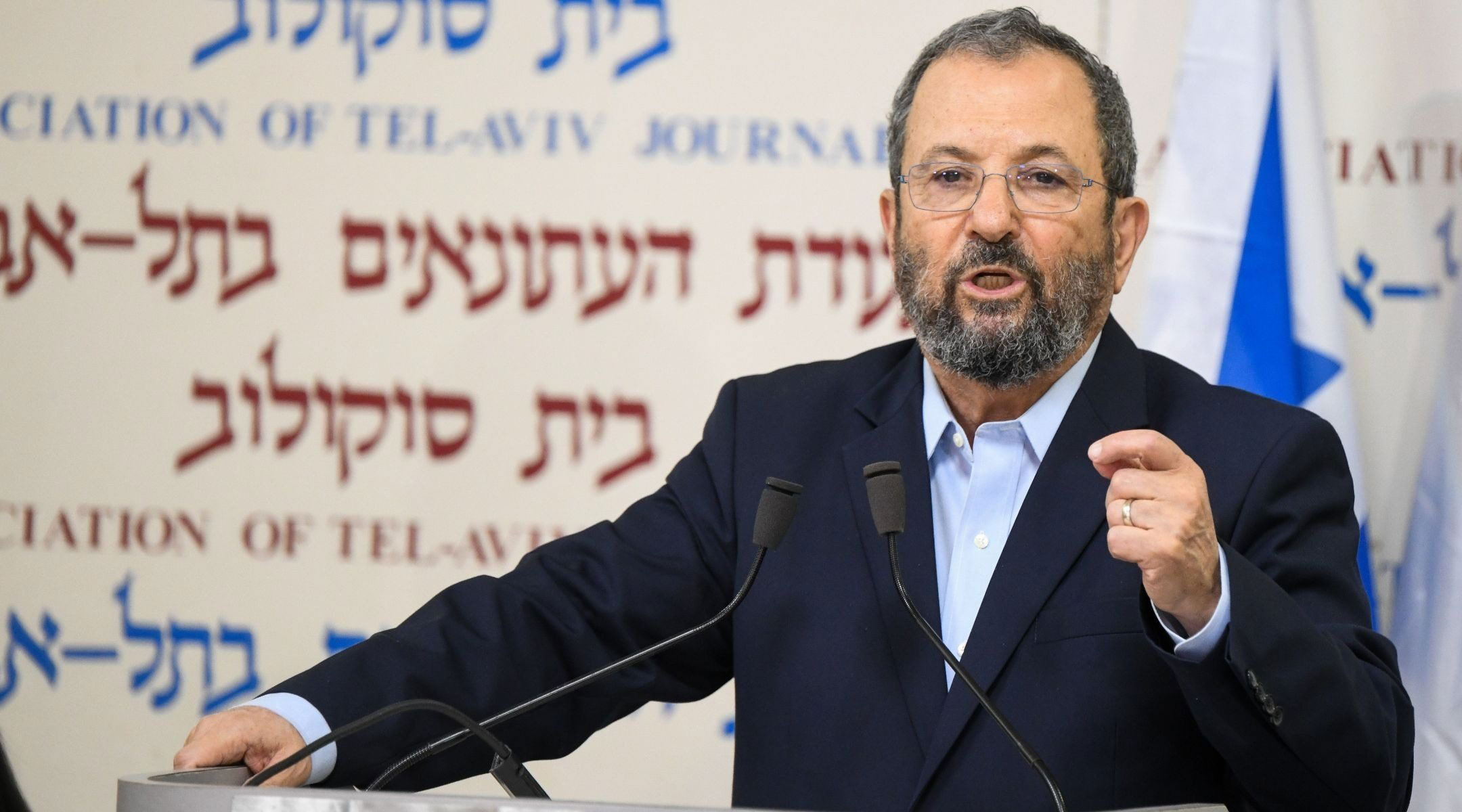
Ehud Barak, a former prime minister of Israel, announces the establishment of a new political party that he will lead, in Tel Aviv, June 26, 2019
(JTA) — When newly released audio recordings revealed former Israeli Prime Minister Ehud Barak discussing mass conversion and selective immigration with Jeffrey Epstein, disgraced financier and the convicted sex trafficker, the reaction in Israel was swift and deeply political.
Israel’s current prime minister, Benjamin Netanyahu, accused Barak of seeking to “select” Jews for immigration and charged that Israel’s political left was trying to “replace the people” after failing at the ballot box — an echo of contemporary conspiracy theories about immigration that appear to have been treated as a serious idea at the time.
The recordings, released this week as part of the U.S. Justice Department’s latest disclosure under the Epstein Files Transparency Act, capture Barak in a wide-ranging conversation with Epstein. The audio appears to date to around 2013, when Barak — a longtime leader in the liberal Labor Party — was 71 years old and transitioning into the private sector.
In the recording, Barak argues that Israel should weaken the Orthodox rabbinate’s control over conversion and open the door to large-scale conversion as a demographic strategy.
“We have to break the monopoly of the Orthodox rabbinate — on marriage and funerals, the definition of a Jew,” Barak says. “Open the gates for massive conversion into Judaism. It’s a successful country. Many will apply.”
Over more than three hours, Barak speaks candidly about population trends in Israel, the West Bank and Gaza, warning that without a two-state solution, Jews could lose their demographic majority.
“It will be an Arab majority,” Barak says of the territories. “It’s a collective blindness of our society.”
Barak also expresses concern about the growing proportion of Arab citizens within Israel, noting that Arabs made up about 16% of the population four decades ago and roughly 20% today. He contrasts that growth with the ultra-Orthodox Jewish population, which he says is expanding more rapidly.
As a counterweight, Barak proposes immigration, conversion and minority inclusion. He praises the Druze and Christian minorities as highly integrated and points to immigrants from the former Soviet Union as prime candidates for conversion.
“We can control the quality much more effectively, much more than the founding fathers of Israel did,” Barak says. Referring explicitly to immigration from North Africa, he adds: “They took whatever came just to save people. Now, we can be more selective.”
Barak lauds the post-Soviet aliyah of the 1990s, which brought more than 1 million Russian-speaking immigrants to Israel, and says the country could “easily absorb another million.” He recounts telling Russian President Vladimir Putin that Israel about this idea and joking about mixed Russian-Israeli names in the military as evidence of rapid integration.
The remarks drew sharp criticism from Pinchas Goldschmidt, who spent more than three decades leading Moscow’s Jewish community before leaving the country after Russia’s invasion of Ukraine in 2022. In an interview, Goldschmidt said the recording echoed conversations he encountered repeatedly during his years in Russia.
“I spent 33 years in Moscow, and there was talk like this,” Goldschmidt said. “Not necessarily among the heads of the agencies dealing with aliyah, but among employees and officials who felt this was their opportunity to stop Israel from becoming a Levantine country.”
In his comments, Netanyahu also said Barak’s close relationship with Epstein proved that Epstein did not work for Israel or its intelligence services, saying it would make no sense for an Israeli asset to be closely associated with one of the government’s most vocal opponents.
Barak’s ties to Epstein — including repeated meetings years after Epstein’s 2008 conviction — have been reported previously, and there is no evidence of criminal wrongdoing by Barak.