Courtesy of JTA. Photo credit: Screenshot via YouTube
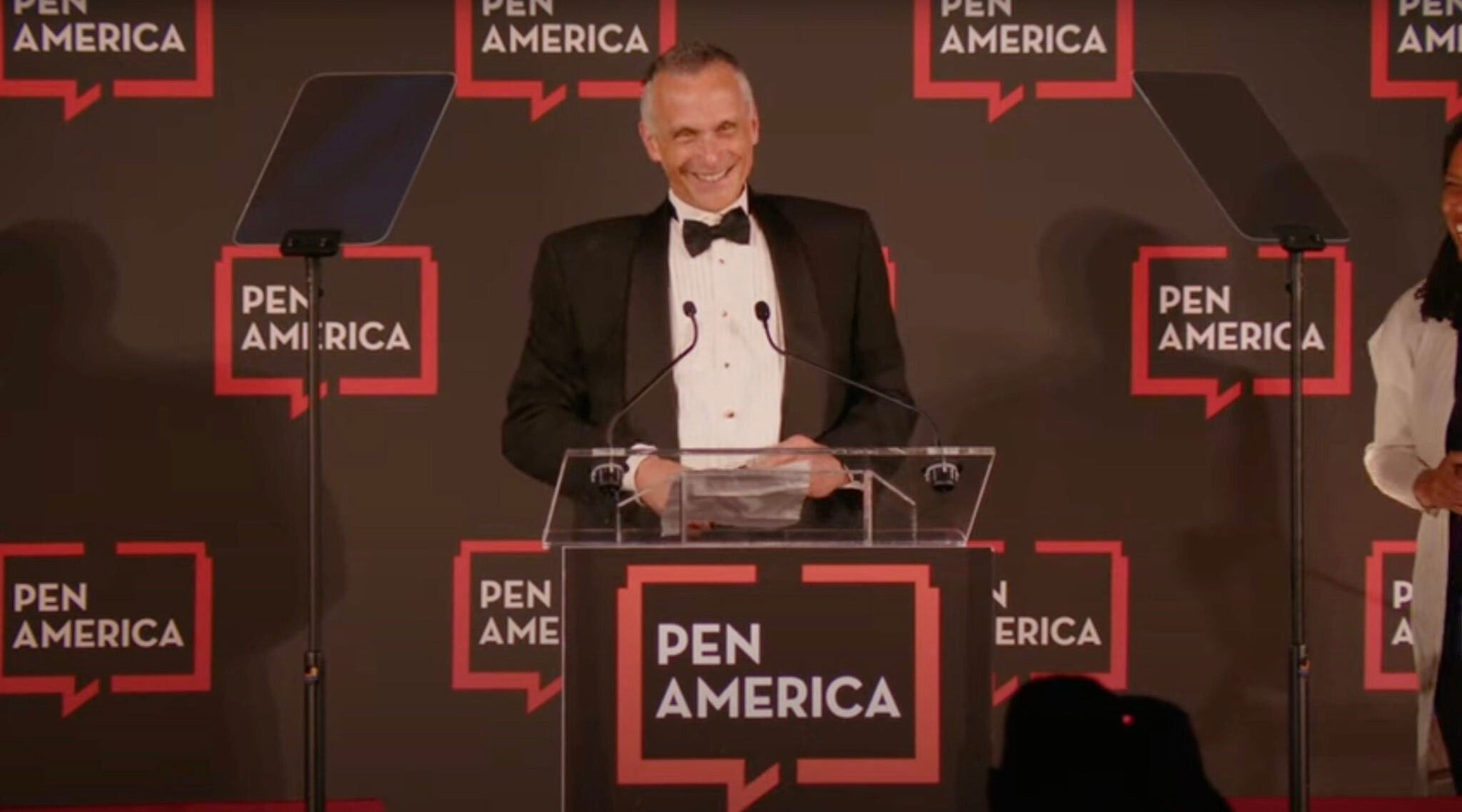
Wesleyan University president Michael Roth accepts a free-speech award from PEN America, May 21, 2025
(JTA) — As he often does these days, Wesleyan University president Michael Roth recently delivered a lecture on another campus outlining all the reasons why academia should be more forcefully standing up to President Trump’s policies.
He peppered the lecture with Yiddish words. He laid thick on what he called his “Jewish accent.” A colleague came up to him afterwards. “You’re doing Jew-speak,” they told him.
Roth laughed recalling his response: “No s–t, Sherlock. That’s part of what I’m doing.”
What he’s doing, Roth told the Jewish Telegraphic Agency in a recent interview, is constantly reminding his potential critics who he is. For one, he’s the only university president in the country who openly, repeatedly rejects Trump’s claims that the administration’s campus crackdowns — rescinding grants, limiting international student visas, dismantling “DEI” — are a means of fighting antisemitism after the Oct. 7, 2023, Hamas attack on Israel.
For another, when his own school dealt with pro-Palestinian encampments last year, he made no secret of handling the matter diplomatically instead of through discipline — an approach that landed other university presidents in hot water, but not him.
And above all that, he’s proudly Jewish.
“If you’re going to accuse Wesleyan’s administration of being antisemitic, start with me. But don’t call me on Saturday,” Roth quipped. “Because I’m going to be in Torah study.”
Roth isn’t quite sure how he, the leader of a small-town Connecticut liberal arts school with a mere 3,000 students, became so unusual among his profession by defending what he sees as the central principles of academic freedom.
“It’s a bit of a puzzle,” he told JTA. “I don’t think my view is very original. Any of the presidents I know at different schools probably have similar views.” His views also seem to align with most American Jews, at least according to polls, which show that nearly three-quarters of them also believe Trump is using antisemitism as an excuse to attack higher education.
In recent days, two other Jewish presidents, at the Massachusetts Institute of Technology and Brown University, have publicly rejected a Trump administration offer of “priority” funding that would have required them to bar some forms of speech, making them the only university leaders to do so. But Roth still stands out in the lengths he is going to rebuff Trump’s higher education policies — and to center his Jewish identity in doing so.
There he is, accepting a “courage award” from the literary free-speech group PEN America “for standing up to government assaults on higher education.” There he is, giving interviews in which he lambasts “prominent Jewish figures around the country who get comfortable with Trump, it seems to me, because they can say he’s fighting antisemitism: ‘He’s good for the Jews.’ It’s pathetic. It’s a travesty of Jewish values, in my view.”
There he is, signing an open letter declaring that antisemitism “is being used as a pretext to abrogate students’ rights to free speech, and to deport non-citizen students.” The leaders of Jewish Voice for Peace, an anti-Zionist group that has been suspended from multiple college campuses for disruptive protests, were on that letter. So was the leader of Wesleyan University.
And there he is, telling JTA that so-called institutional neutrality positions, adopted by a range of universities amid the Israel-Gaza war (and supported by the Jewish campus group Hillel International), are “bogus.”
A representative for the American Association of University Professors, a faculty union that has dropped its former opposition to boycotting Israel, praised Roth’s presence on the national stage.
“Michael Roth is criticizing the misuse of Title VI to define anti-semitism as criticism of Israel and its weaponization in the campaign to attack higher education. There is nothing startling about that position,” Joan W. Scott, a Jewish researcher at the Institute for Advanced Study who sits on the union’s academic freedom committee, told JTA.
Scott added, “I’d say Roth’s reasons for his courageous stance have to do with his integrity and perhaps his knowledge of history. He doesn’t want to be among those who, like Heidegger, thought that appeasing the regime in power was a safe position to take.”