Courtesy of JNS. Photo credit: Uri Lenz/Flash90
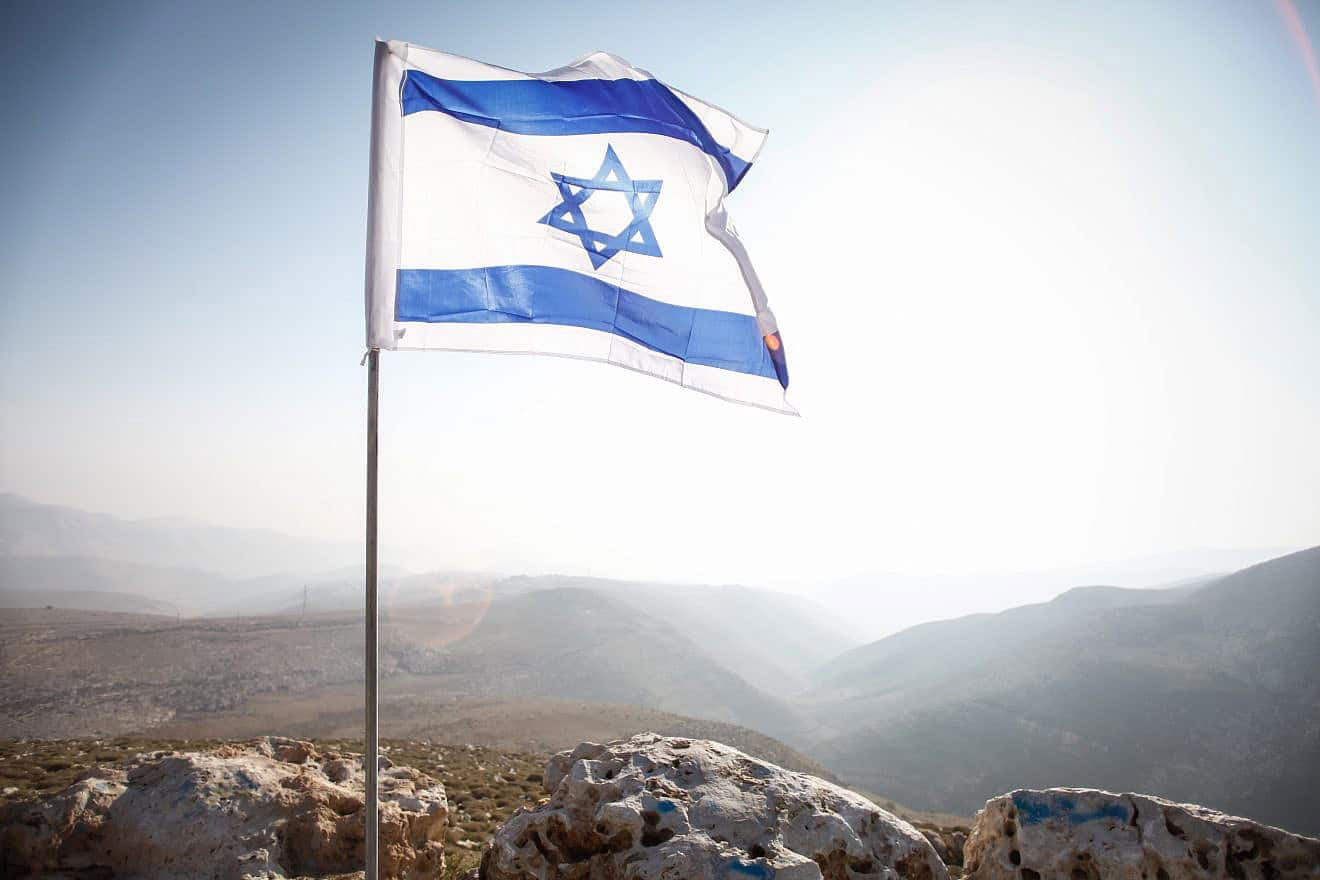
An Israeli flag in the Jordan Valley, near the community of Ma’ale Efraim, Jan. 2, 2014
(JNS) — The Jewish population in Judea and Samaria grew in 2025 at twice the rate of Israel’s overall population, according to a report compiled by former lawmaker Ya’akov Katz and first shared with JNS on Friday.
As of Jan. 1, 2026, 541,085 Jews lived in Judea, Samaria and the Jordan Valley, amounting to some 5.32% of the total population of the Jewish state, according to the West Bank Jewish Population Stats Report.
The population grew by 2.2% last year, exactly double the 1.1% growth rate of the nation’s overall population.
That figure, culled from Interior Ministry statistics, does not include the some 340,000 Jews living in the eastern part of Jerusalem, which the Palestinians claim despite it being part of Israel’s capital, the report noted.
Despite that, it showed a slight slowdown in growth in Judea and Samaria, which Katz attributed to the aging population.
Bet El, in the Binyamin region of southern Samaria, for example, had the country’s highest birth rate in 1986, when most of its residents were of childbearing age. Four decades later, many residents there and across Judea and Samaria are in their 60s and 70s, moderating growth.
The Jewish population in Judea and Samaria has grown 13.8% since 2021, when 475,481 Jews lived in the region liberated during the 1967 Six-Day War.
Katz’s report lists several recently legalized towns as having only several residents, as they were previously registered in neighboring, established villages, and the Population Registry has yet to reflect those changes.
The natural growth of the disputed region’s Jewish residents is expected to result in a population in excess of 600,000 by 2030, 685,112 by 2035 and over one million by 2050, according to Katz’s data analysis.
Katz credited Israeli Finance Minister Bezalel Smotrich — who also serves as a second minister in the Defense Ministry responsible for civilian issues in Judea and Samaria — and Israel’s minister for settlement and national missions, Orit Strook, for bringing about “a far-reaching revolution.”
Their “reshaping of Israel’s administrative and planning architecture has translated ideology into a surge in development,” Katz stated in a press release.
Over the past two years, Smotrich has overseen the establishment of 69 new communities, approved more than 60,000 housing units and designated tens of thousands of dunams (thousands of hectares) of land as state property, he explained.
The establishment of new towns has created Jewish territorial contiguity across about 82% of Judea and Samaria, Katz said, a development that could help thwart efforts to establish a Palestinian state in the area.
The former lawmaker said 7 billion shekels (about $2.2 billion) were invested in highways and that 140 Jewish farms were established throughout Judea and Samaria, reclaiming some 700,000 dunams (70,000 hectares, or 173,000 acres).
The ranches exert de facto control over nearly 1 million dunams (100,000 hectares, or about 247,000 acres), according to the report, an area it said was roughly four times larger than that of established Judea and Samaria communities.
Enforcement against illegal Palestinian construction was also stepped up, with demolitions quadrupling. In 2025, more unauthorized Arab structures were demolished than built for the first time, Katz said.
Over recent years, Smotrich and Strook achieved “not merely growth in settlement numbers, but a revolution in governance,” stated the former MK. “By aligning authority, resources and vision, they have translated long-held national aspirations into irreversible realities.”
Smotrich and Prime Minister Benjamin Netanyahu have led an unprecedented drive to expand control of Judea and Samaria.