Courtesy of JTA. Photo credit: Nathan Posner/Anadolu via Getty Images
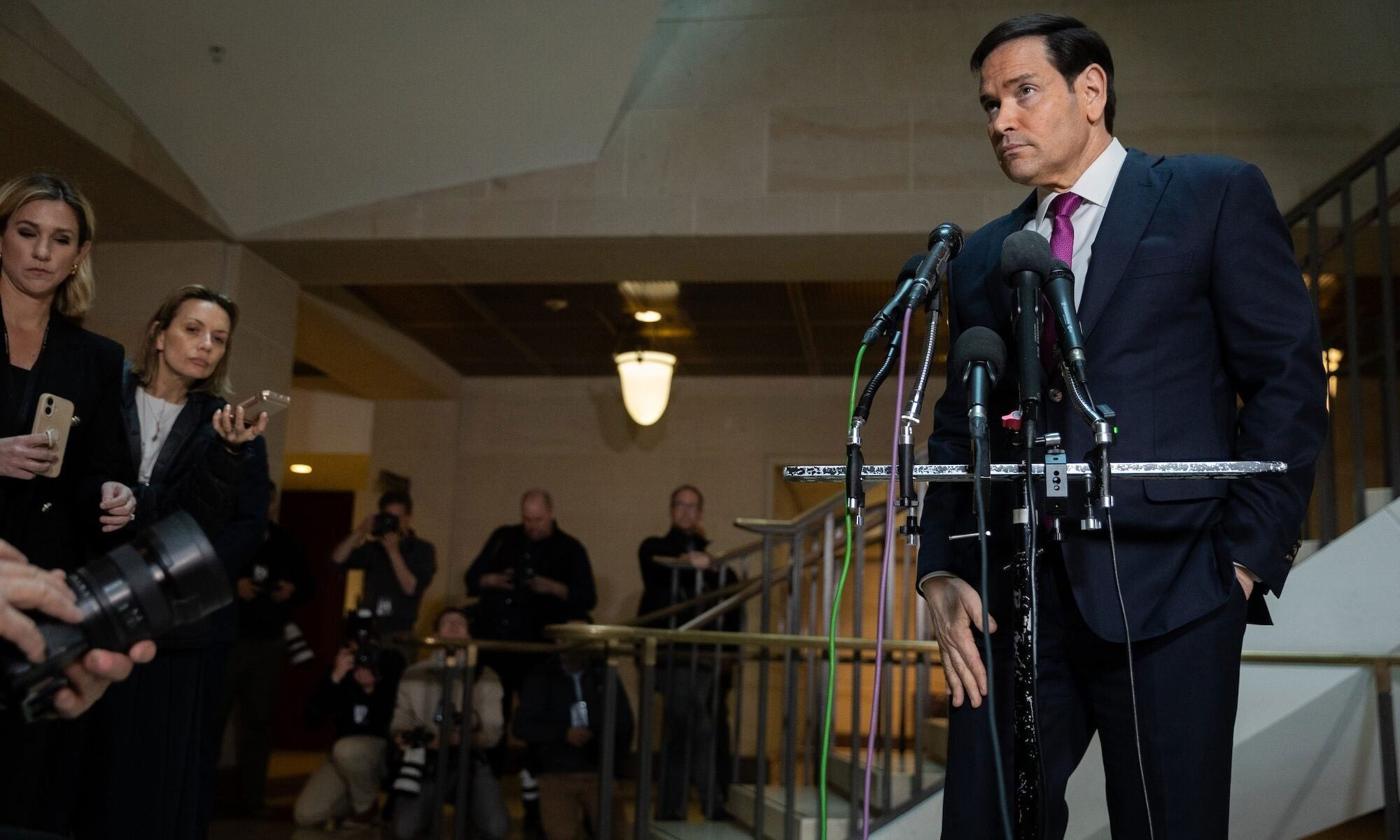
Secretary of State Marco Rubio talks to reporters ahead of briefing the Congressional “Gang of Eight” on U.S. strikes on Iran, at the U.S. Capitol in Washington, D.C., on March 2, 2026
(JTA) — Secretary of State Marco Rubio inflamed critics of the U.S.-Israel war on Iran on Mar. 2 when he suggested that Israel had pulled the United States into the conflict.
“We knew that there was going to be an Israeli action, we knew that that would precipitate an attack against American forces, and we knew that if we didn’t preemptively go after them before they launched those attacks, we would suffer higher casualties,” Rubio told reporters in Washington, D.C.
After a reporter asked Rubio to clarify whether the United States was forced to strike because of Israel’s plans, the secretary said no.
“This operation needed to happen because Iran in about a year or a year and a half would cross the line of immunity, meaning they would have so many short-range missiles, so many drones, that no one could do anything about it because they could hold the whole world hostage,” Rubio said. He added, “Obviously, we were aware of Israeli intentions and understood what that would mean for us, and we had to be prepared to act as a result of it. But this had to happen no matter what.”
The comments were sensitive because allegations that the United States is subservient to Israel have gripped both the far right and far left in recent years.
And despite his clarification, Rubio’s first comment caught on among skeptics of the war from across the ideological spectrum.
“Secretary Rubio says the quiet part out loud: this is an unnecessary war of choice,” tweeted Rep. Sara Jacobs, a Jewish progressive from California. “Israel forced our hand — there was no imminent threat to the United States. And instead of talking Israel out of going to war, President Trump went along with it and put U.S. lives at risk.”
The conservative commentator Matt Walsh, meanwhile, shared a video of Rubio’s initial statement and tweeted, “So he’s flat out telling us that we’re in a war with Iran because Israel forced our hand. This is basically the worst possible thing he could have said.”
Trump, meanwhile, told the New York Post on Mar. 2 that he believed that most Americans support the war, despite polling showing approval at well under 50%. He said he had made the decision to strike only after failed negotiations with the Iranians in Geneva after learning that Iran was continuing to seek to produce nuclear weapons at a new site.
Still, Rubio was not the only prominent voice close to the decision-making table to implicate Israel as a driver of the war plans on Mar. 2, amid a reckoning over what prompted Trump to engage U.S. forces in an expansive and increasingly deadly war without congressional approval, which is required by law except if there is a direct, imminent threat. On Tuesday, the U.S. military said the number of service members killed had risen to six.
Speaker of the House Mike Johnson said the United States had to prepare for war because it knew it would be embroiled if Israel acted alone. “Because Israel was determined to act with or without the U.S., our commander in chief and the administration and the officials had a very difficult decision to make,” he told reporters.
Sen. Mark Warner, a Democrat who is on the Senate Intelligence Committee, said that despite supporting Israel, he still had questions about the appropriateness of striking when there is no immediate threat to the United States. “This is still a war of choice that has been acknowledged by others that was dictated by Israel’s goals and timeline.”