Courtesy of JNS. Photo credit: Getty Images
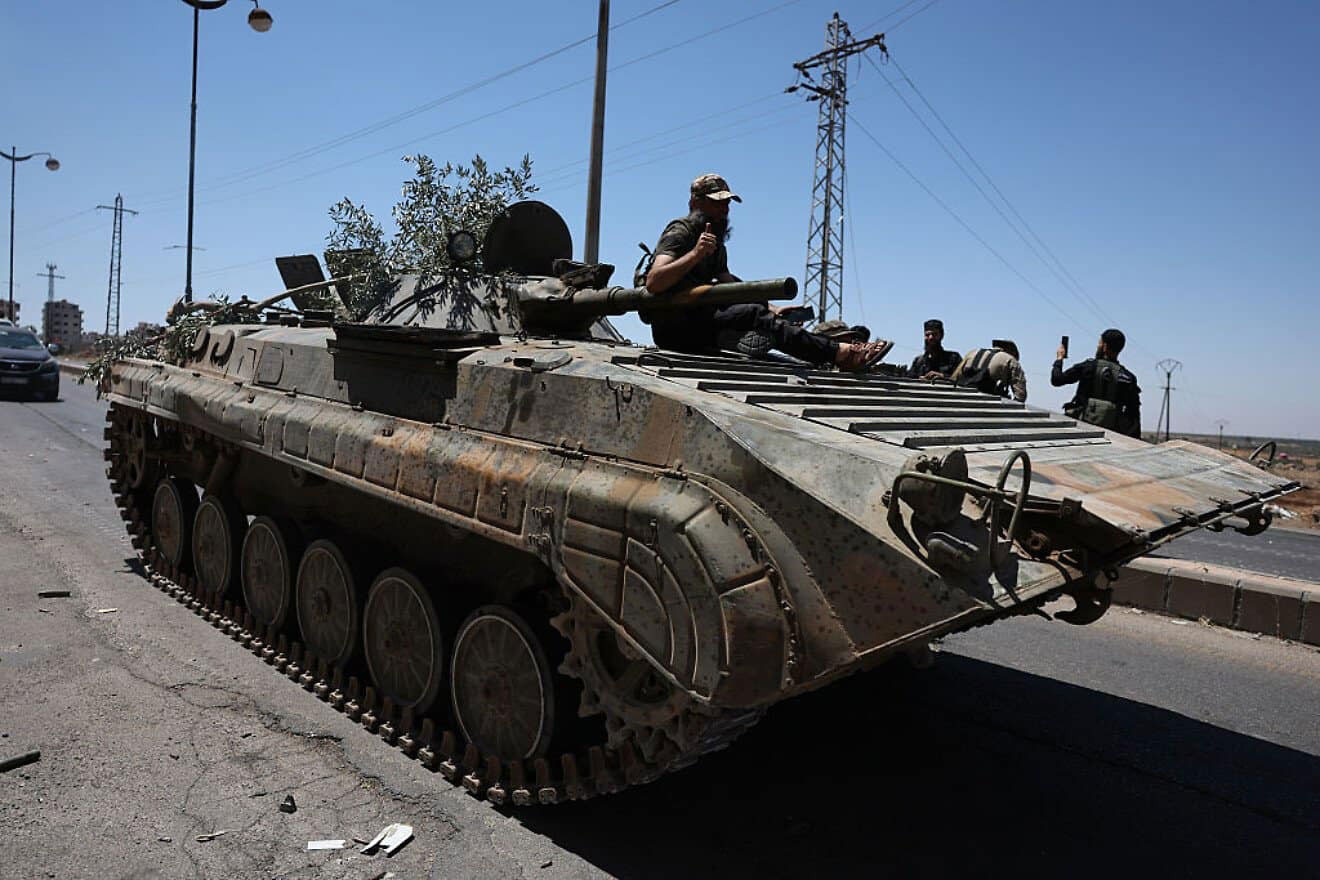
A tank and military personnel are seen as the Syrian Army and Security Forces arrive in the Druze city of Sweida in southern Syria on July 15, 2025
(JNS) — A large-scale initiative to rebuild and modernize the Syrian Army is underway, a report by the Washington-based Institute for the Study of War think tank indicates.
The project is being led by President Ahmed al-Sharaa, as part of an attempt to consolidate his burgeoning control over Syria and reimpose Damascus as a player in Middle Eastern geopolitics.
Kelly Campa, an Institute for the Study of War analyst, explained that the project is in a critical stage but may take significant time to materialize.
“The Syrian government is still building the army, and it is currently in a highly formative stage,” she said. “The formation of a new army that is responsive to an institutionalized chain of command will be extremely challenging and will take years.”
The Syrian military was almost entirely destroyed during the fall of the Assad regime in December 2024, under the combined pressure of rebel armies, internal desertion and sweeping Israeli airstrikes. The collapse of the Syrian military followed 14 years of civil war, which significantly eroded Damascus’s military strength.
Following the 2024 revolution, al-Sharaa assumed the role of transitional president and moved to reestablish state authority under a centralized system based in Damascus. The current modernization project is being largely driven and influenced by al-Sharaa’s experiences with factionalism during the Syrian civil war, the Institute for the Study of War reported.
During the civil war, al-Sharaa was the leader of the Hayat Tahrir al-Sham Sunni Islamist terrorist group and found himself consistently bogged down by internal rivalries and a general lack of cohesion.
“Al-Sharaa sought to unify the Syrian opposition to overthrow [President Bashar] Assad and control Syria, an effort that naturally brought him into conflict with many other Syrian armed groups. Al-Sharaa and his contemporaries recognized the need for unity to defeat the Assad regime early in the civil war, but the opposition’s disparate goals and the diversity of its backers made unity difficult to achieve,” Brian Carter, a research manager at another Washington-based think tank, the American Enterprise Institute, explained.
“Al-Sharaa now aims to extend state control through the new army … over all Syrian factions, similar to the way in which he centralized control over [northwestern Syria] during the later years of the civil war,” Carter added.
The Defense Ministry has organized the new Syrian Army through the reflagging of civil war-era militias. Reflagging replaced the original identities of these groups with formal military designations while retaining their personnel and internal structure. The ministry has continued to form new divisions and merge others since March 2025.
Together, the patchwork approach has resulted in unprecedented growth in the military’s manpower. As of November 2025, there are at least 23 fully integrated divisions in the Syrian army. Each division is estimated at approximately 2,400 to 3,600 personnel, making it the size of a small conventional brigade in a Western military.
Brig. Gen. (res.) Assaf Orion, an expert at the Washington Institute for Near East Policy and a senior research fellow at Tel Aviv University’s Institute for National Security Studies, explained that the numbers being reported are most likely significantly exaggerated. “Twenty-three divisions are almost twice as many as Assad had at the height of Syria’s power. These are clearly inflated reports,” Orion told JNS.
“These are not real divisions. There is no capability of raising a maneuvering army of that size in such a short time,” he added.
Despite these manpower constraints, the new Syrian military, even at this early stage, already constitutes a far more significant threat than the Assad regime did, which, even at the height of its power before the civil war, could only support 13 divisions, most of which were considered unreliable as fighting formations.