Courtesy of JNS. Photo credit: Matt Kaminsky/JNS
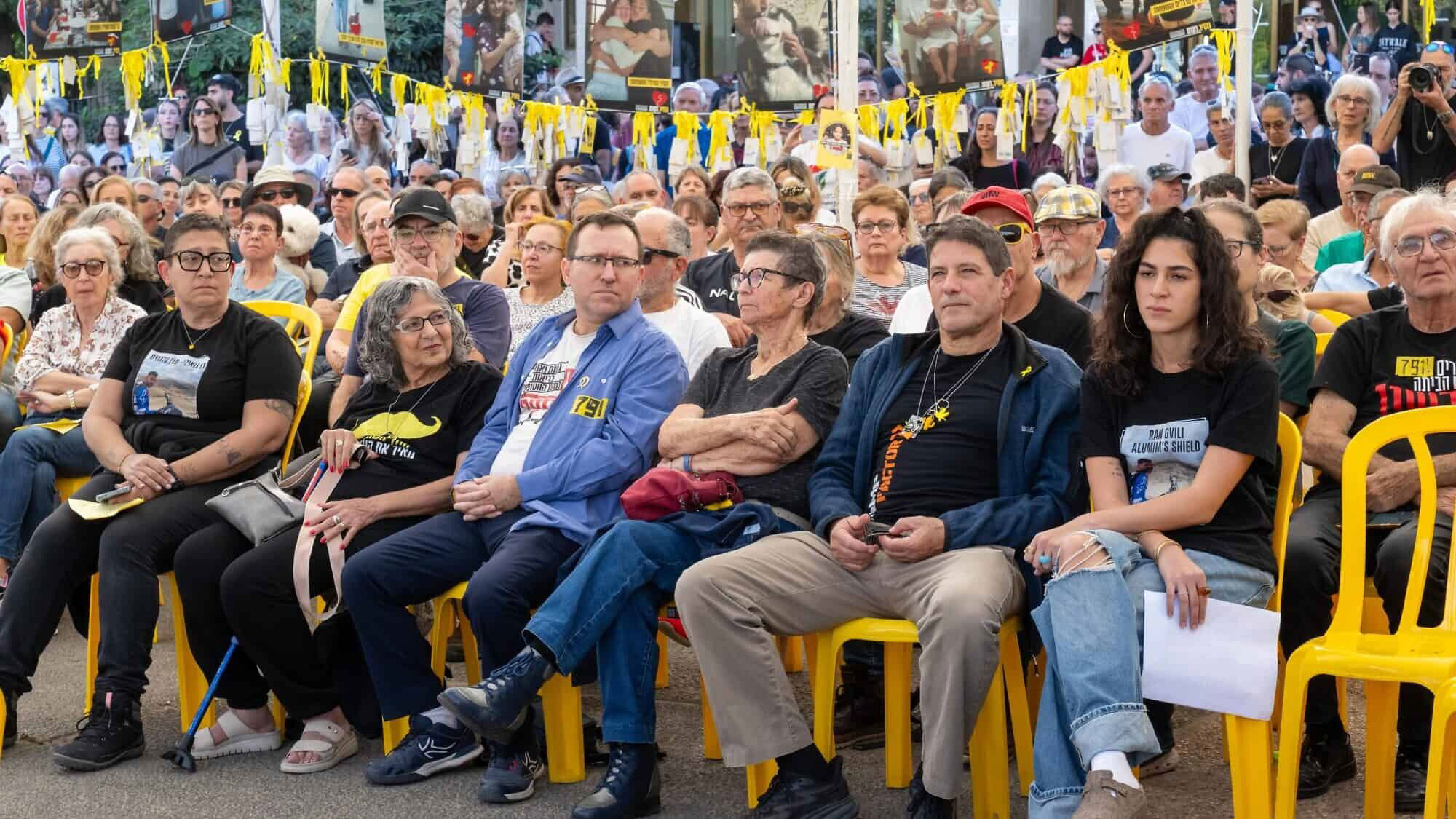
Hundreds gathered in Tel Aviv’s Hostages Square before Shabbat to demand the immediate return of the final hostage, Ran Gvili, Dec. 5, 2025
(JNS) — Before the war, Israelis were no strangers to protest culture. Demonstrations over judicial reform, clashes over public prayer in Tel Aviv and anti-Haredi marches in Bnei Brak kept the country in a constant churn of political tension. Heated Knesset debates were routine, even unremarkable.
Then came Oct. 7, 2023.
In the days immediately following the Hamas attacks, the divisions seemed to melt away. Massive volunteer efforts emerged overnight, and what had been a fractious society began operating with uncommon unity and compassion.
On Oct. 8, in the basement of Shelly Shem Tov, the mother of hostage Omer Shem Tov, families of the abducted gathered, joined by representatives from some 1,400 other families who supported them.
The meeting led to the creation of the Hostages and Missing Persons Forum (HMFF), a grassroots, volunteer-driven effort that soon expanded from Israel to more than 70 countries. Its leaders insisted the organization was non-political. But was it ever truly apolitical?
Almost immediately, the slogan “Bring Them Home Now” appeared on posters, shirts, banners and bumper stickers. Yet many Israelis felt the message implicitly shifted responsibility away from Hamas — the terrorist captors — and placed it squarely on the Israeli government.
While HMFF declared itself non-partisan, statements from some members told a different story.
Sagit Dinnar, whose husband was murdered on Oct. 7 and who herself was abducted and later released, became one of the group’s most outspoken voices. She frequently argued that the government’s strategy on hostage negotiations was shaped by political survival rather than security considerations, and she did not shy away from sharp criticism of Israeli Prime Minister Benjamin Netanyahu.
In an April 2024 Reddit AMA titled “My family member is a hostage in Gaza. With Netanyahu in charge, I’m afraid he’ll never make it home,” Dinnar wrote, “Hamas is never going to give up enough hostages to make their destruction become a sweet pill to swallow,” effectively endorsing partial deals to save lives.
She accused the government of being “willing to pay any price, even at the cost of the lives of the hostages or the soldiers.”
Other families pushed back — and organized.
In response to early HMFF pressure campaigns, Tzvika (Zvika) Mor, the father of abducted IDF soldier Eitan Mor, and several like-minded families began meeting informally and later established the Tikva Forum. Unlike HMFF activists who saw concessions as a moral obligation, Tikva members argued that negotiating with Hamas would endanger remaining captives and embolden future kidnappings.
“During wartime, and especially while negotiations are underway, demonstrations against the government harm the war effort,” Mor told JNS. “We saw Hamas release videos of abductees shortly before the weekly rallies. The rallies attacking the government served Hamas.”
The two groups’ approaches diverged sharply.
By March 2024, well before most hostages had been released, HMFF rallies began overlapping with the anti-overhaul “Kaplan” protests. The Begin–Kaplan intersection, renamed “Democracy Square” by demonstrators, hosted joint events in which hostage families and anti-government activists called both for a deal and for early elections.
With the return of most hostages, HMFF declared its final weekly rally on Dec. 1. But protests continued in new forms. Days later, demonstrators gathered outside the Tel Aviv courthouse, accusing the government of prioritizing “political survival over justice.”
Do protests help or harm Israel? For Mor and the Tikva Forum, the answer is clear. “When demonstrations are held against the government to create pressure, terrorist organizations learn that they can use Israeli citizens against the government and for their own benefit,” he told JNS. “Protests give power to our enemies.”