
Efrat, Israel – “And God saw everything that He had made and behold it was very good.”
(Genesis 1:31)
The article below is from Rabbi Riskin’s book Bereishit: Confronting Life, Love and Family, part of his Torah Lights series of commentaries on the weekly parsha, published by Maggid
A sensitive reading of the biblical description of the creation of the world forces the reader to come to some understanding of the relationship between Judaism and scientific discovery. Contrary to popular opinion, Judaism does not balk at modernity, especially if it furthers G-d’s honor. For example, the invention of the printing press more than 500 years ago changed the nature of reading and literary transmission. The rabbinic leadership at the time welcomed it as a way to make sacred texts available to everyone. Now we’re living in the midst of another communications revolution, and many Jews are involved in the development of the computer and Internet, allowing almost instantaneous call-up of a specific passage in the Talmud or a difficult area of medical ethics in our Responsa literature. The challenge is not to reject inventions but to refine them, not to censor modernity, but to sanctify it.
Commenting on the opening verse of Genesis, ‘In the beginning G-d created the heavens and the earth,’ the Seforno demonstrates how to place Torah insights into the context of scientific developments. He points out that the word shamayim, (usually translated as ‘heavens’) is the plural of the Hebrew sham, meaning ‘there’ or ‘two theres,’ and writes: ‘therefore the word ha-shamayim indicates a distant object in relation to us, the distance being equal from each side, which cannot be unless it is situated in a wheel that is revolving in a completely circular fashion.’ Thus, every point on the planet is equidistant from the heavens (ha-shamayim) and for this phenomenon to be true, the world must be moving in a spherical pattern. Two ‘far-aways’ that are the same distance can only exist if the planet is a revolving sphere.
Interestingly, Seforno lived approximately at the same time as Copernicus (1473–1543), the famed astronomer who spent considerable time in Italy pursuing his studies before returning to his native Poland. Before Copernicus, the center of the universe was the earth; his new scientific theory, suggesting that the earth revolves around the sun, clearly demotes the earth from its formerly exalted position as the center of divine concern.
It stands to reason that a rabbi of Seforno’s stature, who was also a doctor by profession and a respected intellectual of his day, had heard of Copernicus’ theories and had apparently accepted his vision of an earth revolving around the sun. But especially noteworthy for us is how Seforno interprets the ramifications of a scientific theory rejected as blasphemous by most Christian theologians of the period. Not only does Seforno accept the Copernican position, which we now know to be scientifically accurate; he deduces a crucial moral lesson from an earth constantly revolving on its own axis, as it revolves around the sun. This lesson is that the human being is placed squarely at the center of the earth, equidistant from the two ‘theres’ or ‘far-aways’ of the heavens, which can only happen if the earth is constantly revolving.
The medieval sages speak of four levels of creation: the inani- mate level of earth and rock, the vegetative level of plants and trees, the locomotive level of roaming animals and beasts, and finally the communicative level of humans who speak. Each level receives its sustenance from the previous level: vegetation depends on earth and water, animals receive sustenance from the vegetation, and humans gather food, drink, garments and tent-skins from the animals. If the human being communicates both horizontally and vertically with the world and with G-d, he has the capacity to uplift and ennoble the world, to redeem the earth; if he short-circuits his relationship to the divine, if he poisons rather than perfects the physical environment all around him, the entire earth will fall and fail with him.
With this in mind, the human being stands at the center of the universe. Only the human being has the gift of free choice. Our planet earth depends on proper human exercise of his free choice if it is to be redeemed and not destroyed. This is what I believe Seforno meant to extract from a constantly revolving earth. Interestingly enough, Rashi deduces a similar lesson from a later verse. At the end of our portion of Bereishit, after human conduct disappointed the Divine Creator, the Bible states:
“And G-d saw that the wickedness of man was great in the earth…. And G-d said, I will blot out the human being whom I have created…both human and beast, and creeping thing, and fowl of the air…” (Genesis 6:5–7)
The obvious question asked is, why blot out the innocent animals and the silent beasts if the sin belongs to human beings? Rashi explains:
“Everything was created for the human being, and if he is to be destroyed, what need is there for the rest?!” (Rashi on Genesis 6:7)
A central biblical dictum proclaims that ‘human beings must walk in G-d’s ways.’ Yet, how do we determine G-d’s ways? When Moses requested of G-d: ‘Now therefore I pray Thee, if I have found grace in Your eyes, show me now Your ways, that I may know You…’ (Exodus 33:13), G-d’s answer is that Moses cannot hope to see Him completely, but can receive a partial glimpse into the divine – His back, as it were: ‘And G-d passed by before him, and proclaimed: The Lord, the Lord, G-d, merciful and gracious, long-suffering and abundant in goodness and truth’ (Exodus 34:6). Maimonides insists that G-d is not merely informing us of a description of His conceivable essence, but He is presenting us with a divine injunction as to how we humans ought to live:
“Just as He is gracious, so ought you to be gracious; just as He is compassionate, so ought you to be compassionate; just as He is called holy, so ought you to be called holy.” (Laws of Knowledge 1:6)
This divine description, as it were, is not as significant for its theology as it is for its anthropology; it is less a definition of G-d and more a guide for human morality. Once again, humanity is the central concern even of a definition of the divine!
After each creation, there is a biblical value judgment, ‘And G-d saw that it was good.’ There is but one exception: the creation of the human being, after which the Bible does not give its usual afterword, ‘And G-d saw that it was good.’ Seforno explains the reason: the human being is not functional but moral. Whether or not his creation will turn out to have been good depends on his free choice. This is the sense in which the human being stands smack at the center of the earth. Will he sanctify and redeem it, or plunder and destroy it? Will he realize his potential to act in G-d’s image, placing G-d’s attributes as the measure of all things and thereby perfect the world, or will he idealize his own frailty and ultimately drown in his weakness, bringing the entire world down with him? The jury has not yet come in with the final verdict. Until that time, the human being remains at center stage, to a great extent holding the whole world in his hands and in the grip of his free will.
Shabbat Shalom
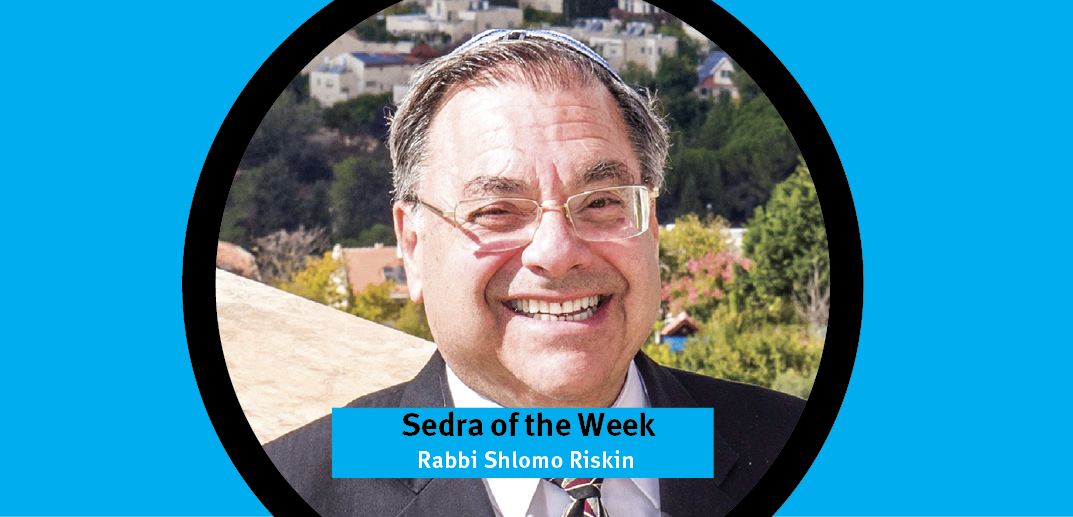
Rabbi Shlomo Riskin
Chancellor Ohr Torah Stone
Chief Rabbi – Efrat Israel