Courtesy of JTA. Photo credit: Creative Touch Imaging Ltd./NurPhoto.
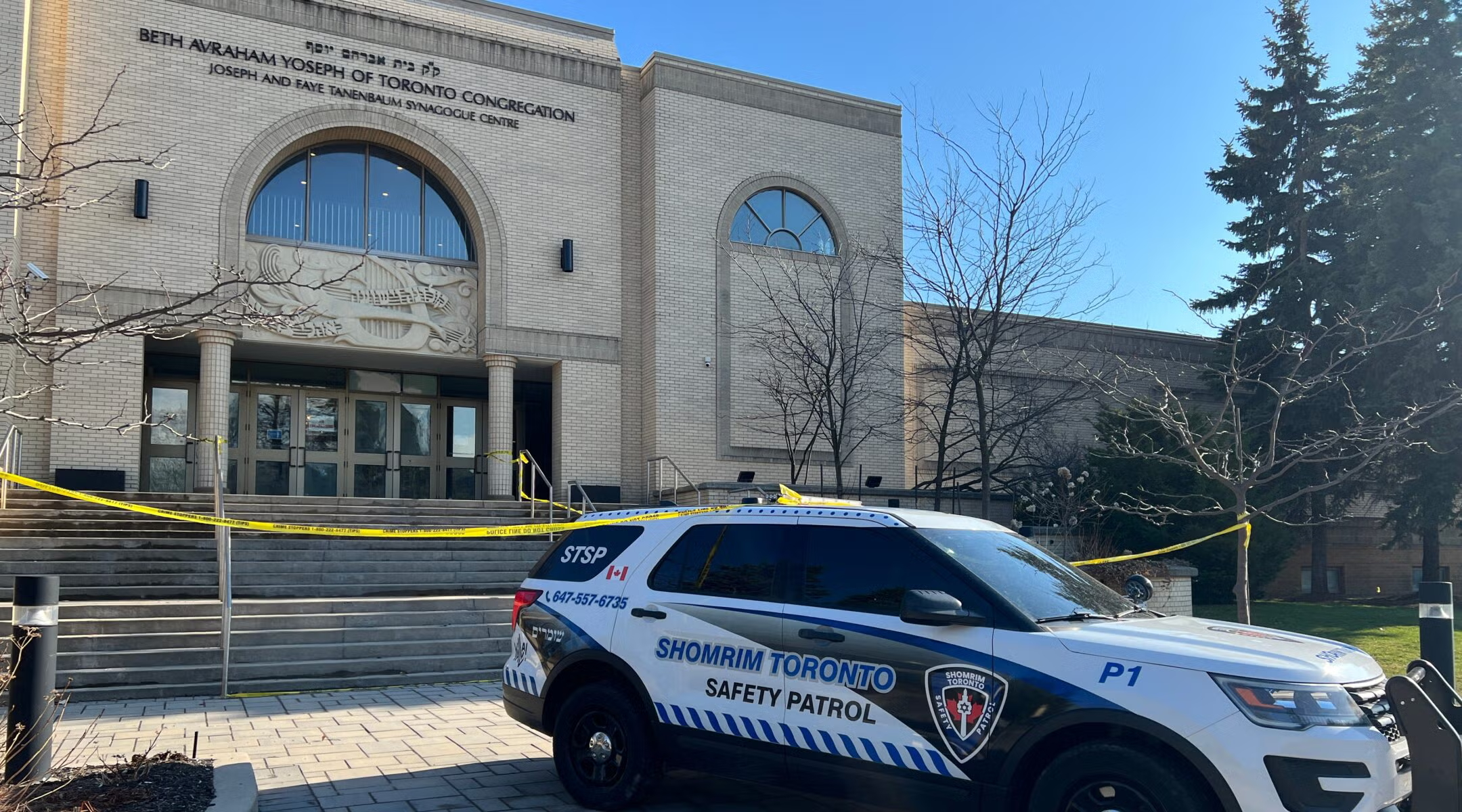
The Beth Avraham Yoseph of Toronto (BAYT) synagogue following gunshots fired at the building in Vaughan, Ontario, Canada, April 09, 2026
(JTA)—TORONTO – Sari Watson was too afraid to attend Yom Kippur services. Concerned by rising levels of antisemitism in Canada, she was safely at home 25 minutes away when a gunman charged at her childhood synagogue.
“My internal alarm has been going off, and you begin to think about escape routes or backup plans,” said Watson, 39, who lives in Quinte West, Ontario, about 15 miles west of Belleville, where the attack during Kol Nidre on Sept. 20 culminated in a shootout that left the gunman dead and one policeman hospitalized. “The only reason I wasn’t at synagogue was because I have been terrified of this exact situation, or worse, happening.”
Florida Sen. Rick Scott, Oklahoma Gov. Kevin Stitt and President Donald Trump himself, all Republicans, have alluded to the idea of extending refugee status to Canadian Jews who fear the spike in antisemitism in their country.
“’It’s so amazing to know that the Republicans understand the level of antisemitism we’re dealing with here,” she said. “President Trump gets the climate and the danger.”
Still, Watson has mixed emotions about the thought of leaving her home country. “I want to stay here and fight for our safety in Canada,” she said. “The option to come to the U.S. is really important, but we shouldn’t have to need it.”
The Trump administration has imposed stringent restrictions on immigration, including on asylum seekers, but is inviting South African whites – and, potentially, Canadian Jews – to apply for refugee status. Critics accuse Trump of playing politics with refugee status, but some Canadian Jews see it as a lifeline.
Talk of Jews feeling compelled to leave Canada gained momentum last week when a well-known Jewish journalist posted publicly on social media about getting a foreign passport. Neil Herland, a newsreader for the national broadcaster, the CBC, wrote on social media about his encounter with pro-Palestinian protesters outside Toronto’s Meridian Arts Centre, where Yom Kippur services were being held. Herland said that, concerned about rising antisemitism in Canada, he recently acquired his Austrian passport as a safety precaution.
Some Jews are past the precaution stage. Sheldon Shagal, 64, and his wife are currently researching how to move to the United States.
“If I were able to claim refugee status to come to the U.S., I’d do it without hesitation,” said Shagal, who lives in Calgary. “I used to love our country … but it’s just not a place that I want to continue to live in.”
Shagal, a property manager, said he has seen increased antisemitism in Canada in the wake of the deadly Hamas raid in Israel on Oct. 7, 2023, and the war it launched. He said he and his wife have been struggling to overcome the complexity of acquiring an American visa.
“The Jew-hatred is no longer rising in Canada, it’s fully immersed here,” Shagal said. “It’s not the country I grew up in. I don’t feel affinity to Canada anymore.”
Shagal’s concerns are reflected in the findings of B’nai Brith Canada, which recently reported a 9.3% increase in antisemitic incidents from 2024-2025. According to this report, online harassment has surged dramatically, while Ontario saw the greatest total number of antisemitic incidents out of all the Canadian provinces and territories.
Antisemitic attacks have proliferated. In March of this year, Toronto synagogue Temple Emanu-El was shot at following Purim celebrations.