

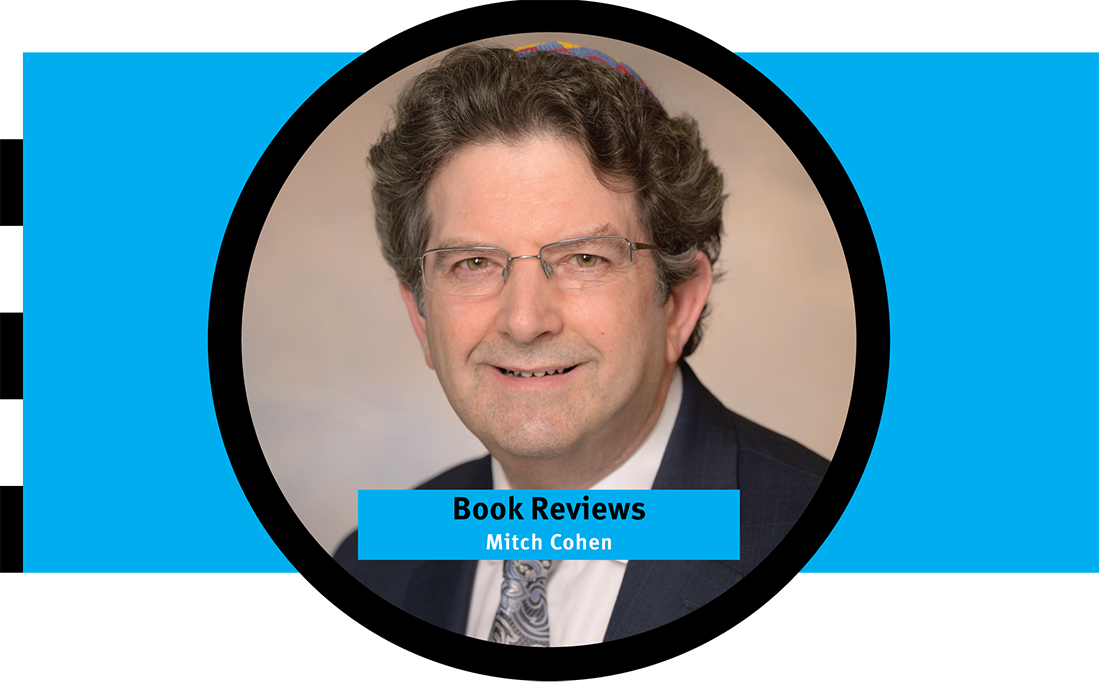
by Mitch Cohen

Reviewed: “Ten Seconds to Midnight” Author: Tova Citrin
When you say, “Next Year in Jerusalem,” at the end of the Passover seder, you aren’t just planning your next trip to Israel. You are repeating a Jewish code phrase with two thousand years of deeper meaning. Look closely around a synagogue, and you will find hidden symbols. I noticed a snake-like creature with a bell hanging from its mouth. There were several of these creatures holding up the bells on the silver Torah ornaments called “rimonim” in our synagogue display case. After digging deeper into the symbolism, I discovered that the creature wasn’t a snake. It was a Leviathan sea monster. As the prophecy goes, the Leviathan will be served at the celebratory feast after the final battle when good defeats evil. This will bring about a new age of peace to the world. My students have told me that stories like these sound like something from the Christian Bible, but I pointed out that they are very Jewish and rooted in our tradition. Popular novels like “The Da Vinci Code” investigate Christian artifacts, but there aren’t many thrillers that focus on Jewish prophecy.
“Ten Seconds to Midnight” is called a spiritual thriller by author Tova Citrin. In her notes she writes that after coming down with meningitis and becoming debilitatingly ill, she “set out on a personal and spiritual exploration—searching for healing by connecting to my own soul, Judaism, and to G-d.” Along the way, she met Reb Chaim of Yerushalayim. She says, “Meeting Reb Chaim was the turning point of my life. He was a walking mystery—a descendent of the Baal Shem Tov—he opened my mind and heart to everything beyond what is visible in the physical world.”
Citrin creates a fast paced gripping adventure. The story begins in Manhattan with her protagonist, David, waking up from a coma in the hospital not knowing how he got there. The reader follows David as he slowly figures out what is happening to him. He is visited by a persistent 87 year old Chassidic rabbi, Reb Nachum. Reb Nachum hands David a chocolate business card and a small pouch—the quest begins.
David is an unlikely hero. He is abrupt and self centered. Many of the characters are happy to point out his flaws, and one even calls him “Mr. Putz.” David reaches out to his ex-girlfriend, Aviya, who he left after a year-long relationship without even saying goodbye.
Up above the action, angels Gabe and Mike argue about a missing page torn out of a massive book called, “The Annual Manual.” The arguing angels help the reader learn the ramifications of what is happening down on earth. They also do their best to nudge the characters onto the right path.
On the dark side, we meet the character the Kabbalists call “Samech Mem” who represents the evil inclination in the world. Samech Mem and his minions take action to stop David. All out war breaks out as Israel is attacked from all sides at once. There are kidnappings and plenty of other obstacles to overcome. Will David and his crew be able to get to the answers in time?
The story has elements of Indiana Jones with a race to find lost Jewish artifacts. We travel from Manhattan to the mystical city of Tzfat. We navigate the caves of Qumran in search of the Copper Scroll and the ashes of the Red Heifer. Jews read about the Red Heifer every year in the Torah portion Parah. Parah means cow in Hebrew. The Torah instructs the priests to sacrifice a red heifer as a method of spiritual purification.
I enjoyed the Jewish references throughout the book. Reb Nachum’s safe combination was 613, the number of commandments in the Torah. There were conversations about going to Hebrew school that will ring true to many Jewish readers. There is a non profit organization in the book called “Narrow Bridge.” It is inspired by the Hebrew phrase, “kol ha olam kulo gesher tzar me’od, v’ha’ikar lo lefahed klal,” which means “The whole world is a very narrow bridge, and the main thing is not to be afraid at all.” Being afraid and conquering your fear are central themes in the book.
The author writes snappy and humorous dialogue that keeps the story moving and the pages turning. One of the first things I noticed was that the pages were filled with short sentences of back and forth dialogue.
Citrin introduces memorable characters, such as Aviya’s protective brother Diamond. He is not a fan of David, to say the least, but he becomes an important part of the adventure team. Diamond says, “I have protexia.” In Hebrew slang that means he has connections. He was able to procure military aircraft, a jeep, and more.
I’m doing my best not to give away spoilers in my review. There are reveals throughout the story all the way to the dramatic ending. I think the book can be read on different levels depending on the reader’s background. It can be fun summer reading as a Jewish adventure with a love story and elements of the supernatural. But if you have knowledge about the prophecies, you can connect even more. I taught classes on Jewish theology to high schoolers, and it was exciting for me to see those themes used in a novel.
It was a seven year journey for Citrin to finish her book. After moving to Israel, she joined a writers workshop. She would write five to seven pages a week and discuss them at the workshop. Then life happened, and her manuscript sat hidden on her shelf for another 15 years before she published it in 2026. She says, “Some books arrive on their own schedule. So do we.”
As a self-published book, it could possibly remain a hidden treasure, much like the Jewish artifacts in the story. Perhaps this review can light a path for readers to discover this unique novel. Not long from now, it is my hope that we can all be guests at the seder table with David, Aviya, and Reb Nachum—Next Year in Jerusalem.