Courtesy of JTA. Photo credit: Michael Kovac/WireImage/Getty Images
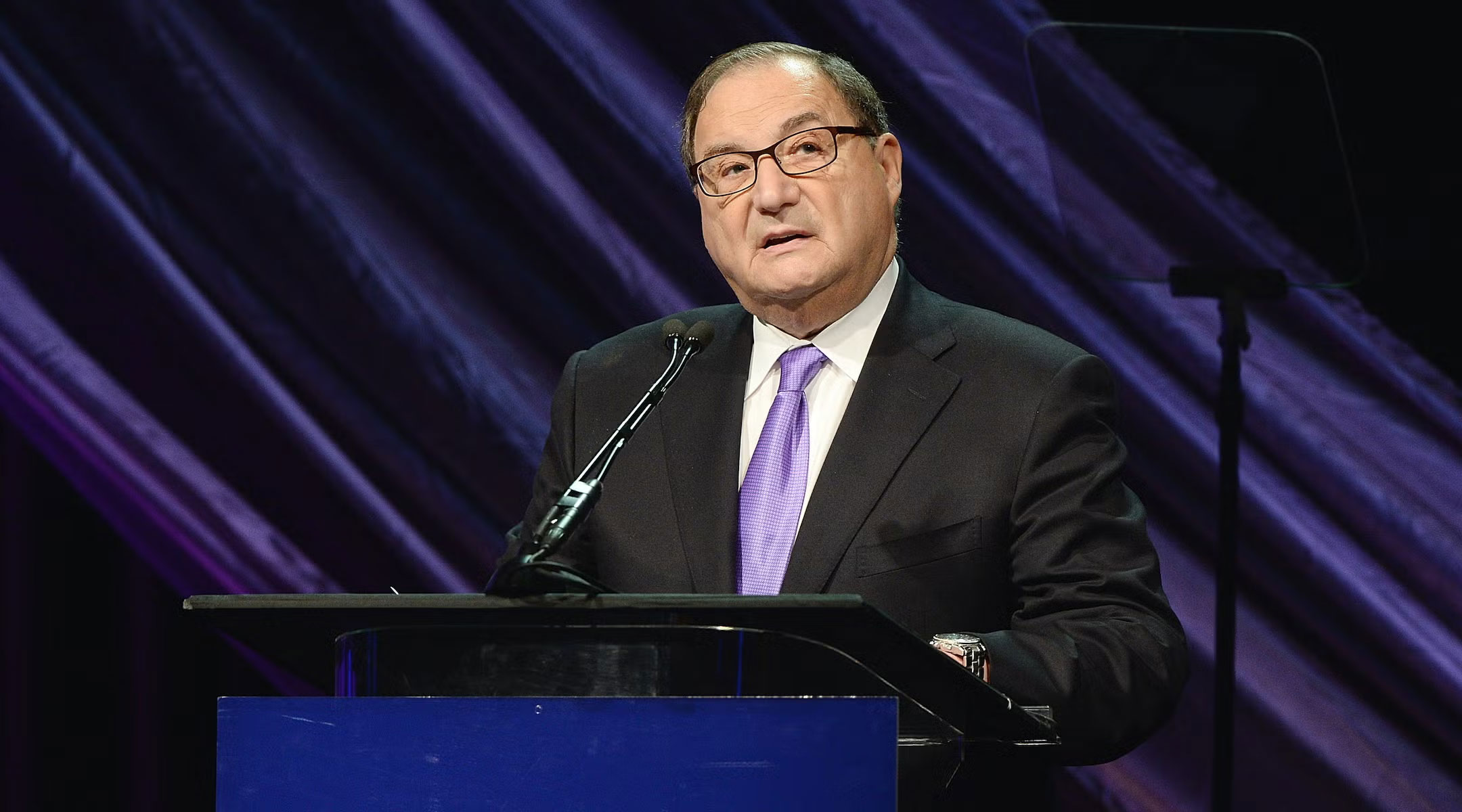
Abe Foxman at an Anti-Defamation League event at The Beverly Hilton Hotel in Beverly Hills, Calif., May 8, 2014
(JTA) — Abraham Foxman, the longtime leader of the Anti-Defamation League who for decades was the last word in post-Holocaust Jewish fury and forgiveness, has died at 86.
Foxman, a child survivor of the Holocaust, could be scathing and trenchant when he identified antisemitism infiltrating the public arena. But he was also an address for public figures who sought to divest themselves of a reputation of hostility toward Jews. And he did not spare himself, regretting crusades on behalf of Israel and Jewish communities he eventually admitted were wrongheaded.
“If you don’t believe you can change people’s hearts and minds, why bother?” he told The New York Times in 2020, when a columnist sought insights from what she called the “pardoner of sins” about the entrenchment of an unforgiving cancel culture. “If you are not going to try and change hearts and minds, why are you in this business at all?”
Under Foxman’s leadership, the ADL transformed from a division of the Jewish organization B’nai Brith into a muscular juggernaut running anti-bias educational and training programs, monitoring antisemitism in the United States and around the world and advocating for anti-discrimination legislation out of an array of regional offices. Foxman himself became a chief arbiter of what qualified as antisemitism — and the granter of absolution when he felt it was warranted. Some jokingly called him “the Jewish pope.”
He joined the ADL as an assistant director of legal affairs in 1965 and rose through a series of positions, including head of Middle Eastern affairs and head of international affairs, before becoming national director in 1987.
“We don’t have a slow season in our business,” he told the Jewish Telegraphic Agency at the time. “What we deal with is words. We’ve learned that words have the power to kill, that words unchallenged, left in silence, words of bigotry, are part of our tradition.”
Foxman thrived for decades in a political culture where the establishment still mattered, and extremism was not considered a virtue. He granted absolution to figures as diverse as former President Jimmy Carter and right-wing broadcaster Glenn Beck and as surprising as the fashion designer John Galliano.
Foxman also knew when to despair of reforming repeat offenders.
“When you say Mr. X engaged in antisemitism, the first time that they do it you can say it’s ignorance, it’s insensitivity,” he told the Jewish Telegraphic Agency in 2007, asked about his refusal to exonerate Hollywood star and director Mel Gibson. “But when you say to them that they are engaging in antisemitism when they say the Jews control the media and the Jews control universities, and when they repeat it the second time, the third time and the fourth time, are you or are you not an antisemite?”
“My answer would be ‘Thanks but no thanks,”’ Foxman told Reuters in 2004 when Gibson said he was contemplating a film about the Maccabees, the Jewish warrior class whose stunning victory over Greek colonists is the basis of the Hanukkah holiday. “The last thing we need in Jewish history is to convert our history into a Western. In his hands we may wind up losing.”
Foxman was born in Poland in 1940 and at 2 years old was left in the care of his Roman Catholic nanny in Vilnius, Lithuania, as his parents sought to escape the Germans. His nanny was his fierce protector and insulated him from the depredations of Nazis and their enablers, baptizing him and teaching him to handily hurl anti-Jewish epithets to fit in.
When his parents returned after the war, she would not give him up: It took bitter encounters in courtrooms to restore him to his family, and to the Jewish people.
Yet he could never hate her, he would often say later in life. “She risked her life,” he told the New York Times in 1991. “She saved my life.”
In 1950, four years after besting his nanny in the courts, Foxman’s parents took him with them to New York. There he attended the Yeshiva of Flatbush followed by the City College of New York and New York University Law School.
Foxman is survived by his wife Golda; his daughter Michelle and his son Ariel; and four grandchildren.