Courtesy of JNS. Photo credit: Amos Ben-Gershom/GPO
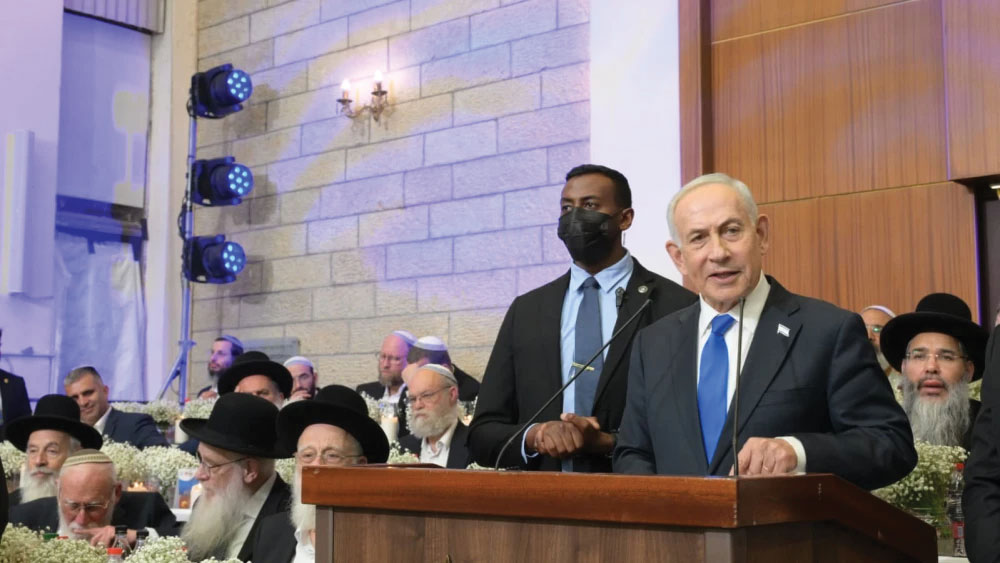
Prime Minister Benjamin Netanyahu addresses students at Jerusalem’s Mercaz HaRav yeshivah at the start of Jerusalem Day, May 14, 2026
(JNS) — Prime Minister Benjamin Netanyahu used a Jerusalem Day address at the Mercaz HaRav yeshivah on May 15, at night to link Israel’s recent military campaign against Iran with the legacy of the Six-Day War and the Jewish return to Judea and Samaria.
Speaking at a festive gathering marking 59 years since the reunification of Jerusalem, Netanyahu said Israel had “broken the barrier of fear” during the war with Iran and reaffirmed the Jewish people’s historic connection to the biblical heartland.
“We held a Bible in hand, and the Bible was alive,” Netanyahu said, recalling the aftermath of the 1967 Six-Day War. “The people of Israel live and the Land of Israel is their land; we returned to our birthplaces, we returned to our places, we returned to our land.”
Referring to Judea and Samaria, he declared: “This is our land and it will always be our land.”
Addressing rabbis, Cabinet ministers, lawmakers and students alongside his wife, Sara Netanyahu, the premier drew parallels between ancient Persia and modern-day Iran, saying Israel had once again overcome an enemy bent on the destruction of the Jewish people.
“At the moment of truth, we stood tall,” Netanyahu said. “We brought the war back to our enemies’ gates. We defended our existence with infinite determination.”
Referring to “Operation Roaring Lion,” the Israeli campaign launched on Feb. 28 against Iran’s nuclear and missile infrastructure, Netanyahu said the Jewish state had thwarted an existential threat.
“Had we not done so, Iran would have at least one atomic bomb today,” he said. “We rose like a lion, we roared like a lion, and we do not stretch our necks out to the slaughterer. That thing has ended in the history of our people.”
Netanyahu said Israel had returned all of the hostages abducted to Gaza during the war that began on Oct. 7, 2023, “down to the very last one,” while also rejecting calls to halt military operations prematurely.
“There were those who said: ‘Get out, get out!’ We did not get out,” he said.
The prime minister credited Israelis with embracing a new spirit of confidence and initiative.
“The greatest thing we did was that we broke the barrier of fear,” he said. “We do not huddle in our own four cubits. We go out into the expanse. We initiate, we act, we attack, we crush our enemies.”
Netanyahu framed the current conflict as part of a centuries-long Jewish struggle for survival, sovereignty and redemption in the Land of Israel.
“We survived the upheavals of time — thanks to the struggle,” he said. “We established our state, thanks to the struggle. We maintained our independence, thanks to the struggle. We unified Jerusalem, our capital, in a miraculous defensive war 59 years ago, thanks to the struggle.”
Netanyahu devoted a major portion of his address to the teachings of Rabbi Abraham Isaac Kook (1865–1935), founder of Mercaz HaRav and one of the central spiritual figures of Religious Zionism, whose philosophy deeply influenced the post-1967 settlement movement in Judea and Samaria.
Citing a 1932 essay by Kook titled “To Add Courage,” Netanyahu described the Zionist enterprise as a difficult but sacred process of perseverance and redemption.
“Some of the diggers get tired and quit the work,” the prime minister said, quoting Kook’s description of “the weary of body and the weak of soul.
“But the one who does not despair, the one who clings to the path, the one who believes in the renewal and realization of the vision, is the one who will find pure and clear water in the depths of the well,” he continued.
Netanyahu said the message reflected his own worldview and leadership.
“This is also my way, as the prime minister of Israel,” he said. “Our mission is to ensure, with God’s help, the eternity of Israel.”