

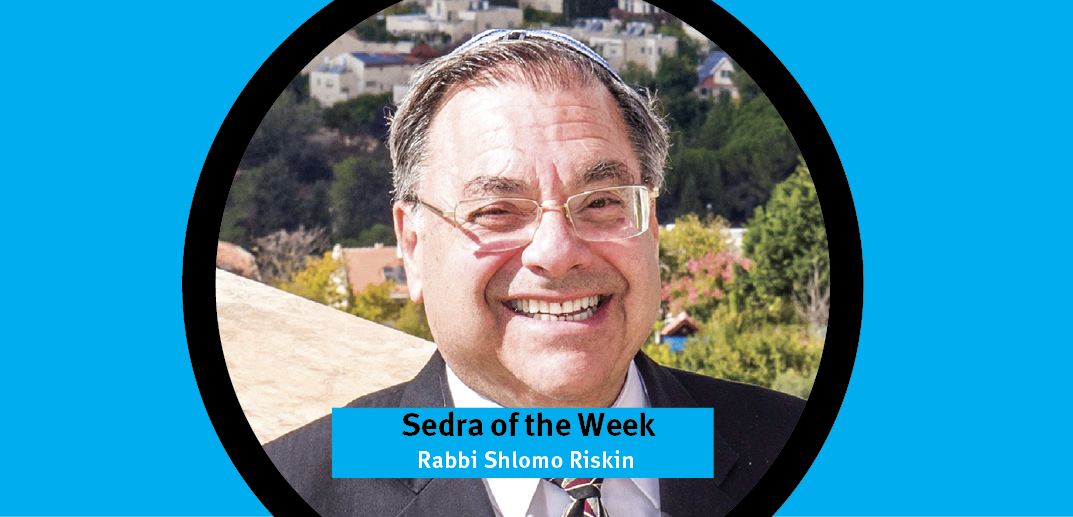
Efrat, Israel — “Count the heads of the entire witness community of the children of Israel.” (Numbers 1:2)
The article below is from Rabbi Riskin’s book “Bemidbar: Trials & Tribulations in Times of Transition,” part of his “Torah Lights” series of commentaries on the weekly parsha, published by Maggid.
The book of Numbers opens with a most optimistic picture of a nation poised for redemption. The Israelites have been freed from Egypt with great miracles and wonders; they have received the Revelation at Sinai, which provided them with a moral and ethical constitution for a soon-to-be established sovereign state, along with a commitment of faith to be a holy nation and a kingdom of priests, which is their mission for the world; the twelve uniquely endowed and individually directed tribes, each with its own flag, are united around a common Sanctuary dedicated to divine service; a standing army is organized; the tribe of Levi is trained to teach Torah and fulfill all the requirements for the sacrificial service. The only missing ingredient is the necessary obligatory war to pave the way for our settlement of the Promised Land of Israel!
But what follows instead is a total degeneration, a descent from the heights of an exalted rooftop down to the depths of a muddied pit. The Hebrews become involved in petty squabbles and tiresome complaints; the reconnaissance mission decides against the attempt to conquer Israel; Korach, Datan, and Aviram stage a rebellion against Moses; a prince of the tribe of Simeon defies Moses’ leadership by publicly fornicating with a Midianite woman; the entire desert generation dies in the wilderness; and only Moses’ successor, Joshua, and the newly-born generation will get to live in the Promised Land.
What happened and why? How could a nation so committed that it pledges “Whatever the Lord has spoken we shall do and we shall internalize” (Exodus 24:7) completely lose their sense of purpose and idealism and “gang up” against the very individual who was their great liberator and law-giver?
I believe that the reason for the change is hinted at in the Midrashic name of this fourth book of the Bible, Sefer Pikudim – the “Book of Censuses” in Hebrew, or the book of Numbers (number counts) in English, after the two censuses, or number counts, of the population, which are taken between its covers. Indeed, our book (and this portion) opens with the command to count the Israelites, stipulating as follows:
“Count the heads of the entire witness community of the children of Israel, by their families, by their parents’ houses, with the number of names of each male body, from twenty years of age and above, all that are able to go forth to war in Israel.” (Numbers 1:2–3)
Such are the details of the census given at the beginning of the book, when the Israelites are still imbued with a vision of mission and “manifest destiny,” and when we still expect them to wage a war for the liberation of the Land of Israel.
However, twenty-five chapters later, after the scouts’ refusal to attempt to conquer Israel, after the various rebellions against Moses culminating in Prince Zimri ben Salou’s shameful public adultery with the Midianite Kozbi bat Tzur directly in front of the presence of Moses himself, a second census is ordered:
“Count the heads of the entire witness community of the children of Israel, from twenty years of age and above, with their household parents, everyone eligible for army conscription.” (Numbers 26:2)
It is clear that the identification of each Israelite for the purpose of the census is radically different in the second census from the way it was in the first census. The first time the count included “the families [proving everyone’s tribal affiliation harking back to Jacob, Isaac, and Abraham], the household parents, and the individual personal names”; the second time, the tribal affiliation and the personal names of each were missing, with only the names of the household parents of each individual provided!
Clearly, herein — between the lines of the significant omissions — lies the secret of the degeneration of the Israelites. This is apparently why the Midrash names this the “Book of Censuses” (Sefer Pikudim) rather than the Book of the Desert (Bamidbar): in order to point us towards the solution to our presenting problem by highlighting the different stipulations of each census respectively. In the first census, taken during the heyday of the generation of the Exodus, each individual Israelite felt connected to his tribal parent, to his biblical patriarchs and matriarchs; by the second census, however, that connection was woefully gone, and the individual only related to his immediate biological parents. Allow me to explain.
The book of Exodus, our birth as a nation, is built upon the book of Genesis, our origins as a very special family. The patriarchs and matriarchs were originally chosen by God because of their commitment to “compassionate righteousness and moral justice” — traits which would make them “a blessing for all the nations of the world” (Genesis 12:3) and ideals to which they were to “command their children and their households after them” (Genesis 18:19). This unique Hebraic culture was to be nurtured and developed within a special land, the Land of Israel, which is the very “body” and the national expression, the physical matrix, of our eternal covenant with God. Only against the backdrop of their land and state would Israel be able to teach compassionate righteousness and moral justice to the other nation-states. The towering personalities of the book of Genesis develop, falter, repair, sacrifice, persevere, and ultimately prevail on these twin altars of commitment to land and law, to sensitive humanity and sovereign nationality; these founding parents established the foundation for the continuity of an eternal people through whom the entire world will eventually be blessed by the peace of ultimate redemption.
“Yichus,” lineage or pedigree, has little to do with privilege and special rights but has everything to do with responsibility and ancestral empowerment. Grandfather Jacob blesses his grandchildren, the sons of Joseph, that “they shall be called by his name and the name of his ancestors, Abraham and Isaac” (Genesis 48:16); this does not only mean naming them Abe and Ike and Jackie but rather means linking them to their patriarch’s ideals, to their values, to their commitments. It also means endowing them — and empowering them — with the eternal promise they received from God that their seed would inherit the Land of Israel and would eventually succeed in conveying to the world the message (and blessing) of divine morality and peace.
Tragically, the desert generation lost its connection with the book of Genesis, with the mission and empowerment, with the dream and the promise of the patriarchs and matriarchs of their family. As a consequence, the second census no longer connected them to the tribal children of our patriarchs and matriarchs. And the loss of connectedness to Abraham and Sarah resulted in a disconnect from the God of our forebears, from the promise and the covenant of that God, from the unique message and mission of Israel provided by the DNA and idealistic life-models of our ancestors. That generation lost faith in itself, became in “their own eyes as grasshoppers, and so were they in the eyes of their enemies,” and lost the courage to conquer the land, despaired of the dream to teach the world. By disconnecting from their past, they lost their future; and so, they did not even merit individual names, names which would count and could only be counted if they were linked with the proud names which founded Jewish eternity. Herein lies the secret of the dissolution of the desert generation. Are we in Israel today not faced with a similar disconnectedness from Abraham, Isaac, and Jacob, from Sarah, Rebecca, Rachel, and Leah, patriarchs and matriarchs of our past who must always remain paradigms for our future?
Shabbat Shalom
Rabbi Shlomo Riskin
Founder & Rosh Yeshiva,
Ohr Torah Stone
Founding Rabbi of Efrat