Courtesy of JTA. Photo credit: Screenshot from YouTube
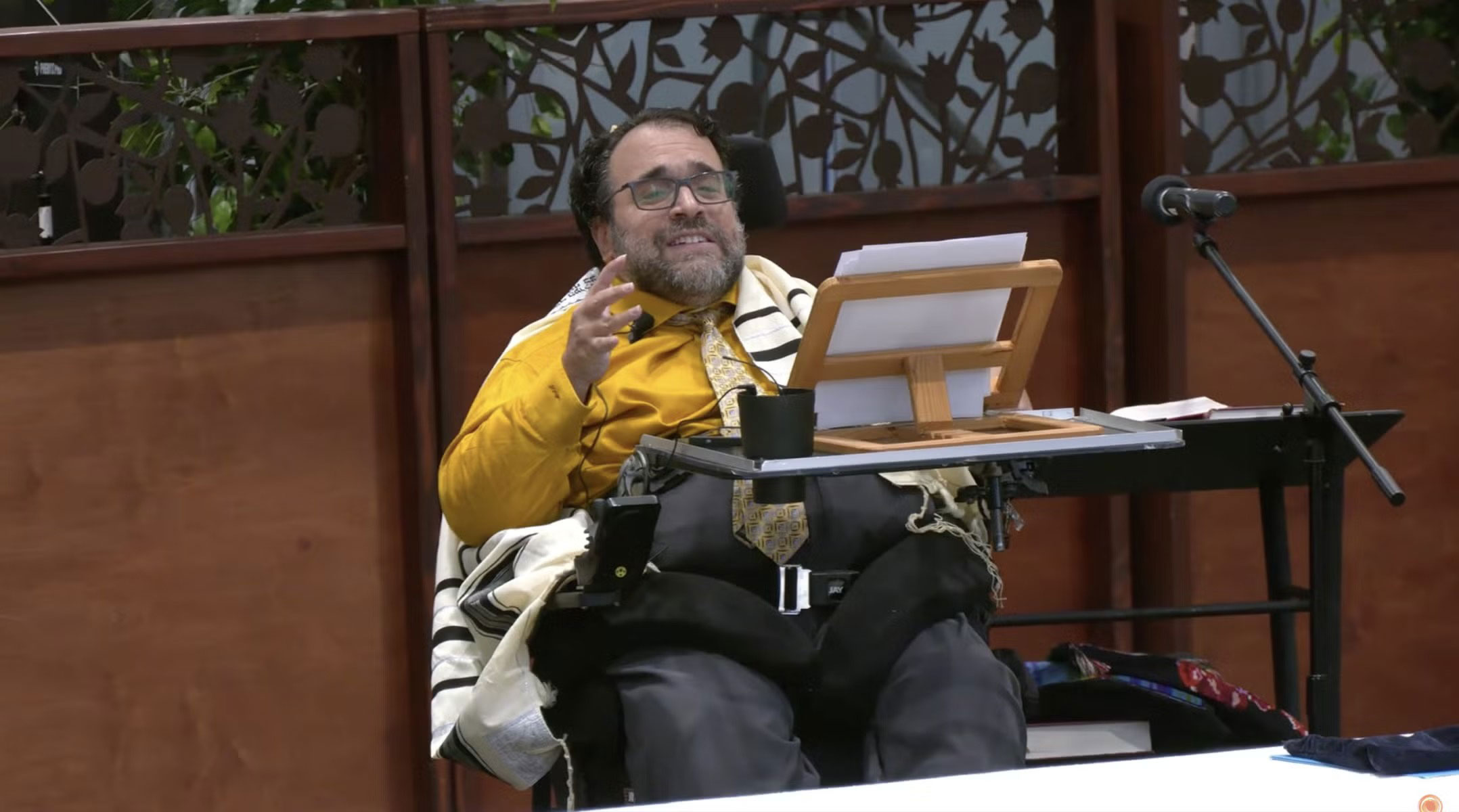
Matan Koch speaks at Ikar, his Los Angeles synagogue, on Disability Shabbat, Oct. 18, 2025
(JTA) — Matan Koch needed little introduction as he rolled up to the podium to speak at his synagogue’s Disability Shabbat service in October. His wide smile and power wheelchair made him well known to many at his Los Angeles congregation, Ikar.
Still, Rabbi Sharon Brous, beaming at him, described her congregant warmly before ceding the microphone.
“The most important thing for you to know about Matan is that he is a deeply soulful, profoundly decent, and incredibly kind human being. And every single day that you have been in our community, you have made our community better,” she said. “It’s an absolute joy and honor to davven (worship) with you, to call you a friend, and to have you as a beloved member of our community.”
In the sermon that followed, Koch described times that he had felt excluded from Jewish communities, or struggled to be included, because of his own disabilities.
Born in 1981, in New Milford, Connecticut, Koch was both brilliant and precocious and from an early age moved through a world not built for his body with clarity and determination, according to Rabbi Shira Koch Epstein, one of his four siblings.
Born prematurely, he had cerebral palsy, a neurological condition that severely limited his mobility and required him to use a wheelchair.
Koch advanced to Yale University at age 16 and went on to Harvard Law School when he was just 20, graduating in 2005. He held numerous appointments on disability rights committees, first at Yale and then as vice president of the New Haven Disability Commission. In 2011, President Barack Obama tapped him to serve on the National Council on Disability.
“His whole life was breaking glass ceilings,” Epstein told the Jewish Telegraphic Agency in a phone conversation just hours before Matan’s death.
Rabbi Jonah Pesner, director of the Religious Action Center of Reform Judaism and senior vice president for the Union for Reform Judaism, was the director of education at Camp Eisner when Koch was a camper. He recalled a time when Koch asked Pesner to help him to go to the bathroom.
Koch led Pesner back to the bunk and explained step-by-step, how to assist, with laughter and without making Pesner feel self-conscious.
At one time, Koch hoped to attend Hebrew Union College and become a rabbi, Pesner recalled. He and others tried for a long time to make it happen. But Koch’s complex medical needs couldn’t be overcome within the school’s physical and programmatic constraints at the time.
“It’s the biggest regret of my career that we could not figure out how to get him rabbinic ordination,” Pesner said. “I think it was a loss for the Jewish people.”
Yet Koch never stopped pressing Jewish communities to rethink how they treat members with disabilities, challenging up-and-coming leaders at the Reform movement’s youth conference and being honored in 2016 by the Jewish disability inclusion organization Matan.
“Sometimes you can be a change-maker and be a person who’s putting out really big ideas, but sometimes it can come with a sharp edge,” Rabbi Rick Jacobs said in a movie compiled to honor Koch at the time, which also included a tribute from the actress Mayim Bialik. “With Matan, it comes with love, and he raises people up.”
Meredith Polsky, the director of the organization Matan, said in an email that her group would continue the mission of the friend and advocate who shared its name — a name meaning “gift” in Hebrew.
“Though his final breath came far too soon, we carry that charge forward, committed to building a Jewish community that reflects his vision of true inclusion and belonging,” Polsky wrote.
Koch’s father Norman died in 2015. Koch is survived by his mother, Rosalyn Koch, siblings Rabbi Shira Koch Epstein and Jason, Yonatan Koch, Adina Koch and Aytan Koch; nieces and nephews Amichai, Kobi, Avigayil, Duncan and Jason and his honorary family: Martin Smith, Jack and Stephanie Rubin and their children Olivia and Edward.