Courtesy of JNS. Photo credit: Official State Department Photo by Freddie Everett
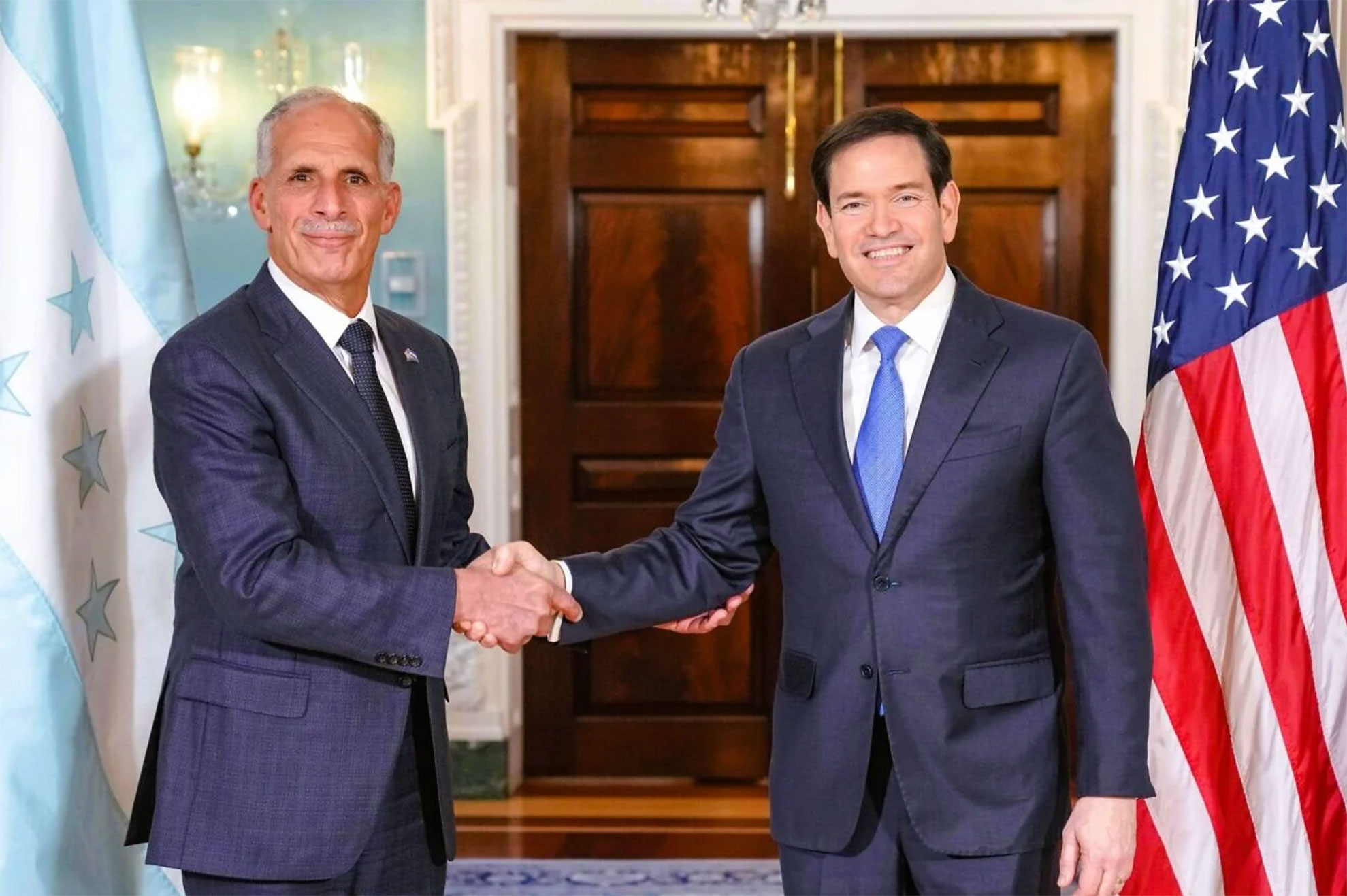
U.S. Secretary Marco Rubio meets with Honduran President-elect Nasry Asfura at the U.S. Department of State in Washington, D.C., Jan. 12, 2026
(JNS) — Two members of a coalition of countries formed solely to punish Israel have withdrawn.
Honduras and Bolivia announced on Mar. 4 their departures from the Hague Group. Both nations recently came under new leadership and have established warmer ties with Israel than their predecessors.
Neither nation specifically cited Israel in their respective withdrawal announcement, instead pointing to their decisions as stressing the sovereignty and autonomy of their countries, in addition to channeling international issues through the proper forums.
Nevertheless, Gideon Sa’ar, Israel’s foreign minister, praised the moves.
On social media, he commended Nasry (“Tito”) Asfura, the new president of Honduras, for taking “a principled step against evil in the international arena. Israel values this moral stance and its strong friendship with Honduras.”
Sa’ar also applauded Bolivian President Rodrigo Paz Pereira “for his moral decision to withdraw from the Hague Group. This is a necessary, principled move confronting evil,” adding “Thank you, Bolivia, for standing on the right side of history.”
Israel and Bolivia reestablished diplomatic ties in December. They were severed two years earlier under a leftist government amid a rupture coming about during the Israel-Hamas war.
The Hague Group was formed in early 2025 to bring the so-called global south together “to take ‘coordinated legal and diplomatic measures’ against Israel’s violations of international law.”
It now includes South Africa, Colombia, Malaysia, Namibia and Senegal, though it attracted approximately 30 states to an “emergency summit” in Bogotá, Colombia, last July. Thee, it announced a series of measures, including preventing weapons transfers to Israel, that it said will bring about an end to Jerusalem’s war against Hamas.
Twelve of the 30, including Bolivia, Colombia, Cuba, Indonesia, Iraq, Libya, Malaysia, Namibia, Nicaragua, Oman, South Africa and Saint Vincent and the Grenadines, pledged to implement half a dozen measures, including preventing the “provision or transfer” of weapons, military equipment, and fuel and dual-use items to Israel.
Vessels thought to be carrying such products to Israel would be barred from transiting or docking at any participating country’s ports, and such vessels would not be allowed to bear the flag of the 12 states.
Each participating state said it would also launch an “urgent review” of its public contracts to ensure they do not support Israel’s so-called “occupation” of Palestinian territory.
States must also “comply with obligations to ensure accountability for the most serious crimes under international law” through independent investigations and support “universal jurisdiction mandates,” which would put Israelis in the crosshairs of any state’s legal pursuits.
Algeria, Botswana, Brazil, Chile, China, Djibouti, Honduras, Ireland, Lebanon, Mexico, Norway, Pakistan, Portugal, Qatar, Slovenia, Spain, Turkey, Uruguay and Venezuela also joined the summit, as did the Palestinian Authority.
Many of the countries that attended the summit are critics of the West, though Qatar and Turkey are purported U.S. allies. Since the conference, Turkey, Colombia and Norway have each taken significant measures, including trade and financial restrictions.
A spokesman for the U.S. State Department told JNS at the time that Washington “strongly opposes efforts by so-called ‘multilateral blocs’ to weaponize international law as a tool to advance radical anti-Western agendas.”
The Hague Group “seeks to undermine the sovereignty of democratic nations by isolating and attempting to delegitimize Israel, transparently laying the groundwork for targeting the United States, our military and our allies,” the spokesman said.