Courtesy of JTA. Photo credit: Larry Luxner
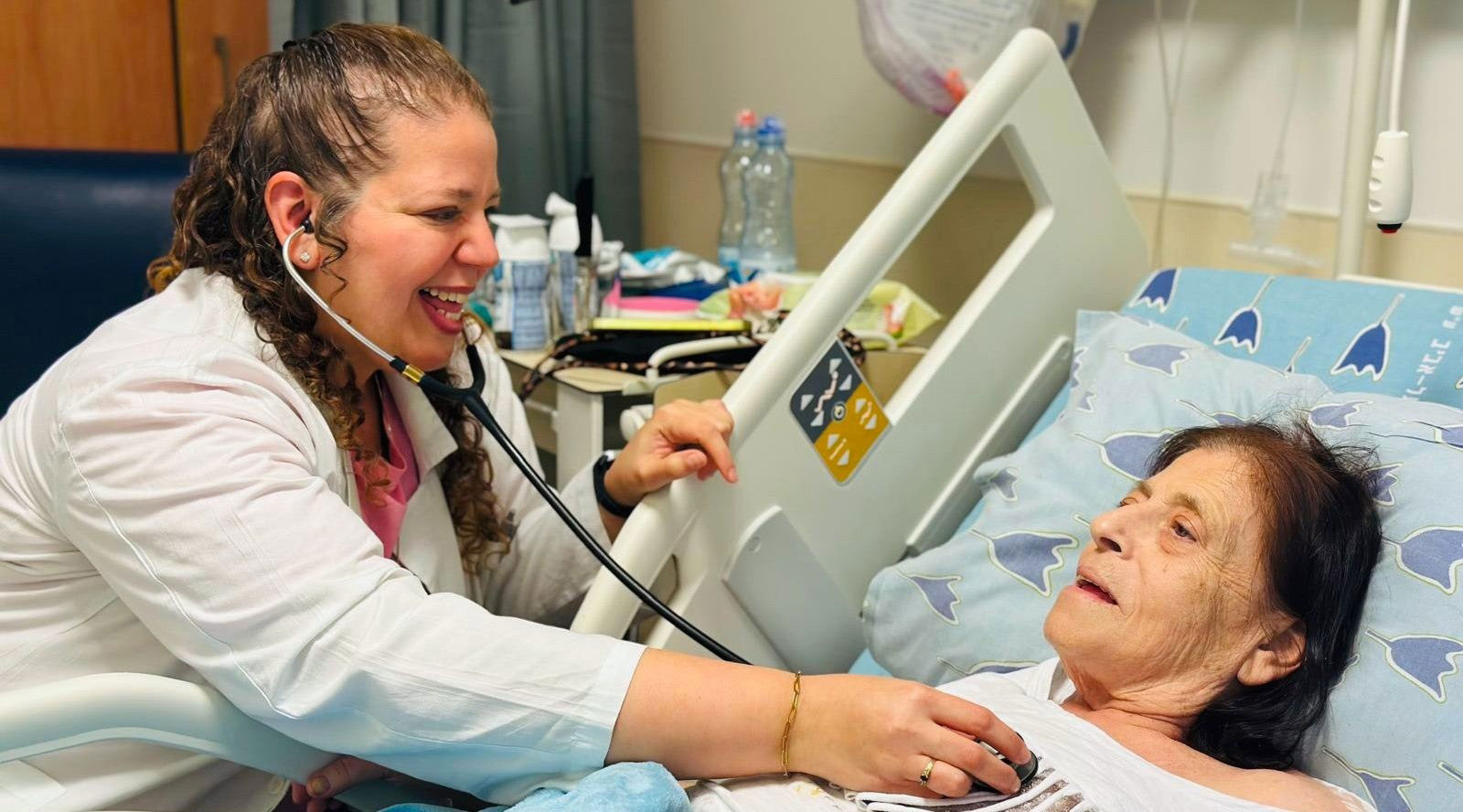
Osnat Steiman examines a patient in the geriatric ward of Ichilov Tel Aviv Sourasky Medical Center
(JTA) — Dr. Olivia Keller-Baruch had long dreamed of working as a doctor in Israel.
But when Keller-Baruch, 29, immigrated recently after finishing her residency at the University of Missouri, she received assistance that smoothed the path to getting credentialed in Israel and quickly finding a job in the Emergency Department at Ichilov Tel Aviv Sourasky Medical Center.
Keller-Baruch is among more than 1,000 doctors who have immigrated to Israel since the launch, in 2024, of the International Medical Aliyah Program (IMAP) — a joint effort headed by Nefesh B’Nefesh in partnership with Israel’s Ministry of Health, the Ministry of Aliyah and Integration, the Ministry of the Negev, Galilee and National Resilience, and the Jewish Agency for Israel.
The program aims to bring 2,000 doctors to Israel by 2029 to help relieve the country’s increasingly dire physician shortage, with support from the Marcus Foundation, the Gottesman Fund, Jewish Federations of North America, the Azrieli Foundation and the Arison Foundation.
Israel’s physician scarcity is due to a number of factors: the retirement of Russian doctors who immigrated to Israel en masse in the 1990s after the fall of the Soviet Union, a decision by the Israeli medical establishment to stop accepting medical degrees from various institutions in Eastern Europe as well as the limited number of seats in Israeli medical schools, according to Tony Gelbart, co-founder and chairman of Nefesh B’Nefesh.
“Israel never fully adjusted for this, resulting in a bottleneck in residency and internship positions,” said Tony Gelbart, whose organization facilitates Aliyah from North America. “The convergence of these factors is creating an impending crisis.”
The International Medical Aliyah Program is bringing accredited physicians to Israel by helping speed their credentialing process and easing their immigration with concierge-style services.
“Physicians interested in aliyah arrive with their diplomas and certifications in hand, some still in frames, and are licensed on the spot,” Gelbart said. “Rather than landing in Israel and waiting nine months for paperwork and processing, physicians complete the licensing process prior to aliyah. Upon arrival, they receive citizenship and, within a week, are able to practice.”
The International Medical Aliyah Program also aims to help doctors find jobs and homes in Israel’s periphery, where the physician shortage is even more severe.
Although Nefesh B’Nefesh generally focuses exclusively on immigrants from North America, its work for the International Medical Aliyah Program is global. In recent months, the organization has held MedEx events in New Jersey, Los Angeles, Paris, London, Buenos Aires, Sydney and Melbourne. In November last year, MedEx launched in Canada, with more than 500 attendees in Toronto and Montreal.
At such events, doctors often sit for interviews with representatives of major Israeli hospitals, including Ichilov, Hadassah, Rambam, Kaplan and Galilee Medical Center, as well as Israel’s four health maintenance organizations.
Doctors who move to Israel should speak serviceable Hebrew, be prepared financially and find a strong support system. The International Medical Aliyah Program can help with all those elements, and ease the daunting administrative side of things.
Asked if she has any advice for physicians considering aliyah, Keller-Baruch said, “Don’t be afraid to make the jump. Despite all the hardships we’ve experienced, these terrible things will only help us grow back stronger.”