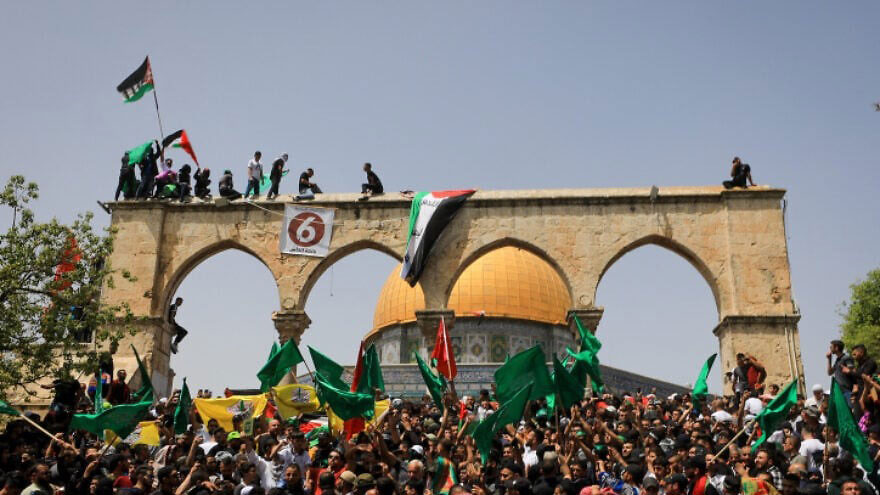
Courtesy of JNS. Photo credit: Jamal Awad/Flash90
Muslims chant anti-Israel slogans near the Al-Aqsa mosque on the Temple Mount in Jerusalem on the last Friday of Ramadan, April 29, 2022
(JNS) — Israel Police enforcement against noise from mosques surged by 1,200% in 2025, though enforcement in Judea and Samaria remains limited, the Knesset National Security Committee heard on Jan. 6.
Police representatives told lawmakers that they received 1,920 public complaints related to mosque noise in 2025, resulting in 193 fines, as well as the removal of loudspeakers and other enforcement actions.
“There exists an orderly process starting with dialogue and explanation, agreements, technological systems that allow control of noise levels, and up to fines,” Israel Police Supt. Shay Malichi said. “If all of this does not work, we move to an investigation with the aim of filing indictments.”
However, in Judea and Samaria, enforcement is limited to exceptional circumstances due to the political agreements the Jewish state signed with the Palestine Liberation Organization in the 1990s, which led to self-governance in some areas, a military legal expert told the panel.
Enforcement can be carried out in cases “involving harm to public order and to the security of Israeli communities and nearby IDF bases,” the IDF major told the Knesset members. Although the Cabinet decided to allow IDF enforcement in Area B, which is under joint Israeli and Palestinian Authority control, in Area A, which is under full P.A. jurisdiction, approval by the political echelon is required for each specific enforcement action, she noted.
A representative of the Israel Police’s Judea and Samaria District said the force was working to establish an “operational framework” after it received a legal opinion stating that there is “some way to act.”
Otzma Yehudit Party lawmaker Tzvika Foghel, chairman of the National Security Committee, said that legislation he has promoted to limit noise from mosques could also be enforced in Judea and Samaria, saying it was “not a religious war, but a right to quality of life and health.”
Foghel is advancing legislation aimed at tightening enforcement against calls to prayer from public address systems, the MK told JNS last week.
Under the legislation, operating a public address system for calls to prayer would require a permit. Permit applications would be reviewed based on noise levels, efforts at noise-reduction and the mosque’s location, as well as the impact on nearby residents.
“Fines will be high, and those who do not pay will have their equipment confiscated,” he said on Tuesday. “If that does not help, we will close the mosque.
“If it continues, we will dismiss the imam, and if necessary, we’ll arrest whoever needs to be arrested so that the right to live under normal conditions is upheld,” vowed the committee chairman.
Following the outbreak of the war on Oct. 7, 2023, police have noted that most mosques’ calls to prayer have increased in volume “in a significant manner, which caused serious harm to residents,” Foghel told JNS.
The Muslim call to prayer, the adhan, dates back to the time of Islam’s founder, Mohammed. A muezzin would proclaim the adhan five times daily. In modern times, the reach has been amplified by loudspeakers.
Of the five prayer times, the most problematic is the dawn prayer, which in winter takes place around 5 a.m. and in summer around 4 a.m.
Several European nations have imposed limits on the volume of mosque sound systems. So has Saudi Arabia, the seat of Islam’s two holiest sites.
In 2021, Riyadh’s Minister of Islamic Affairs, Dawa and Guidance Abdullatif bin Abdulaziz Al-Sheikh ordered mosque loudspeaker volume cut to one-third of the maximum, saying the move was prompted by citizens’ complaints about excessive noise.