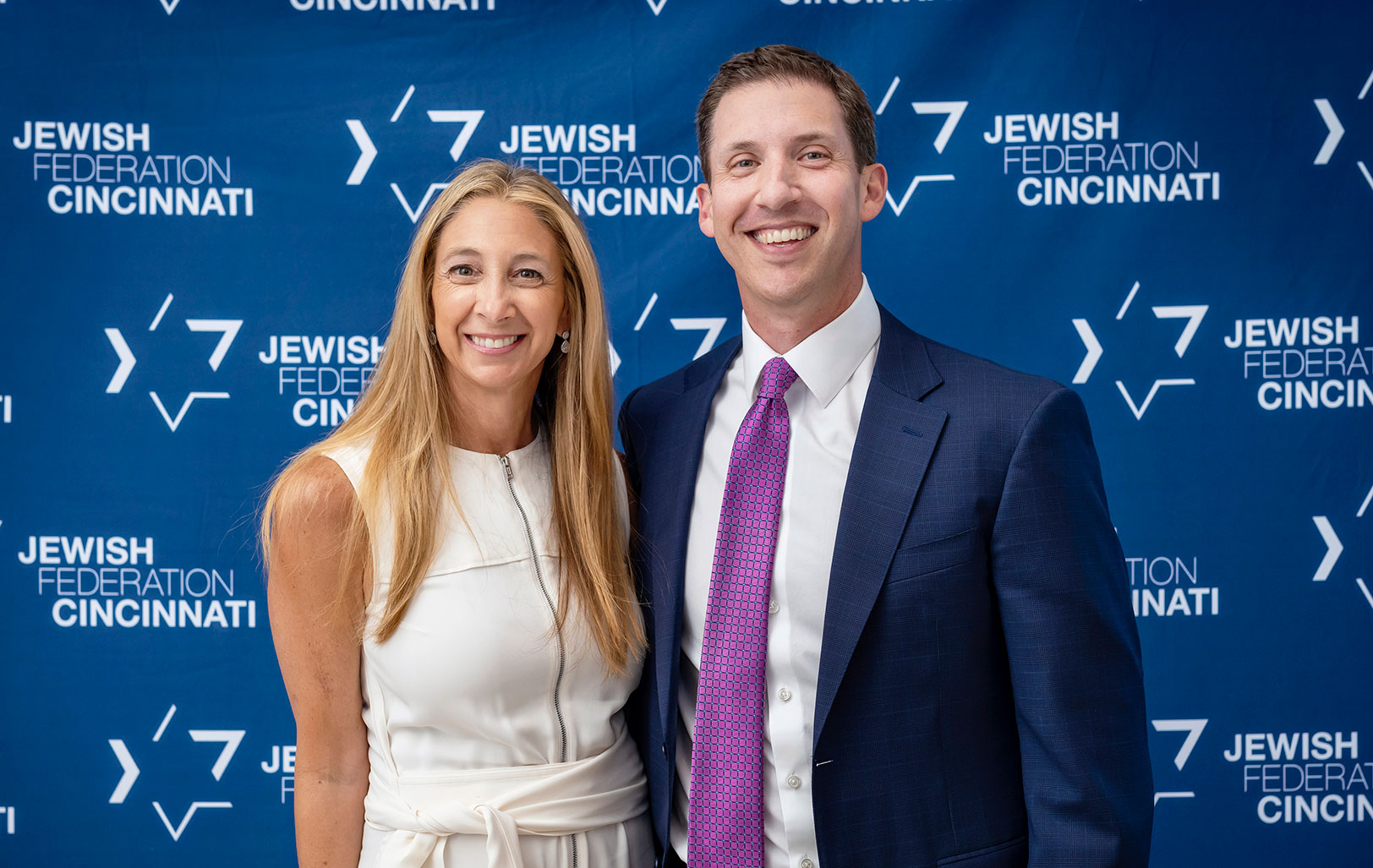
Photo credit: Jewish Federation of Cincinnati
Rini Levy and Ed Kuresman invite our community to give to the Annual Campaign as 2026 begins
Submitted by Jewish Federation of Cincinnati
Ed Kuresman doesn’t see the Annual Campaign as charity. He sees it as necessity. “It’s how we take care of each other,” he says. “The need has always been there. It will always be there. The needs shift, but they never go away.”
Rini Levy puts it more plainly.
“It’s on us,” she says. “If we don’t take care of each other, who will?”
When Ed and Rini were asked to co-chair this year’s Annual Campaign, they started with the same question a lot of donors ask: Why give now?
What convinced them was simple. They’ve watched Jewish Cincinnati show up for their family, their friends and people they will never meet. This year, with rising costs and a sharper sense of vulnerability in Jewish life, they see the Annual Campaign as more than a year-end tradition. It’s how a community stays steady.
One gift does three things. First, it helps people who need support right now. That might be a Rockwern student who needs counseling, or a reservist in Israel who needs mental health support. It also keeps Jewish life visible and accessible, like Hanukkah celebrations or expanding Camp Livingston opportunities to more kids in urban centers. And finally, it strengthens the security and coordination that make all of it possible, including yearly safety training for all Jewish organizations and institutions in the city. “I think people may not realize the immense impact Federation has on their own lives,” Rini says.
Some people think the Federation is just a pass-through for a few big institutions. It’s not. The Annual Campaign is what lets us respond quickly when real life happens. That’s why Ed and Rini keep coming back to the same point. This isn’t charity. It’s necessary infrastructure. It’s what lets Jewish Cincinnati show up quickly and remain steady.
That can mean emergency food and financial support. Or counseling and senior services. It’s camp scholarships and Israel experiences that shape identity. It means Holocaust education for local students and holiday gatherings that make Jewish life feel lived, not theoretical. Across Cincinnati, it’s the difference between a program that exists on paper and an experience that feels open and alive.
This is why Ed and Rini have made increasing their gift a family practice. “We feel fortunate to be part of this community,” Rini says. “So, whenever we are able, we aim to increase our support. We’re mindful that many families are facing real challenges, and we’re grateful for the opportunity to increase our gift whenever we can.”
Their decision reflects a belief that stability matters most when life feels uncertain. We live in a moment when even routine acts of Jewish life can feel different. Dropping off a child at preschool. Attending Shabbat services. Celebrating a holiday with friends.
Annual Campaign dollars help sustain the security coordination that works quietly behind the scenes with synagogues, schools and agencies. This coordination, Ed notes, “Could not have been done without the professional staff at the Jewish Federation and SAFE Cincinnati.”
For many donors, this is the most visceral reason to give now: to strengthen our community’s safety. But the Annual Campaign doesn’t just protect what we have. It builds what comes next, even if that is years away.
Ed first got involved through the Federation’s LEAD program almost two decades ago. “The only reason I’m doing this today is because the Federation invested in me,” he says. “I wouldn’t be here otherwise.”
Leadership development is not glamorous. Board training doesn’t make headlines. Getting agencies to collaborate instead of compete doesn’t trend on social media. But it’s the difference between a community that grows and one that stagnates.
Rini’s simplest argument for skeptics is trust. “I have seen firsthand the impact the money makes,” she says. “I know it’s going where it needs to go. It reaches who it needs to reach.”
Ed puts it in practical terms. “One check is the equivalent of writing a hundred smaller checks,” he says.
They’re also clear about the moment we’re in. Economic uncertainty has made generosity complicated for some families. But inflation hits the organizations people rely on, too. “We don’t want people to give if they’re struggling,” Ed says. “But if you have the ability, this is the moment to step up.”
As Rini puts it, “The gift is needed now more than ever.”
Ed and Rini believe one gift helps keep Jewish Cincinnati steady, caring and ready for whatever comes next.