Courtesy of JNS. Photo credit: Evan Schneider/U.N. photo
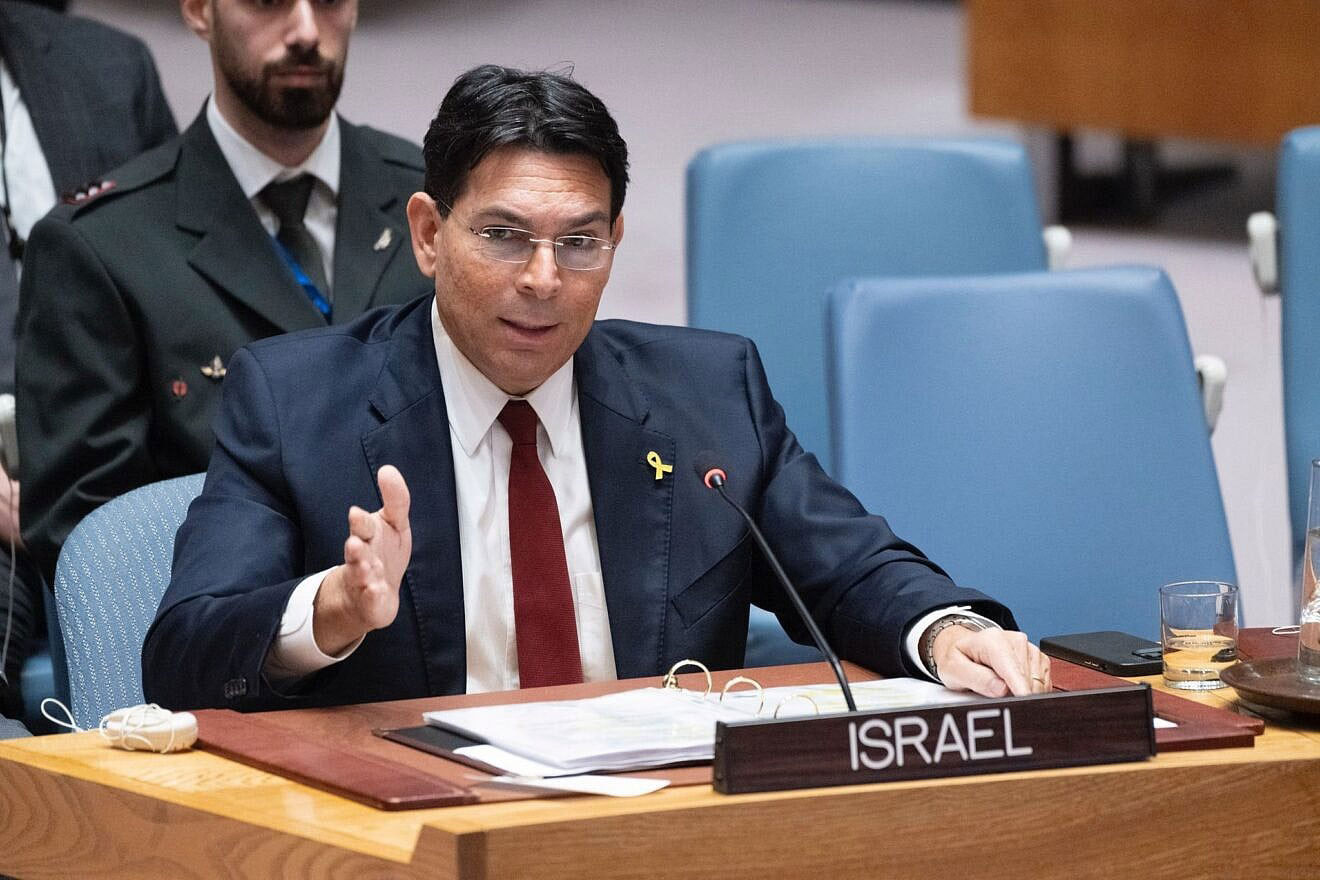
Danny Danon, the Israeli ambassador to the United Nations, addresses the Security Council on June 4, 2025
(JNS) — Israel’s envoy to the United Nations claimed this week that the global body spends upward of $100 million on anti-Israel activity each year.
Ambassador Danny Danon said the United Nations intends to soon approve its 2026 operating budget, and that his office has identified the $100 million “which is dedicated to activities against the state of Israel — to investigations, to discussions, to comprehensive decisions that work against us.”
The U.N. Relief and Works Agency, commonly known as UNRWA, is tabbed to receive $86.5 million next year, according to documents viewed by JNS.
The Palestinian-only aid and social services agency is under fire for ties to Hamas, and several countries and entities, including the United States, have suspended and reduced funding for the agency.
U.S. Secretary of State Marco Rubio told JNS at a press briefing last week that “I think we can deliver humanitarian aid without UNRWA,” calling it “a corrupted organization that’s unsalvageable, period.”
Critics have accused the agency of primarily serving a political agenda, but U.N. Secretary-General António Guterres refused to propose financial cuts or related reform for UNRWA, despite the United Nations’ severe cash crunch.
Outside UNRWA, documents viewed by JNS attribute $4 million in budget requests for entities housed within the U.N. Division for Palestinian Rights, including the Committee on the Exercise of the Inalienable Rights of the Palestinian People, which largely acts as an advocacy organization.
Without parallel in the U.N. system, the Division for Palestinian Rights employs 15 people, and Israeli officials accuse the entity, which falls under the purview of the U.N. Department of Political and Peacebuilding Affairs, not of aiming to resolve the Israeli-Palestinian conflict, but of disseminating a one-sided narrative.
Elsewhere, the budget documents viewed by JNS show approximately $800,000 a year dedicated to funding travel and training for Palestinian journalists, $4 million for the U.N. Human Rights Council’s commission of inquiry on the Israeli-Palestinian conflict — which has issued a series of reports highly critical of Israel, including charges of genocide and calls for boycotts — and nearly $1 million promoting a Middle East Weapons of Mass Destruction-Free Zone, which Israeli officials say singularly targets Jerusalem.
With debates and reports aimed at criticizing Israel running at around 100 per year across the U.N. system, according to figures viewed by JNS, the cost runs at around $3 million a year, and with 30 regular U.N. General Assembly debates last year dedicated to recurring Israel-related items, plus other Israel-focused debates at other U.N. institutions, the cost for those likely exceeds $1 million.
Other costs were more difficult to pin down, including the salaries and related expenditures for four U.N. High Commission for Human Rights staff members dedicated to investigating, compiling and publishing the annual U.N. blacklist of companies doing business in Judea and Samaria, and five staff members employed by the same entity’s Working Group of Business and Human Rights that focus on encouraging boycotts of Israel.
While U.N. special rapporteurs and so-called independent experts are not salaried, their travel and other administrative costs are paid for by the United Nations.
“It is a shame that so much money is dedicated to activities against Israel instead of going to places that really need the investment,” Danon said.
Israel paid nearly $21 million in dues to the United Nations this year, while the Palestinian Authority, which holds non-member observer status but was granted unique enhanced rights by the General Assembly last year, contributes nothing to the general budget, as it is not required to do so.
Guterres’s office has repeatedly demurred when asked by JNS about the significant financial costs of anti-Israel activity within the U.N. system, saying that it is a matter for member states.