
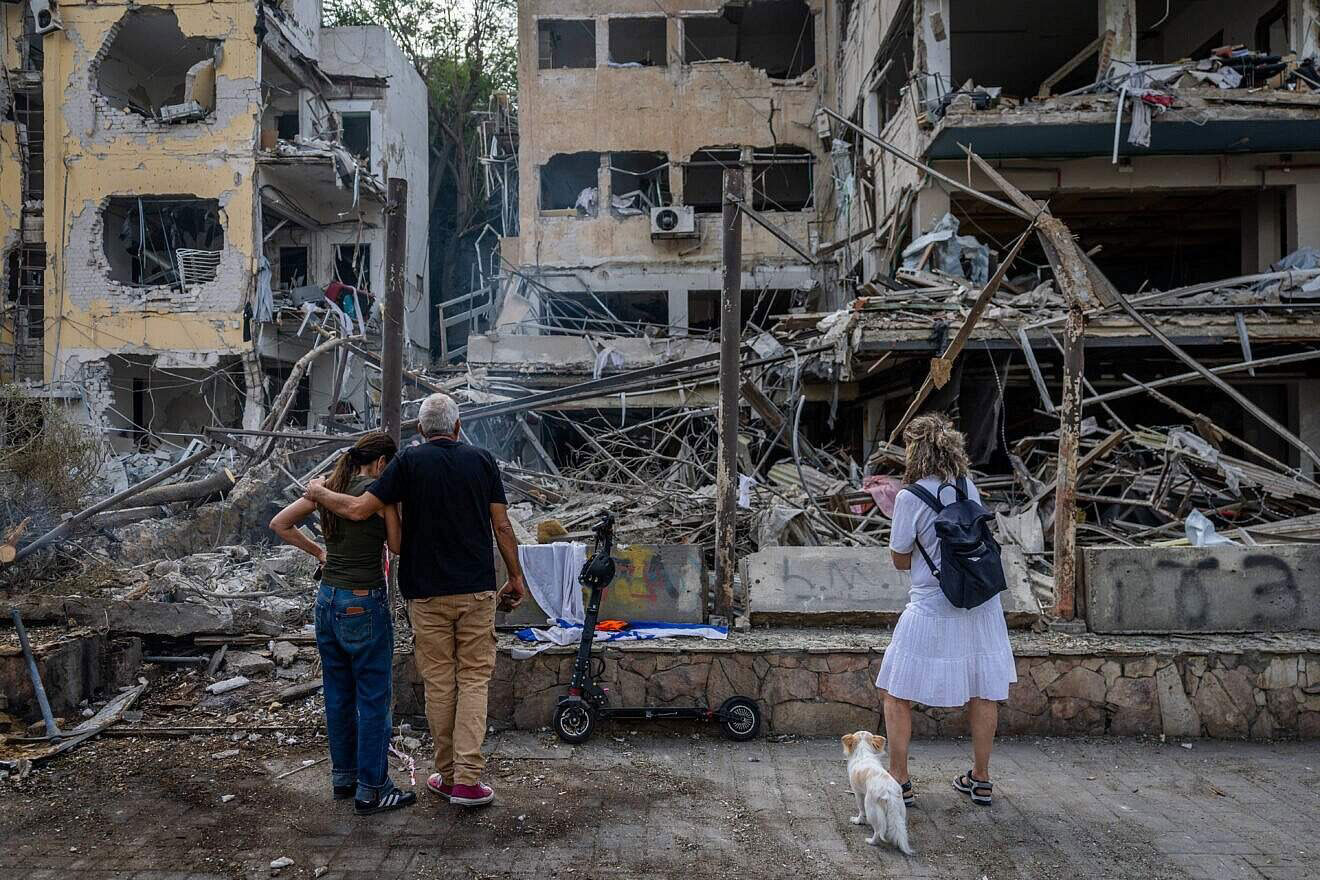
Courtesy of JNS. Photo credit: Chaim Goldberg/Flash90
Israeli security and rescue personnel at the scene where a ballistic missile fired from Iran hit in Tel Aviv, June 16, 2025
(JNS) — In recent months, several indicators have suggested that Iran is in the midst of a mass push to reconstitute its ballistic missile arsenal.
Western intelligence services have identified a sharp increase in the flow of dual-use materials into the country, most notably sodium perchlorate, a chemical that can be converted into ammonium perchlorate, the oxidizer used in solid-fuel ballistic missiles. CNN investigators have tracked 10 to 12 recent shipments from Chinese ports to Bandar Abbas, a central node in Iran’s missile production architecture, totaling more than 2,000 tons of fuel material. These transfers represent one of the largest documented movements of dual-use materials into Iran in recent years.
Jeffrey Lewis, director of the East Asia Nonproliferation Project at the Middlebury Institute of International Studies in Monterey, Calif., assessed that the scale of these shipments reflects Tehran’s desire to rapidly rebuild its production base. “Iran needs much more sodium perchlorate now to replace the missiles expended in the war and to increase production,” he told CNN in a recent interview, adding that he expects additional deliveries as Iran seeks to rearm.
According to Lewis, 2,000 tons of sodium perchlorate would be enough for roughly 500 missiles, significant, but still short of what Iran requires to restore its pre-war goal of producing about 200 missiles per month.
However, Maj. (res.) Alexander Grinberg, a former officer in the IDF Military Intelligence research department and an Iran expert at the Jerusalem Institute for Strategy and Security, said that the reports of dual-use chemical shipments were misleading and overinterpreted the significance of the influx.
“The shipment of the dual-use materials is a hint that they are rebuilding, but there is a lack of precise information, and Iranian agents have an interest in making it seem like the significance of this sort of shipment is greater than it is in reality,” Grinberg told JNS. “There is a long way from these chemicals to full ballistic missiles; it doesn’t mean in any way that war is imminent.”
Satellite imagery shows that Iran has moved quickly to reconstruct key solid-propellant facilities destroyed in Israeli strikes. Several production halls are being rebuilt, including structures that previously housed the mixers used to convert chemical inputs into solid rocket fuel. Those mixers were among Israel’s primary targets during the 12-day “Rising Lion” operation in June, because they are essential for manufacturing high-energy propellant used in medium- and long-range missiles, including systems that could carry nuclear warheads.
However, Grinberg challenged this assessment, saying that it is wrong to put too much weight on the satellite images. “There are some photographs from missile and nuclear sites showing that there is activity, but that doesn’t definitively prove anything about the pace of missile production,” he said. “It’s not surprising to see that there is some rebuilding going on after a site is blown up, but that doesn’t necessarily mean that the capacity is rebuilt.”
Before fighting broke out in June, Israeli intelligence estimated Iran held roughly 2,700 missiles. Officials now believe the Islamic Republic has already restored at least half of that stockpile and is working to expand it beyond pre-war levels.
This renewed industrial effort coincides with a major push to expand the range of Tehran’s missile arsenal. Iranian lawmakers and commanders have recently promoted a policy of “ballistic missiles without limits,” with senior officers stating that Iran will extend its range “to any necessary extent.”
Recent reports from Iranian opposition groups suggest that Tehran has been quietly expanding the range and capability of several missile families for several years, but has recently put many of these long-term projects into overdrive.