Courtesy of JNS. Photo credit: Abed Rahim Khatib/Flash90
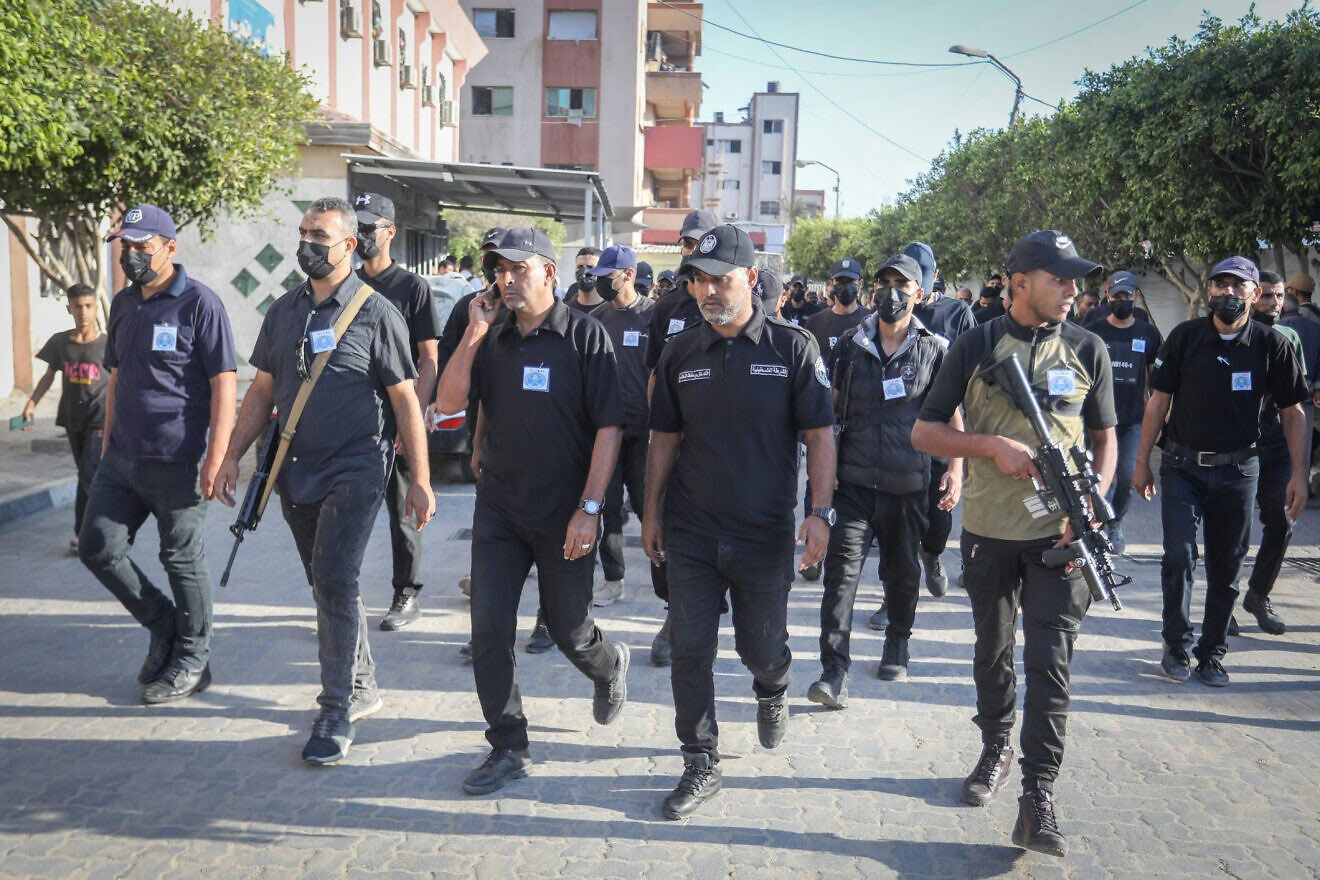
Hamas terrorists in Khan Yunis, the southern Gaza Strip. Oct. 13, 2025
(JNS) — In the wake of the ceasefire agreement that has seen the Israel Defense Forces redeploy to new defensive lines in the Gaza Strip, Hamas has launched a brutal campaign to reassert its control over the parts of the Strip it holds, including the heart of Gaza City.
This effort has included ruthless suppression of dissent, leading to intense firefights with armed Gazan clans, and a wave of executions. The terror group’s actions signal an explicit rejection of the deal’s demilitarization clauses and the notion of a future governance arrangement that is free of Hamas influence.
Col. (res.) Amit Assa, a former senior member of the Israel Security Agency (Shin Bet) with more than 30 years of experience, told JNS in recent days that “Hamas’s control, in the areas from which the IDF withdrew, is full control. There will be no local force that can stand against them, and any international force that receives a mandate to intervene will face significant security challenges.”
Assa pointed to recent declarations by Hamas leadership as proof the group has no intention of abiding by either the spirit or letter of the ceasefire.
“The statement by Khalil al-Hayya, who says that Hamas will continue to strengthen and establish its grip as its vision has not changed and is the destruction of the State of Israel, only proves Hamas’s disagreement with Trump’s conditions in the deal, in which the organization must disarm,” he assessed.
“This disagreement and the violent behavior will lead to another political attempt to impose the conditions on Hamas, and as expected, its refusal will bring about a renewed phase of the war, leading to Hamas’s complete surrender with the backing of the Trump administration,” said Assa.
The anti-Hamas militias located in the areas under Israeli military control will continue to manage the lives of Gazans in these areas and will constitute the infrastructure for establishing a regional “emirates plan” in the Gaza Strip and also in Judea and Samaria, according to the former Shin Bet official.
Lt. Col. (res.) Shaul Bartal, a senior research fellow at the Begin Sadat Center for Strategic Studies at Bar-Ilan University who has served in multiple security roles in Judea and Samaria, characterized the internal fighting as a form of Palestinian civil war.
“We are witnessing a type of civil war where anyone who does not agree with Hamas is immediately labeled a ‘supporter of the occupation.’
Bartal noted that widespread criticism of Hamas by the Gaza population due to the immense destruction in the Strip will complicate the group’s efforts to reimpose its authority.
“On the ground, this will translate into difficulty for Hamas in imposing its rule. It is possible that Israel is encouraging this, but there is no official confirmation,” he said.
Bartal said that a government of technocrats is supposed to be established in Gaza, which will be “supervised by Qatar, Turkey and the Gulf states, because only in this way will the money be transferred for reconstruction.”
Under this scenario, Bartal added, the Palestinian Authority would have a nominal presence, allowing its leader, Mahmoud Abbas, to claim that Gaza is still part of his domain, “but in practice, nothing would move forward without Hamas’s agreement.”
Hamas forces have murdered dozens of Gazan clan members since the start of the ceasefire, according to media reports. Hamas sources have announced a wide-ranging “security operation” to “eradicate collaborators with Israel,” targeting powerful opposition clans. This bloody campaign, which Hamas has branded “Purification before Liberation,” has involved public executions in Gaza City, often in front of a cheering crowd.
The fighting has been intense in the Sabra neighborhood of Gaza City between Hamas and the Dughmush clan. Al Jazeera and local media reported that Hamas security forces claimed to have taken control of the clan’s “militia,” arresting around 60 armed men and killing more than 50 others, while suffering at least dozen casualties among their own ranks.